Posts tagged: mountaintop removal

unEARTHED. The Earthjustice Blog

mountaintop removal


    SIGN-UP for our latest news and action alerts:
   Please leave this field empty

Facebook Fans

Featured Campaigns

Everyone has The Right To Breathe clean air. Watch a video featuring Earthjustice Attorney Jim Pew and two Pennsylvanians—Marti Blake and Martin Garrigan—who know firsthand what it means to live in the shadow of a coal plant's smokestack, breathing in daily lungfuls of toxic air for more than two decades.

Coal Ash Contaminates Our Lives. Coal ash is the hazardous waste that remains after coal is burned. Dumped into unlined ponds or mines, the toxins readily leach into drinking water supplies. Watch the video above and take action to support federally enforceable safeguards for coal ash disposal.

ABOUT EARTHJUSTICE'S BLOG

unEARTHED is a forum for the voices and stories of the people behind Earthjustice's work. The views and opinions expressed in this blog do not necessarily represent the opinion or position of Earthjustice or its board, clients, or funders.

Learn more about Earthjustice.

View Liz Judge's blog posts
15 October 2010, 11:26 AM
Regional administrator asks for revocation of mine's permit

Today signals a historic and hugely positive step taken by the EPA to protect the people of Appalachia, who have suffered the harmful and grave consequences of mountaintop removal mining for too long.

The news, just released, is that EPA Region III Administrator Shawn Garvin is recommending a veto of the permit for Spruce No. 1 Mine. Read here for background on the EPA's historic decisionmaking around the Spruce No. 1 Mine. Garvin's recommendation is to EPA Administrator Lisa Jackson, who ultimately must make the decision.

What this means is that after years of watching their streams buried and waters contaminated by mountaintop removal mining, there is hope for the health and well-being of the people of Appalachia.

Here is part of Garvin's letter :

3 Comments   /   Read more >>
View Liz Judge's blog posts
06 October 2010, 5:13 PM
WV Governor suing the EPA for policies which protect the people of his state
Gov. Joe Manchin

Today, we learned that West Virginia's Governor, Gov. Joe Manchin, is suing the EPA for its policies to strengthen watch over the state's biggest polluter, the coal mining industry and to ensure that mining does not put the people of the state and their water supplies directly in harm's way, compeletely devalue their property and turn their communities into wrecking zones for coal corporations.

He's joined the National Mining Association in suing the EPA over its recent guidance on mountaintop removal mining and its permitting process for mountaintop removal operations. The guidance is based on two new scientific studies, both affirmed and validated by an independent science advisory board, which reveal new information about mountaintop removal mining's impacts on waterways in Appalachia.

The guidance is meant to provide EPA field staff with a better, more secure, more scientifically sound way of protecting waters from irreversible harm -- and with a more responsible way of permitting these mining operations.

The travesty is that as long as mountaintop removal mining is allowed -- which the EPA is still doing -- our waters are not being protected.

2 Comments   /   Read more >>
View Liz Judge's blog posts
27 September 2010, 2:17 PM
The destructive mining practice cannot go on at the expense of Appalachians
Appalachians call for an end to watershed poisoning caused by mountaintop removal coal mining

On the campaign trail, President Obama shared his thoughts about mountaintop removal mining:

We have to find more environmentally sound ways of mining coal than simply blowing the tops off mountains. We're tearing up the Appalachian Mountains because of our dependence on fossil fuels ... Strip-mining is an environmental disaster ... What I want to do is work with experts here in West Virginia to find out what we need to do to protect the waterways here. That's going to be a primary task of the head of my Environmental Protection Agency.

This, if it happens, would be a sea change from the previous administration's EPA, which effectively wrote loopholes and exemptions into that law that allowed mining companies to evade longstanding regulations, sidestep basic Clean Water Act protections and dump their mountaintop removal mining waste directly into Appalachia's waters, contaminating drinking water supplies for communities and burying important streams.

Nearly two years into President Obama's term, we've seen small steps toward reducing the destruction of mountaintop removal mining in Appalachia, but the fact is: President Obama and his administration are still allowing this devastation to continue. The Army Corps of Engineers and the EPA are still permitting mountaintop removal mining permits in Appalachia, despite the regulations of the Clean Water Act.

2 Comments   /   Read more >>
View Liz Judge's blog posts
15 September 2010, 3:02 PM
One key decision on a mountaintop removal mine will signal what's to come
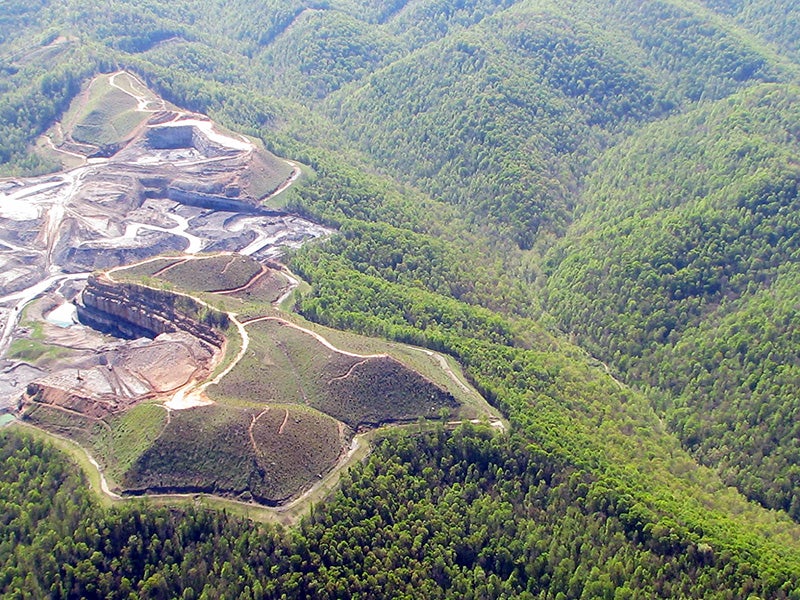
The site of the proposed Spruce mine (green valley to right). Photo by Vivian Stockman of OVEC, Flyover courtesy SouthWings

At the end of this month, all eyes will be on the EPA as it makes its next key decision on mountaintop removal coal mining: its preliminary determination whether to veto the permit for the Spruce No. 1 mine, due September 24.

The Spruce No. 1 mine is one of the largest mountaintop removal mining projects ever considered in Appalachia. Last spring, the EPA released a proposal to rescind this permit based on scientific and legal analysis showing that the mine does not adhere to Clean Water Act standards.

The EPA must do its job of enforcing the Clean Water Act and finalize this veto, or the mining company will proceed to permanently bury more than seven miles of streams with mining waste, severely degrade water quality in streams adjacent and downstream from the mine, and devastate 2,278 aces of forestland — in an area already hard-hit by this type of mining.

Why is this one mine so important?

2 Comments   /   Read more >>
View Liz Judge's blog posts
20 August 2010, 1:01 PM
Roaring Fork Valley and Aspen residents turn out en force for documentary

Mountaintop removal mining is one of those things in life that you can't really understand until you've seen it. All the blog posts, articles, editorials, and columns in the world combined can't equal the impact of bearing direct witness to a mountain being razed by explosives, to streams buried in rubble, and to crystal mountain waters running black.

The eye of the actual beholder of this destructive mining practice feels something that words cannot convey. And the person who sees it destroying ancient mountains and forests, and the lives of people who live among them, has a knowledge and experience that can never be imparted by this blog alone.

That's why Earthjustice was eager to support filmmakers Mari-Lynn Evans and Phylis Geller as they made their moving and stunning documentary on mountaintop removal mining, Coal Country.

2 Comments   /   Read more >>
View Liz Judge's blog posts
03 August 2010, 2:07 PM
Army Corps and EPA to follow core legal requirements in MTR mine permitting

The EPA and Army Corps of Engineers have announced a major step to help prevent the destruction caused by mountaintop removal mining. In a rare joint guidance, the two agencies agreed to improve the process for permitting mountaintop removal mines.

Although it doesn't solve the problem of mountaintop removal mining, this new direction will make it much harder for coal mining companies to use Appalachian waterways as dumping grounds for their mining waste.

For 30 years, the Corps of Engineers allowed mining companies to completely bury streams with the rubble from their mountaintop mining explosions on the condition that they replace the stream with a manmade stream. In reality, this was a death sentence for healthy streams and entire ecosystems.

Here's how it happened: mining companies exploded the tops off of hundreds of mountains and dumped the waste into streams, burying more than 2,000 miles of vital Appalachian waterways. They claimed to replace the "structure" of those streams with drainage ditches as their permits required. Trouble is, science tell us that you can't just dig a ditch and create a living, healthy stream.

2 Comments   /   Read more >>
View Liz Judge's blog posts
22 July 2010, 9:00 AM
Regular updates from Massey Energy CEO Don Blankenship's press lunch

I'm live at the National Press Club in Washington, DC, where Massey Energy CEO and chairman Don Blankenship is speaking in a special press luncheon today. Outside are protestors who are calling Mr. Blankenship to task for his oversight of the non-union company whose safety law violations -- over 100 citations from the U.S.Mine Safety and Health Administration this year alone -- led to a fatal explosion this year that took 29 lives and whose mountaintop removal mining practices have racked up thousands of Clean Water Act violations. For more info on those environmental violations, see my blog yesterday, and for more information on how mountaintop removal mining is devastating the environment all across Appalachia, contaminating water supplies, sickening people, and tearing apart communities, see our campaign page on our work to Stop Mountaintop Removal Mining. Finally, for some more background on just how Mr. Blankenship became such a notorious national figure, read this New York Times story on his politics in West Virginia.

1 Comment   /   Read more >>
View Liz Judge's blog posts
21 July 2010, 1:40 PM
We're live blogging tomorrow as he speaks at the National Press Club

Tomorrow (July 22), Don Blankenship, the notorious chairman and CEO of Massey Energy, speaks at the National Press Club. We'll be live blogging to make sure you all get the play-by-play -- which promises to be interesting at the very least if Blankenship's previous speaking engagements are any indicator (we live-blogged at his public debate with Robert F. Kennedy, Jr., in January in Charleston, WV -- check it out here).

As you may know, an explosion April 5 at the Massey’s Upper Big Branch Mine in Montcoal, West Virginia killed 29 miners. It was the deadliest coal mine explosion in the United States in 40 years.

4 Comments   /   Read more >>
View Liz Judge's blog posts
18 June 2010, 9:41 AM
Fast-track approach to mountain destruction is suspended
Kayford Mountain in West Virginia - photo by Vivian Stockman, courtesy of Ohio Valley Environmental Coalition

Yesterday the Army Corps of Engineers announced that it is suspending the use of nationwide permits for mountaintop removal coal mining.

Under U.S. law, companies who wish to engage in mountaintop removal mining—this is, to use explosives to blow off the top of mountains to get to the coal underneath, and then dispose of the rubble in streams and waterways—need to get a permit from the Army Corps of Engineers to do so. This permit is actually a Clean Water Act permit, and the granting of it holds that a company is abiding by the Clean Water Act, the cornerstone of water protection in the United States, and is following its requirements when it dumps its mining waste in the valley streams and waterways.

In 1982, the Army Corps of engineers established a nationwide permit (NWA Permit 21) for mountaintop removal mining operations, most of which are in Appalachia. This was a generalized, fast-track process that waived the Clean Water Act permit application for companies and automatically granted them permits. Instead of applying and going through a normal permitting process that assesses each company's impact on the waterways and streams, this Corps permit acted as a blind rubber stamp, outright allowing companies to engage in mountaintop-removal mining without proving that Clean Water Act requirements will indeed be met.

1 Comment   /   Read more >>
View Kathleen Sutcliffe's blog posts
11 June 2010, 8:44 PM
Let’s turn this bad action-adventure plot around
Have we been cast as extras in a fossil fuels end-of-days flick?

Is it just me? Or did this week's oil and gas news have a doomsday quality to it?

On Monday we had not one, not two, but three industrial gas disasters: a natural gas pipeline in Texas exploded, killing one worker, injuring several others and sending up a geyser of flame visible for miles around; a fireball and explosion burned seven workers drilling for natural gas in West Virginia; and authorities shut down activities at a Pennsylvania gas drilling site after a plume of toxic wastewater shot 75 feet into the air from a ruptured gas well, raining chemicals down on the site for 16 straight hours.

All of this as BP kept churning out an estimated 25,000 to 30,000 barrels of oil a day into the Gulf of Mexico and investigations continued into the Massey mine disaster in West Virginia that killed 29 miners.

Looking around at this fossil fuels end-of-days drama unfolding around us, I can't help but feel like we've all been cast as extras in some scary action-adventure movie.

5 Comments   /   Read more >>