Posts tagged: U.S. Supreme Court

unEARTHED. The Earthjustice Blog

U.S. Supreme Court


    SIGN-UP for our latest news and action alerts:
   Please leave this field empty

Facebook Fans

Featured Campaigns

Everyone has The Right To Breathe clean air. Watch a video featuring Earthjustice Attorney Jim Pew and two Pennsylvanians—Marti Blake and Martin Garrigan—who know firsthand what it means to live in the shadow of a coal plant's smokestack, breathing in daily lungfuls of toxic air for more than two decades.

Coal Ash Contaminates Our Lives. Coal ash is the hazardous waste that remains after coal is burned. Dumped into unlined ponds or mines, the toxins readily leach into drinking water supplies. Watch the video above and take action to support federally enforceable safeguards for coal ash disposal.

ABOUT EARTHJUSTICE'S BLOG

unEARTHED is a forum for the voices and stories of the people behind Earthjustice's work. The views and opinions expressed in this blog do not necessarily represent the opinion or position of Earthjustice or its board, clients, or funders.

Learn more about Earthjustice.

View Ted Zukoski's blog posts
18 April 2013, 10:02 AM
Feds, locals don't always have wildlife's best interests at heart
The imperiled Gunnison sage grouse. (FWS)

It's hard to know, sometimes, who to trust with America’s wildlife.

For the most part, wildlife is managed by individual states, which do some good science and issue tags for hunting licenses. They are also, theoretically, on the front lines of ensuring that wildlife species don’t get into such trouble that the federal government needs to step in under the auspices of the Endangered Species Act.

There is a constant tug-of-war between the locals and the feds, and it might be tempting to say those who love vibrant wildlife populations should favor one over the other.

But it’s not always easy to pick.

2 Comments   /   Read more >>
View Liz Judge's blog posts
03 April 2013, 12:03 PM
Highlights from the EPA’s chief of water policy

Last week, the Environmental Protection Agency revealed that 55 percent of U.S. streams and rivers are in “poor” condition, according to its most recent national rivers and streams assessment. Following the release of that grim report, the EPA held a live Twitter chat to answer questions about our clean water protections and the state of our waters in the United States.

This was a rare opportunity for the public to directly ask the EPA’s head of water policy, Nancy Stoner, about the agency’s plans to address our nation’s water quality problems. We got a chance to ask some questions, too.

The first question of the chat was ours. We wanted to know how the EPA plans to fix the situation we find our nation in today: The fact is that 27% of the nation’s rivers and streams have excessive levels of nitrogen and 40% have high levels of phosphorus. These nutrient pollutants, which come from factory farms and industrial agriculture, cause toxic green slime outbreaks that are harmful to public health.

View Trip Van Noppen's blog posts
15 March 2013, 3:45 PM
Politics have kept key federal court judgeships vacant
Four of the D.C. Circuit Court's 11 seats have been left vacant due to congressional obstruction. (DOJ)

Over the past four years, the federal halls of justice have been left partially hollow as the number of judicial vacancies in the federal courts continues to mount—due to foot-dragging on nominations and partisan filibuster once nominations are made. These vacancies hobble the courts’ ability to do their core work, which includes determining the fate of our most important environmental protections.

Take, for example, President Obama’s nomination of Caitlin Halligan for a seat on the United States Court of Appeals for the D.C. Circuit. In 2010, the president nominated Halligan, praising her “excellence and unwavering integrity,” yet two years later the Senate has twice refused to confirm her to this environmentally critical court. Halligan, a distinguished litigator who has argued five cases in front of the U.S. Supreme Court, is well-qualified for a seat on the D.C. Circuit. Yet despite bipartisan support and several high profile endorsements from law enforcement organizations and leaders, last week Halligan was forced to suffer through a second politically motivated filibuster that Senate GOP’s justified by willfully misrepresenting her record.

43 Comments   /   Read more >>
View Trip Van Noppen's blog posts
15 February 2013, 12:34 PM
Americans can’t wait for Congress to address climate change
President Obama delivers the State of the Union address in the House Chamber on Feb. 12, 2013.  (Chuck Kennedy / White House)

Last week, President Obama demanded that Congress take action on climate change, or else he would.

But, after years of political gridlock on the climate issue, coupled with rising seas and worsening droughts, one thing is clear: the nation simply cannot afford to wait any longer to take action. Though Congress may eventually pull together and pass a climate bill, the president must not wait on that uncertain prospect. He must act now.

After all, today the U.S. is farther from enacting a nationwide plan to reduce carbon emissions than it was four years ago. Congress has failed miserably. And though America’s greenhouse gas emissions are beginning to decline, the rate at which they’re doing so is nowhere near what we need to avoid catastrophic climate change.

25 Comments   /   Read more >>
View Raviya Ismail's blog posts
22 January 2013, 2:34 PM
Supreme Court refuses to review case that upheld limits to SO2 emissions
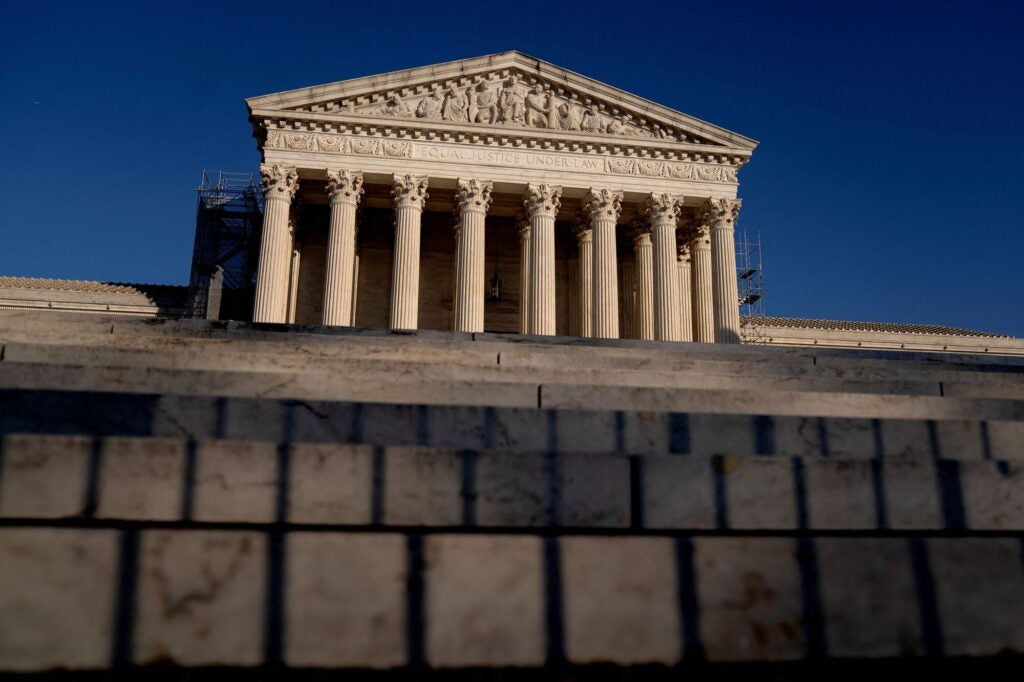
The U.S. Supreme Court has kept the life-saving sulfur dioxide standard intact. (Mark Fischer)

We were thrilled in July when the U.S. Court of Appeals for the District of Columbia Circuit ruled to uphold a clean air standard that limits dangerous intense bursts of sulfur dioxide pollution from power plants, factories and other sources. Sulfur dioxide is a pretty nasty agent that causes a variety of adverse health impacts including breathing difficulties, aggravation of asthma and increased hospital and emergency room visits for respiratory illnesses.

Today our lungs have an even better reason to rejoice: the Supreme Court has refused to review the appeals court decision, keeping the standard intact.

View Patti Goldman's blog posts
03 December 2012, 5:53 PM
Supreme Court considers two citizen enforcement cases
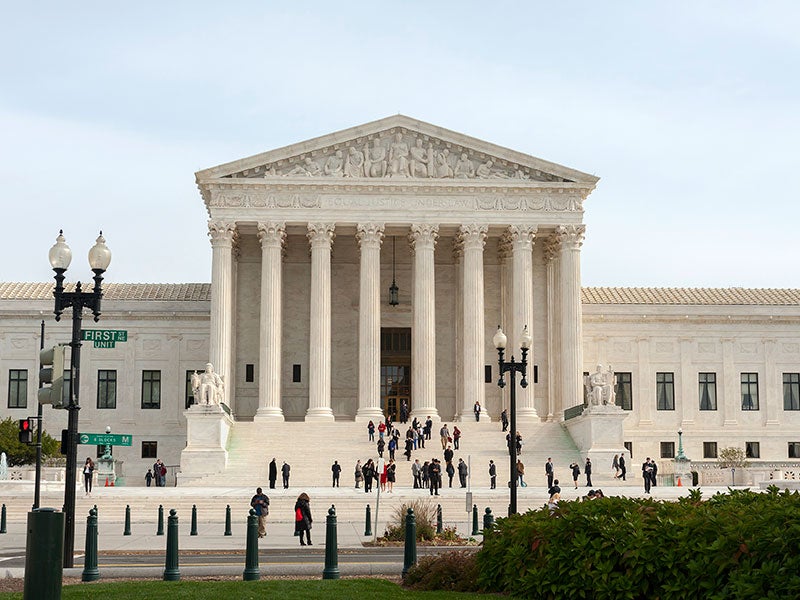
The U.S. Supreme Court. (Mark Fischer)

The U.S. Supreme Court is considering a pair of cases that could cut back on the ability of citizens to enforce the Clean Water Act. Although different, at their core, both afford the court opportunities either to preserve or weaken the power of citizens to hold polluters accountable for harming our nation’s waters.

The Clean Water Act, enacted four decades ago, aimed to make the nation’s waters drinkable, fishable, and swimmable. To make good on this promise, it prohibits discharges of pollution into U.S. waters without a permit and holds polluters to the limits imposed in such permits. Congress gave citizens the power to enforce the Clean Water Act, for Congress recognized that the government often lacks the financial resources and political will to enforce environmental laws against violators. In this way, the Act enlists people who use treasured waters or live near facilities that expose their communities to untenable pollution to stand in the shoes of the government to enforce the law against wrongdoers.

3 Comments   /   Read more >>
View Terry Winckler's blog posts
18 September 2012, 3:19 PM
His legacy flows through America's waterways
Russel Train -- Photo Courtesy The Heinz Awards

It’s not the passing of Russell Train – who died Monday at 92 – that we remember, but the life he led as a powerful, humble, principled warrior for the Earth.

Mr. Train was chairman of the newly created White House Council on Environmental Quality before President Nixon picked him to be the second head of the Environmental Protection Agency, a role that fully launched his career as a conservationist, recalls Joan Mulhern, a colleague of mine who worked with this remarkable man to protect the Clean Water Act.

A lifelong Republican, Mr. Train embodied what it meant to be a conservative conservationist, Joan said.

View Sarah Burt's blog posts
28 June 2012, 3:20 PM
Vessels must avoid dirtier fuels off state coast

Twenty seven million Californians—80 percent of the state’s population—are exposed to emissions from ocean-going vessels, resulting in serious health impacts such as cancer, respiratory illnesses like asthma, as well as increasing the risk of heart disease. California estimates that the ships’ direct particulate emissions cause 300 premature deaths across the state every single year, even after excluding cancer effects.

The Ninth Circuit’s 2011 decision in Pacific Merchant Shipping Assn. v. Goldstene involved a shipping industry challenge to the Vessel Fuel Rule. The Ninth Circuit rejected industry’s claims that the ARB regulation is preempted by the federal Submerged Lands Act and contravenes dormant Commerce Clause principles. By denying certiorari, the Supreme Court has decided to let the Ninth Circuit’s decision stand.

View Raviya Ismail's blog posts
26 June 2012, 11:09 AM
Federal appeals court sides with clean air

Today has turned into a better day for our planet—and our lungs. In a landmark decision, the D.C. federal appeals court upheld every single one of the EPA’s carbon pollution limits. These EPA protections are in response to the Supreme Court’s 2007 ruling in Massachusetts v. EPA, and are important parts of the agency’s efforts to curb such pollution under the Clean Air Act.

The rules went to oral argument in February after more than 60 lawsuits by companies including Massey Energy Co.; business groups such as the U.S. Chamber of Commerce; and states such as Texas and Virginia pushed the court to overthrow the “arbitrary” and “capricious” standards.

However, today the three-judge panel of the D.C. court of appeals ruled that the EPA’s interpretation of the Clean Air Act was “unambiguously correct.” The court also concluded that opponents don’t have the legal right to challenge the timing and tailoring rules.

3 Comments   /   Read more >>
View Ted Zukoski's blog posts
17 March 2012, 8:23 AM
Yet another toxic mining threat
A uranium mine near the Grand Canyon's North Rim. Photo: Don Bills, USGS.

At the beginning of the last century, Ralph H. Cameron was a booster of the Grand Canyon. He wanted to promote – and cash in on - the Canyon as a tourist destination. He helped expand Bright Angel Trail, now one of the most popular trails into the Canyon from the South Rim.  But at a price; he charged a toll to visitors.

32 Comments   /   Read more >>