False Killer Whales: Wounded by Longline Fishing

More SlideshowsThe false killer whales (Pseudorca crassidens) of Hawai‘i are in trouble. When the Hawai'i-based longline fleet catches yellowfin tuna, mahi mahi, and other target species on its hooks, false killer whales are attracted to this all-you-can-eat buffet and are often wounded or killed by the gear. Earthjustice has gone to court to compel the National Marine Fisheries Service to finally come up with a plan to reduce the damage done to false killer whales. Read full article: Protecting False Killer Whales in Hawai'i.

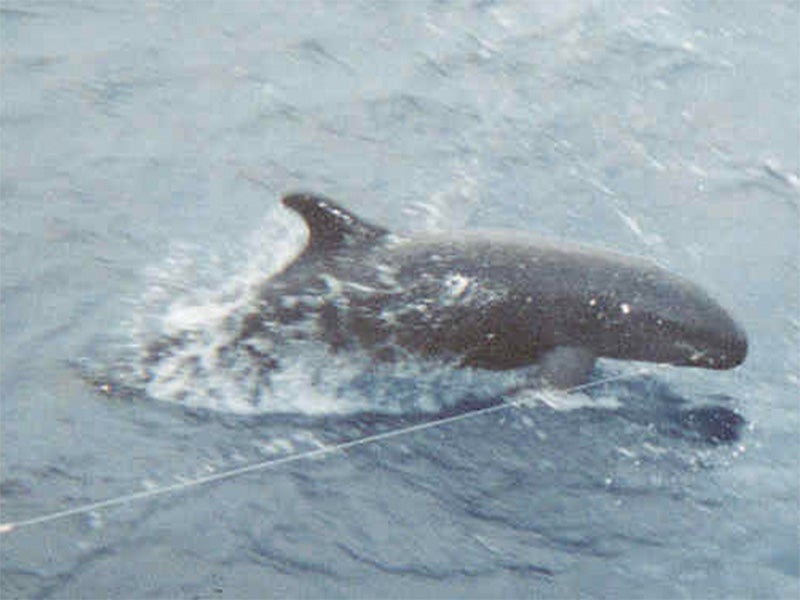
Whale snagged on a longline becomes victim of commercial fishing.

Photo: NMFS

False killer whales are attracted to bait on longlines.

Photo: NMFS

Struggling to get away, false killer whales are wounded.

Photo: NMFS

When completely ensnared in longline gear, whales can die.

Photo: NMFS

When the Hawai'i-based longline fleet catches yellowfin tuna, mahi mahi, and other target species on its hooks, false killer whales are attracted to this all-you-can-eat buffet and are often wounded or killed by the gear.

Photo: NMFS

Typical injuries include dorsal fin damage that leave the whales unable to swim, gather food or reproduce. Whales can also get tangled in the longliners’ miles of lines and drown.

Photo: NMFS

False killer whales are protected under the Marine Mammal Protection Act.

Earthjustice has gone to court to compel the National Marine Fisheries Service to finally come up with a plan to reduce the damage done to false killer whales.

Photo: NMFS

Deaths from the longline fishing fleet are occurring at twice the level Hawai‘i’s false killer whales can sustain.

"These are intelligent mammals that deserve not to be indiscriminately killed in order to put a tuna fish sandwich together," says Earthjustice Attorney David Henkins.

Photo: NMFS


More Photo Slideshows:

The ocean's underwater creatures are swimming against the tide of multiple environmental stressors. Learn about a few of the wildlife who are at risk and the threats they face
Coal plant pollution has a serious impact on health: every year, it causes exacerbated asthma, heart problems, hospital visits, days when people miss work and school, and worst of all, premature death. See a photo slideshow of two Pennsylvanians who live next door to a coal-fired power plant.
The Crown of the Continent ecosystem serves as a critical refuge for grizzly bears, wolverines, and more. Conservationist Gene Sentz shares his photos of the ten-million acre expanse of land whose untouched wilderness harkens back to the days of Lewis & Clark.
National forest lands are the largest source of drinking water in the U.S., providing fresh water to some 66 million people. In addition to giving many of us the water we drink, our forests also are cherished grounds of our nation's outdoor legacy.