

Court Hears Arguments in Legal Challenge to the Arctic National Wildlife Refuge’s Leasing Program
Meanwhile, the Alaska Industrial Development and Export Authority, an Alaska-sponsored corporation, quietly submitted an exploration application to federal agencies
Contacts
Elizabeth Manning, emanning@earthjustice.org
Earthjustice attorneys, alongside attorneys from two other plaintiff groups, argued yesterday in federal court in Alaska that the oil and gas leasing program within the Arctic National Wildlife Refuge’s Coastal Plain is unlawful.
The plaintiff groups contend the Trump administration broke bedrock environmental laws when it opened the Coastal Plain to reckless oil and gas leasing.
Earthjustice, along with co-counsel Natural Resources Defense Council, represents the Center for Biological Diversity, Friends of the Earth U.S., and NRDC.
In court, Earthjustice outlined how the unlawfully authorized oil and gas program in the Refuge would further threaten imperiled species like polar bears that already face near-term extinction and cause other widespread and serious harm to sensitive Arctic ecosystems, wildlife, migratory birds, and the climate.
“Polar bears are in serious trouble,” said Earthjustice Attorney Hannah Foster, noting that the government predicts it could kill dozens of polar bear cubs and the Trump administration arbitrarily downplayed the harms to polar bears in the environmental studies analyzing the leasing program in the Coastal Plain.
The Native Village of Venetie Tribal Government, Arctic Village Council, and Venetie Village Council, represented by the Native American Rights Fund, have filed a separate lawsuit challenging the leasing program. Their arguments yesterday focused on harms to the Tribes’ access to subsistence and cultural places the leasing program may inflict if implemented. The Gwich’in Steering Committee and 11 allied groups, represented by law firm Trustees for Alaska, also presented oral arguments yesterday in a related lawsuit centered on subsistence and wildlife harms.
Plaintiffs are requesting the court invalidate the unlawful Refuge leasing program, as well as the current oil and gas leases that relied on the unlawful analyses. No major oil companies have bid on Refuge leases during three lease sales held in 2021, 2025 and 2026; just one small oil company and a state of Alaska-sponsored corporation, the Alaska Industrial Development and Export Authority (AIDEA) currently hold leases in the Refuge. The sales generated a fraction of the revenue Congress assumed they would, even though those inflated estimates were used to justify opening the Coastal Plain to oil leasing in 2017.
The plaintiffs and public learned Wednesday from a news story that AIDEA quietly filed a seismic exploration permit application three months ago to conduct extensive exploration studies in the Refuge. Seismic testing, which would cover vast swaths of the Refuge, could kill polar bears and leave scars on the Refuge’s sensitive landscape for decades. The Trump administration has now acknowledged that federal agencies are reviewing applications for at least one seismic application for operations this winter, but it has not provided any information about the proposed activity to the public yet or any opportunity for public comment.
The Trump administration’s push to expand oil drilling into the Refuge is matched by an even more aggressive push to expand oil drilling in the nearby Western Arctic. Within the National Petroleum Reserve-Alaska, the administration is also seeking to change the rules there to favor the oil industry and cut out the public.
In September, the Trump administration proposed new regulations for the Western Arctic at the request of the oil industry that would circumvent public comment on proposed oil and gas drilling for production and shortcut environmental reviews within the National Petroleum Reserve-Alaska. That action was soon followed in October by announcement of a categorical exclusion that aims to exempt oil and gas exploration projects in the Western Arctic from individual review under the National Environmental Policy Act.
“What we’re seeing is a lack of transparency in the Arctic Refuge and new regulations for the Western Arctic to do the oil industry’s bidding while completely cutting the public out of decisions,” said Earthjustice Attorney Erik Grafe. “At stake are some of the most ecologically significant and treasured public lands in the world, as well as imperiled species like polar bears and caribou that Indigenous people have relied on for millennia.”
Background:
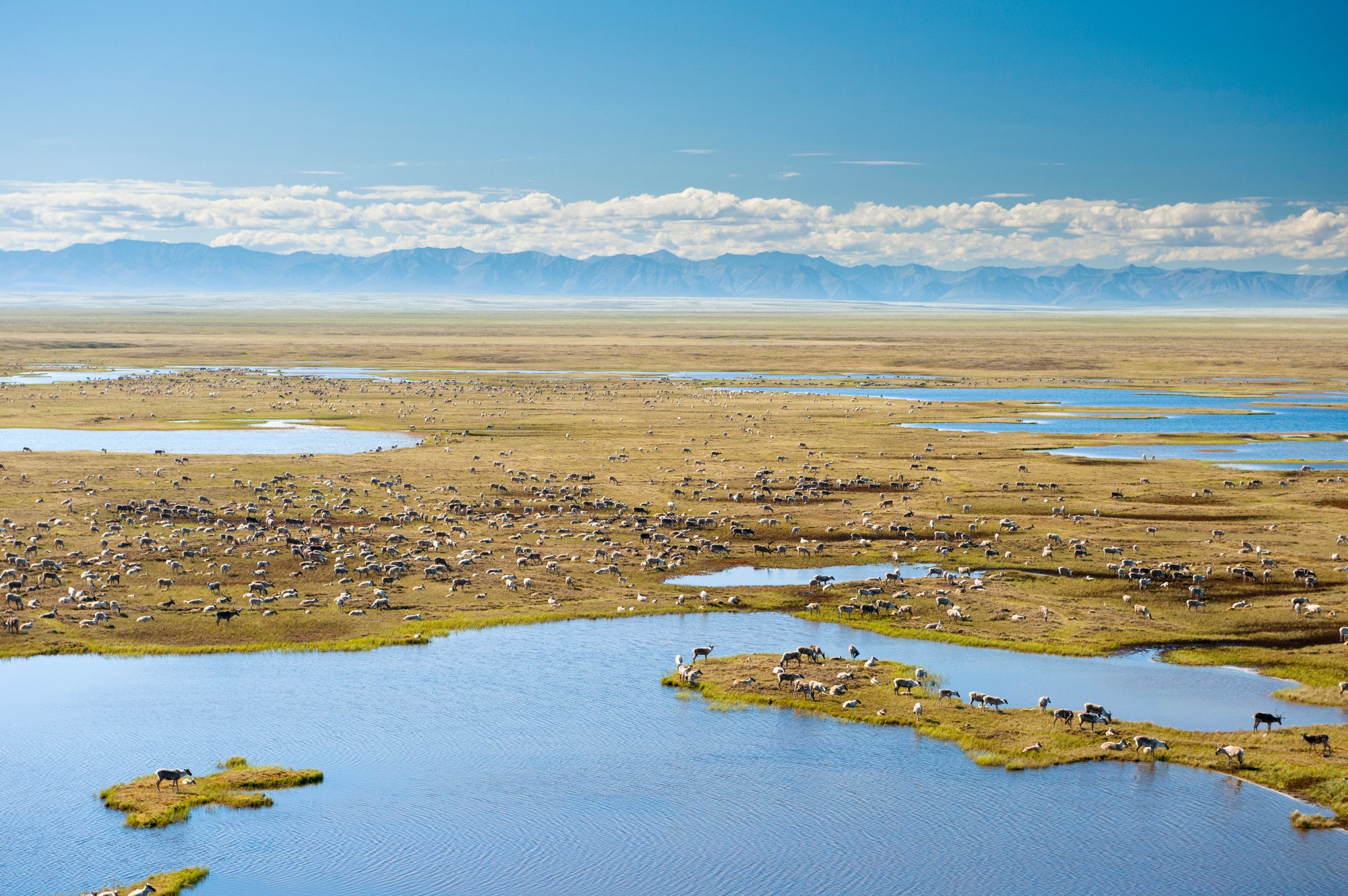
The Refuge’s Coastal Plain — 1.56 million acres of tundra, braided rivers, and wetlands — is the biological heart of the Arctic Refuge, providing essential habitat for polar bears, caribou, and millions of migratory birds. It is exceedingly sensitive to disturbance and slow to recover.
Earthjustice and NRDC attorneys, on behalf of NRDC, the Center for Biological Diversity, and Friends of the Earth, first filed suit in 2020 challenging the prior attempt to lease the Coastal Plain. A lease auction was held on Jan. 6, 2021, and the Biden administration subsequently imposed a moratorium and review. The Biden administration then offered a smaller sale in 2025 that drew no bids.
In October 2025, Interior rescinded the Biden record of decision and readopted the earlier program that opens the entire Coastal Plain to leasing and moved to lift the suspension on AIDEA’s leases. That move prompted Earthjustice and NRDC to file an amended complaint that restarted the legal challenge to the Refuge’s leasing program.
Additional Resources
About Earthjustice
Earthjustice is the premier nonprofit environmental law organization. We wield the power of law and the strength of partnership to protect people's health, to preserve magnificent places and wildlife, to advance clean energy, and to combat climate change. We are here because the earth needs a good lawyer.