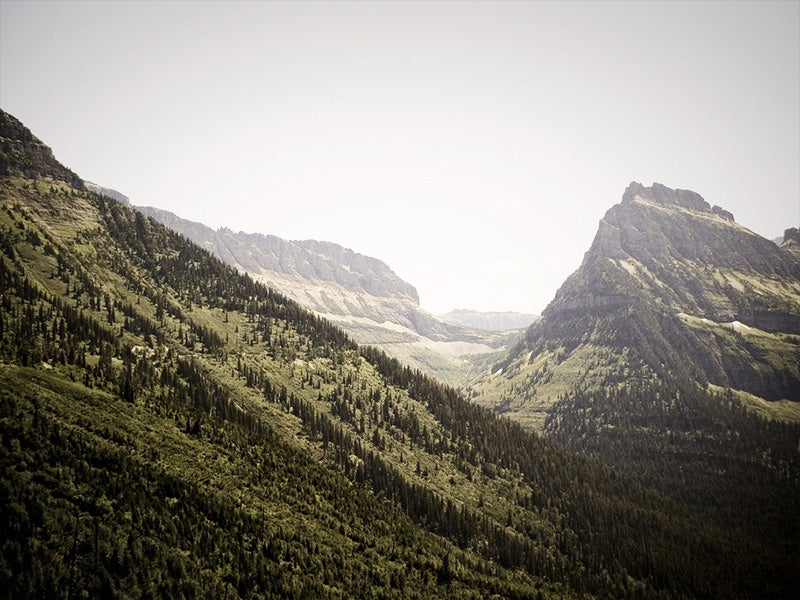
One of the largest—and last—remaining wild places in North America, the Crown of the Continent ecosystem is a ten-million acre expanse of land whose untouched wilderness harkens back to the days of Lewis & Clark. View photos taken by conservationist Gene Sentz, co-founder of the Friends of the Rocky Mountain Front, who has spent three decades working to protect the Rocky Mountain Front. Earthjustice has worked with organizations like Gene's to protect the Front, the surrounding landscape and the wildlife that reside there from harmful development.
Rocky Mountain Front
An outfitter traveling with a pack horses along the Rocky Mountain Front.
Photo © Gene Sentz
Related
Freezeout Lake, Montana
Every March, tens of thousands of snow geese rest at Freezeout Lake in Montana after a nearly 1,000 mile flight from California before heading off to Canada.
Photo © Gene Sentz
Related
Sun River
A view of the Sun River, which Native Americans called the "Medicine River" because they believed the hot springs possessed healing properties.
Photo © Gene Sentz
Related
Rocky Mountain Front
Sunrise in the Rocky Mountain Front.
Rocky Mountain Peak (top right) is the highest peak in the whole front range south of Glacier National Park.
Photo © Gene Sentz
Related
Black Bear Sow and Cubs
This black bear sow ran her three cubs up a tree after the photographer came upon them in the wilderness.
(If you look at the top of the picture, you can see the one of the cubs' bottoms.)
Photo © Gene Sentz
Related
Old Man of the Hills
A local rancher's horses standing peacefully in front of the mountain, Old Man of the Hills, on a very cold and windy day.
Photo © Gene Sentz
Related
Sawtooth Mountain
A view of the Sun River with Sawtooth Mountain in the background.
Photo © Gene Sentz
Related
Mount Werner, Montana
Climbing Mount Werner in Montana.
Photo © Gene Sentz
Related
Two Medicine Lake
A view of Two Medicine Lake in Glacier National Park. The highest mountain, in the upper right corner, is called Rising Wolf.
Photo © Gene Sentz
Related
Prince's Pine (Pipsissewa)
A bundle of moss and wild mushrooms in the Rocky Mountain Front. The pink flower is called Prince's Pine or Pipsissewa by the Blackfeet Indian tribe.
Photo © Gene Sentz
Related
Glacier National Park
Hiking through Quaking Aspen trees in the fall.
Photo © Gene Sentz
Related
Two Medicine Lake
A fly fisherman on Two Medicine Lake in Glacier National Park.
Photo © Gene Sentz
Related
Two Medicine Lake
Two Medicine Lake, part of Glacier National Park.
Photo © Gene Sentz
Related
Mount Cleveland
Mount Cleveland, the highest peak in Glacier National Park.
The mountain is named after Grover Cleveland, the only U.S. President to serve two non-consecutive terms.
Photo © Gene Sentz
Related
Cameron Lake
Cameron Lake in the Waterton-Glacier International Peace Park, located on the borders of Montana and Alberta.
Photo © Gene Sentz
Related
Belly River Ranger Station
The Belly River Ranger Station in Glacier National Park.
The large mountain in the background is Chief Mountain, one of the most prominent peaks and rock formations along the Front.
Photo © Gene Sentz
Related
Glacier National Park
Established as the tenth national park in the U.S., Glacier National Park celebrated its 100th anniversary on May 11, 2010.
Photo © Gene Sentz
Related
Lake McDonald
A view of Lake McDonald, the largest lake in Glacier National Park.
Photo © Gene Sentz
Related
Rocky Mountain Front
A mountain view sunset over the Rocky Mountain Front.
Photo © Gene Sentz
Related
Grinnell Glacier
Grinnell Glacier, which was named by George Bird Grinnell, an American naturalist widely credited as the father of Glacier National Park.
Photo © Gene Sentz
Related
Rocky Mountain Front
A view of the Rocky Mountain Front, which is part of the Crown of the Continent ecosystem, a 10 million acre expanse of wild lands.
Photo © Gene Sentz
Related
Bighorn Ram
A bighorn ram in Sun River country.
The Rocky Mountain Front is thought to contain the largest herd of bighorn sheep in the lower-48 states.
Photo © Gene Sentz
Related
Glacier Lily
A glacier lily, an early spring flower widely found in Glacier National Park.
Photo © Gene Sentz
Related
Swift Reservoir Lake
Swift Reservoir Lake in Birch Creek, with the Bob Marshall Wilderness in the background.
Photo © Gene Sentz
Related
Calypso Orchid
The Calypso orchid, also known as the Fairy Slipper or Venus's Slipper, is a perennial member of the orchid family found in undisturbed northern and montane forests.
Photo © Gene Sentz
Related
Ear Mountain, Montana
The photographer, Gene Sentz, climbing Ear Mountain in Montana, with the Bob Marshall Wilderness in the background.
Photo © Gene Sentz
Related
Castle Mountain
The Sun River, with Castle Mountain in the center background.
Photo © Gene Sentz
Related
Sun River Wildlife Management Area
Some 3,000 elk come to the Sun River wildlife management area every year.
Photo © Gene Sentz
Related
Paw Print
A frozen paw print, most likely of a lynx, a threatened species found throughout the Crown ecosystem. (Learn more about lynxes.)
Photo © Gene Sentz
Related
Teton River, Montana
Teton River in Teton Canyon in Montana. The yellow trees growing along the river bottom are cottonwood trees.
Photo © Gene Sentz
Related
Coalition to Protect the Rocky Mountain Front
Members of the Coalition to Protect the Rocky Mountain Front meeting with a member of Sen. Max Baucus' staff (second from left). Sen. Baucus (D-MT) successfully helped pass legislation in 2006 that withdrew all public lands along the Front from oil and gas leasing and hardrock mining.
Photo © Gene Sentz
Related
Rocky Mountain Front
A frosty morning on the Rocky Mountain Front.
Photo © Gene Sentz
Related
Bighorn Rams
Three rams running through the snow just west of Choteau, Montana. The photographer was snowshoeing and accidentally spooked the rams. (Learn about bighorn sheep.)
Photo © Gene Sentz
Related