

Protecting Who? “Bring Your Own Power” Projects for AI Data Centers Would Wreak Havoc on Communities and the Environment, New Report Finds
The rapid expansion of “Bring Your Own Power” arrangements for AI data centers will lead to a massive gas buildout that poses serious risks to communities and the environment
Contacts
Kathryn McGrath, kmcgrath@earthjustice.org
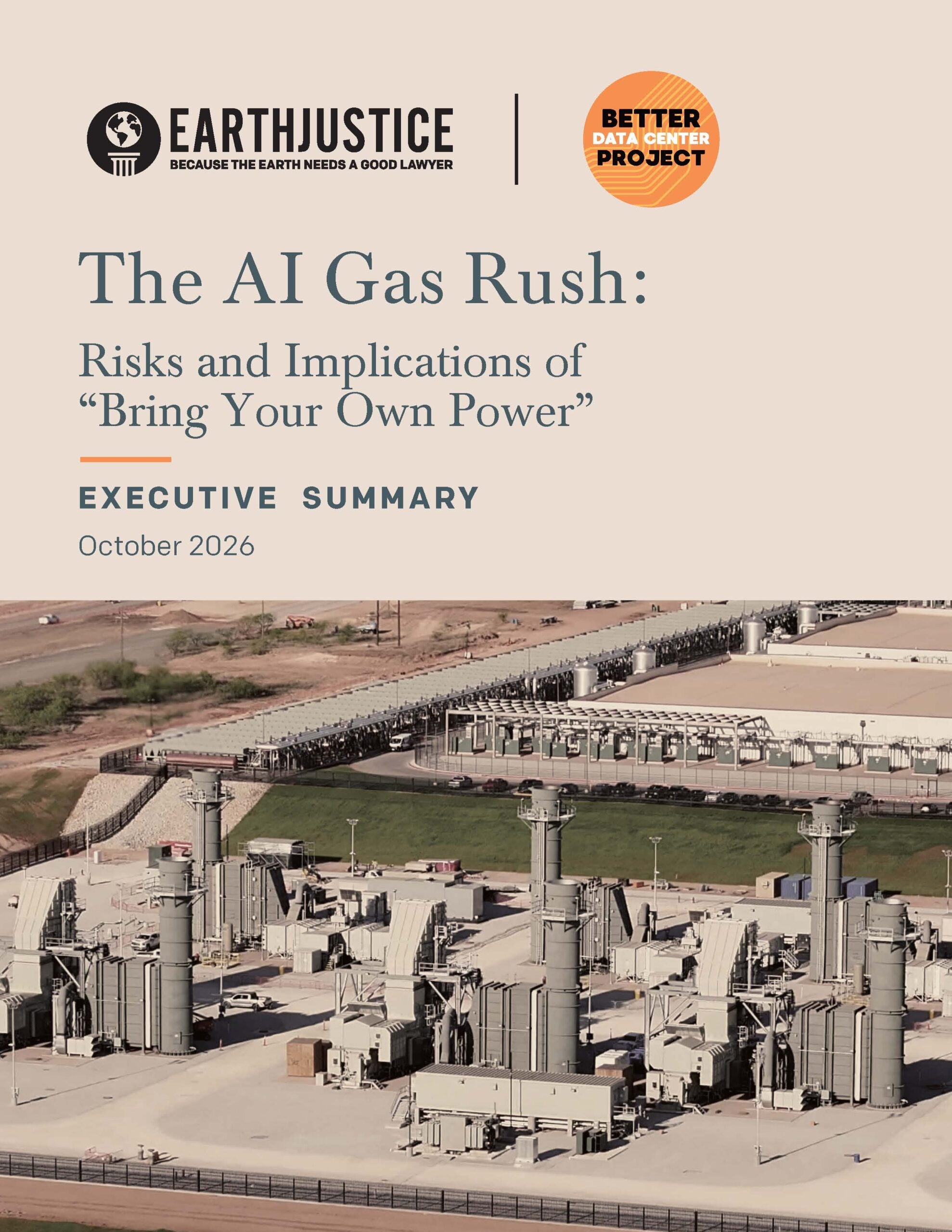
A new report published today by Earthjustice and the Better Data Center Project, a technical assistance provider for communities, reveals that the rapid expansion of “Bring Your Own Power” (BYOP) arrangements for artificial intelligence (AI) data centers will lead to a massive gas buildout that poses serious risks to communities and the environment operating outside of already weakened current permitting, legal and regulatory systems. While the President, governors, lawmakers, and regulators are increasingly encouraging and incentivizing AI data centers to secure their own power generation, the report reveals that this purported ‘solution’ will significantly increase pollution and a slew of mounting costs for decades to come.
This new, comprehensive analysis focuses on AI data centers proposing to bring their own power (BYOP), providing an overview of these convoluted projects and how they enable billion-dollar companies to sidestep laws and regulations meant to protect consumers, communities, the environment, and climate, so they can power their enormous AI data centers as quickly as possible.
The analysis finds that:
- BYOP is driving a massive, rapid buildout of predominantly dirty gas plants: 80% of proposed energy generation from BYOP projects over the next five years — enough to power 65% of U.S. homes — will come from gas, rather than the renewables companies have committed to.
- If built, nine proposed gas BYOP projects will become among the top 10 largest power plants in the U.S.
- Ozone and particulate matter pollution from BYOP could cause an estimated $5–10B in monetized health damages each year.
- The report also analyzes the specific types of gas generators proposed, finding that over half of disclosed BYOP gas projects would use less efficient and more polluting gas generators than typical gas power plants.
- Most BYOP projects are expected to seek grid connection eventually despite circumventing regulations and safeguards today.
- Developers ‘segment’ projects into separate permit applications to avoid more stringent environmental review.
- Despite being posed as an affordability solution, BYOP can still have significant cost impacts.
- In addition, these so-called “privately powered” BYOP projects are subsidized by the public—receiving tax breaks, property abatements and expedited regulatory treatment.
Co-authors discussed their key findings in the report about the implications of this troubling trend using case studies from Texas, Pennsylvania, and Ohio — among the top five states with the highest concentration of proposed BYOP capacity in the country. The report outlines not only the impacts and scale of these projects, but how Big Tech operates outside of and is taking advantage of weakened regulations to build faster.
The co-authors also provided an overview of the current policy landscape and considerations for communities and policymakers.
“Our research is clear: BYOP is not the answer that state and federal leaders are claiming it to be. The world’s wealthiest tech companies should not be building dirty, behind-the-meter gas projects, creating a shadow grid that’s causing even greater risks to communities and the climate. BYOP proposals for AI data centers — almost all of which rely on polluting gas instead of cleaner and cheaper energy sources — won’t protect us from the consequences of AI data centers’ unprecedented energy demand. In fact, we need stronger safeguards to protect people and the planet,” said Mandy DeRoche, Director of Emerging Issues, Earthjustice.
“Bring Your Own Power is a tool sought by developers to build AI data centers as fast as possible — while local communities, ratepayers, and our planet pay the costs. Our research finds 177 GW of planned gas BYOP, enough to power 65% of all U.S. homes. With over half of this disclosed gas capacity using inefficient and more polluting technologies, these projects could cause up to $10 billion a year in health damages. Addressing AI’s demand for power requires stronger local, state, and federal policies and oversight — yet the majority of recent policies weaken oversight designed to protect water, air, people, and the climate,” said Catherine Casomar, Co-Founder, Better Data Center Project.
Additional Resources
About Earthjustice
Earthjustice is the premier nonprofit environmental law organization. We wield the power of law and the strength of partnership to protect people's health, to preserve magnificent places and wildlife, to advance clean energy, and to combat climate change. We are here because the earth needs a good lawyer.