

The AI Gas Rush: Risks and Implications of “Bring Your Own Power”
The race to scale artificial intelligence is driving an unprecedented rush to build power plants solely to power data centers that are predominantly gas-powered. These power plants are evading regulations, harming communities and the climate, and are not a solution to rising energy bills. A new report by the Better Data Center Project and Earthjustice explores and analyzes this trend.
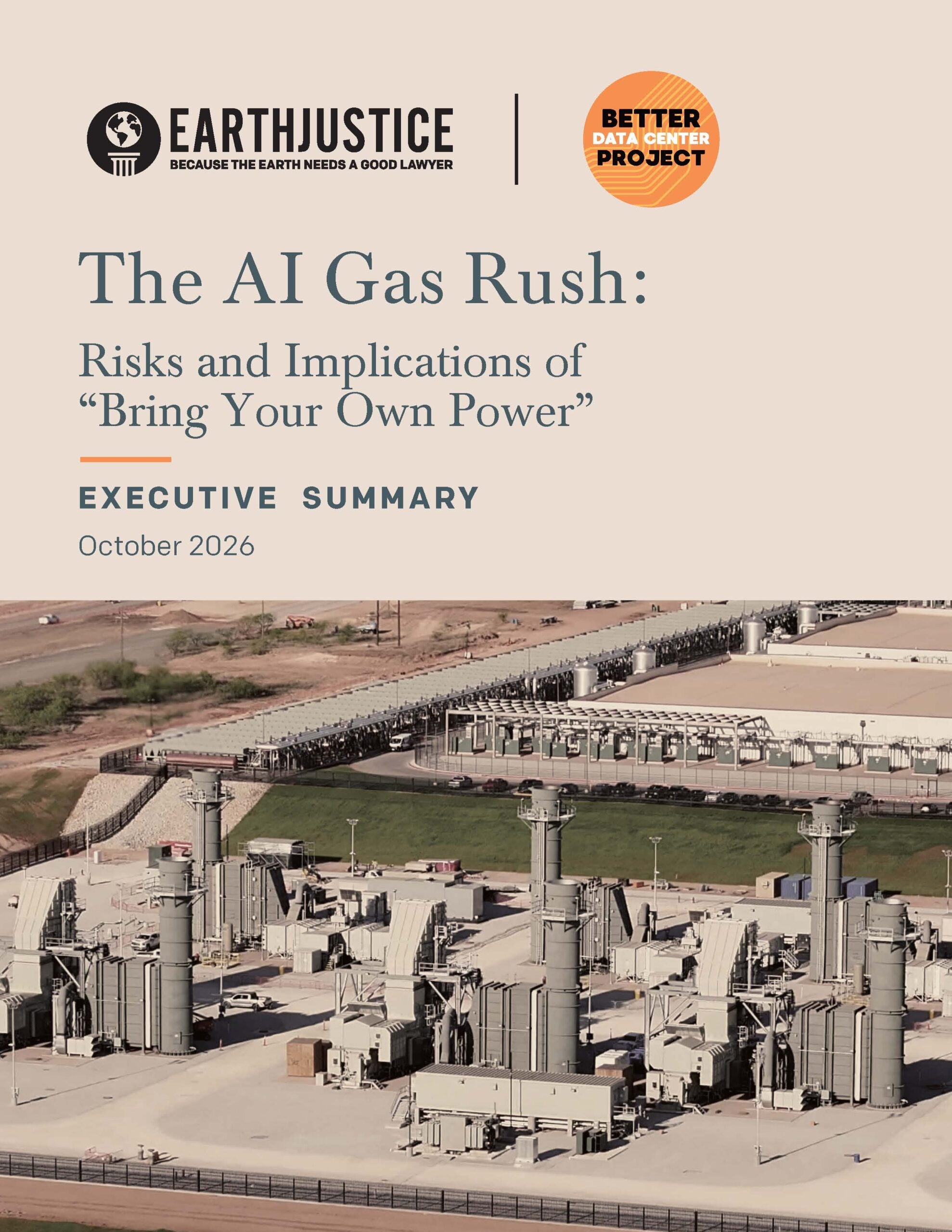
The race to scale artificial intelligence (AI) has triggered an unprecedented increase in electricity demand. As of mid-2026, the U.S. has over 300 gigawatts (GW) of AI data center capacity planned or under construction. To put this in context, peak U.S. electricity demand on the hottest day in 2025 was 760 GW. To bypass long wait times for grid service, developers are increasingly pursuing "Bring Your Own Power" (BYOP) strategies, where they procure dedicated energy resources rather than relying solely on grid power.
Building on work from Global Energy Monitor, the Environmental Integrity Project, and Cleanview, we estimate that gas will power approximately 80% of energy generation from BYOP projects coming online in the next five years. In total, we identify 177 GW of planned gas capacity, equivalent to 23% of the entire U.S.’s peak demand in 2025 and enough to power 65% of all U.S. homes.
These massive gas projects will have substantial impacts on people and the planet — not only worsening climate change, but harming the health of nearby communities, including those already burdened by historical and ongoing disinvestment, environmental injustice, and extractive industry.
Despite these risks, policymakers across the nation are incentivizing or requiring BYOP in an attempt to address energy bill impacts from new AI data centers. But AI data center developers are turning to BYOP to gain access to power as quickly as possible (“speed-to-power”) — not to solve the energy bill impacts of AI.
This report finds potential ratepayer benefits are not guaranteed, while harms of the massive gas BYOP buildout have been inadequately addressed.
This report was prepared in response to questions received from communities, Tribal, state, and local governments, and others navigating BYOP proposals and policies. It builds on the growing body of work raising serious concerns about gas BYOP.
Massive scale and impact: The scale of both total and individual BYOP proposals is massive. As of August 2026, there are nine proposed gas BYOP projects that are 4.5 GW or larger. If all are built, nine of the top 10 largest power plants in the U.S. would be data center gas BYOP.
Altogether, the current 177 GW of gas proposals would emit over 400 million metric tons of carbon dioxide equivalent (mtCO2e) annually, increasing the U.S. power sector’s total emissions by 23%. Ozone and particulate matter pollution from these projects could cause an estimated $5–10B in monetized health damages each year.
Majority gas: Building on prior reports, we estimate that for current BYOP proposals, approximately 80% of energy generation will come from gas.
Inefficient gas technologies with more air pollution: More than half of disclosed gas BYOP capacity uses technologies that are less efficient and more polluting than typical gas power plants.
Inadequate regulatory oversight and laws to protect the environment, climate and consumers: BYOP projects are moving forward without sufficient oversight by entities charged with protecting people and the planet. Behind the meter BYOP projects can bypass important planning or regulatory processes that generally apply to large new power plants, and most gas BYOP projects are proposed in states with weak environmental laws and protections. Widespread efforts to dismantle federal environmental laws erode federal backstops, which are particularly important in states with the largest gas BYOP buildouts.
Additionally, developers are attempting to bypass remaining legal safeguards through project segmentation to avoid more stringent permitting requirements. They may also site projects in unincorporated or industrial areas with limited local zoning or land use approvals. These factors can create significant gaps in oversight and further limit opportunities for public participation.
Most will seek grid connection: Most BYOP projects are expected to seek grid connection eventually, raising important questions about the long-term economic, technical, and societal consequences of allowing future grid-connected gas projects to circumvent regulatory decision-making and protections today.
Secrecy and lack of public participation: A pervasive lack of transparency, non-disclosure agreements, and project segmentation mean the relationship between AI data centers and their BYOP projects is often obscured. This further erodes opportunities for public participation and excludes communities—particularly members of overburdened communities—from meaningfully participating in the decisions that affect them.
Economic risks to ratepayers and communities remain: BYOP is not a simple solution to affordability concerns: There are many pathways through which BYOP projects can drive up energy bills including increased demand for gas and energy infrastructure, and if grid connected, upward pressure on capacity and electricity prices. Tax exemptions and other public subsidies often further undermine claimed economic benefits.
BYOP policies lack sufficient safeguards: The majority of enacted BYOP state laws focus on ratepayer impacts while facilitating BYOP via incentives like expedited permitting or exemptions from public utility commission (PUC) oversight. While more protective policies are starting to emerge, they’re often not in states where the majority of gas BYOP is planned and do not address the full range of impacts.
Rapidly evolving landscape: The policy and industry landscape for BYOP is changing rapidly, and decisions made over the next few years will have an outsized impact on communities and the planet.
Author’s Note
BYOP is only one aspect of the broader risks associated with the rapid expansion of AI data centers. This report is not intended to de-emphasize other critical (and related) harms, including water impacts, toxic pollution including PFAS, land use, economic impacts, privacy, civil rights, and environmental justice. We believe that communities have a right to meaningful participation in decisions about whether and how large energy infrastructure is developed and who it benefits, and that everyone deserves clean air and water, healthy and comfortable surroundings, a sustainable local economy, and a stable climate.
Media Inquiries: Kathryn McGrath, Earthjustice, kmcgrath@earthjustice.org
Earthjustice’s Clean Energy Program uses the power of the law and the strength of partnership to accelerate the transition to 100% clean energy.
More perspective on the report’s findings: The AI Gas Rush: How “Bring Your Own Power” Evades Regulation and Drives Deadly Pollution by Mandy DeRoche, Earthjustice’s Director of Emerging Energy Issues and Callie Rabinovitz, Research & Policy Analyst in Earthjustice’s Clean Energy program.