

What You Need to Know About AI Data Centers
Earthjustice attorneys are fighting to control their pollution and climate impacts — and your energy bill.
Key Fights
- The NAACP and Earthjustice are suing Elon Musk’s company xAI over air pollution from an unpermitted power plant built for an AI data center.
- Earthjustice stopped a congressional bill that would have exempted data centers for key environmental protections.
Communities nationwide are facing the prospect of new data centers and power plants in their backyards to power the artificial intelligence boom.
At Earthjustice, we believe that American households shouldn’t foot the bill for the tech industry’s AI buildout. That’s why our attorneys are stepping in to protect communities and fight data centers that increase pollution and electricity costs.
Done wrong, the unchecked, speculative buildout of data centers raises electricity rates, increases pollution, and undermines clean energy and climate goals. The Trump administration is using AI as an excuse to boost 19th century fossil fuels — stopping uneconomic coal power plants from retiring, speeding construction of new, expensive methane gas plants, and gutting health and environmental laws.
We are pushing for strong policies that ensure data centers are powered by clean energy, do not pass on their costs to billpayers, and disclose and mitigate their impacts.
Here’s what you need to know about these proposals for enormous new data centers and what we’re doing to control their pollution, climate impacts, and your energy bill.
What are data centers?
Data centers being built for AI tools are different than data centers of the past and present.
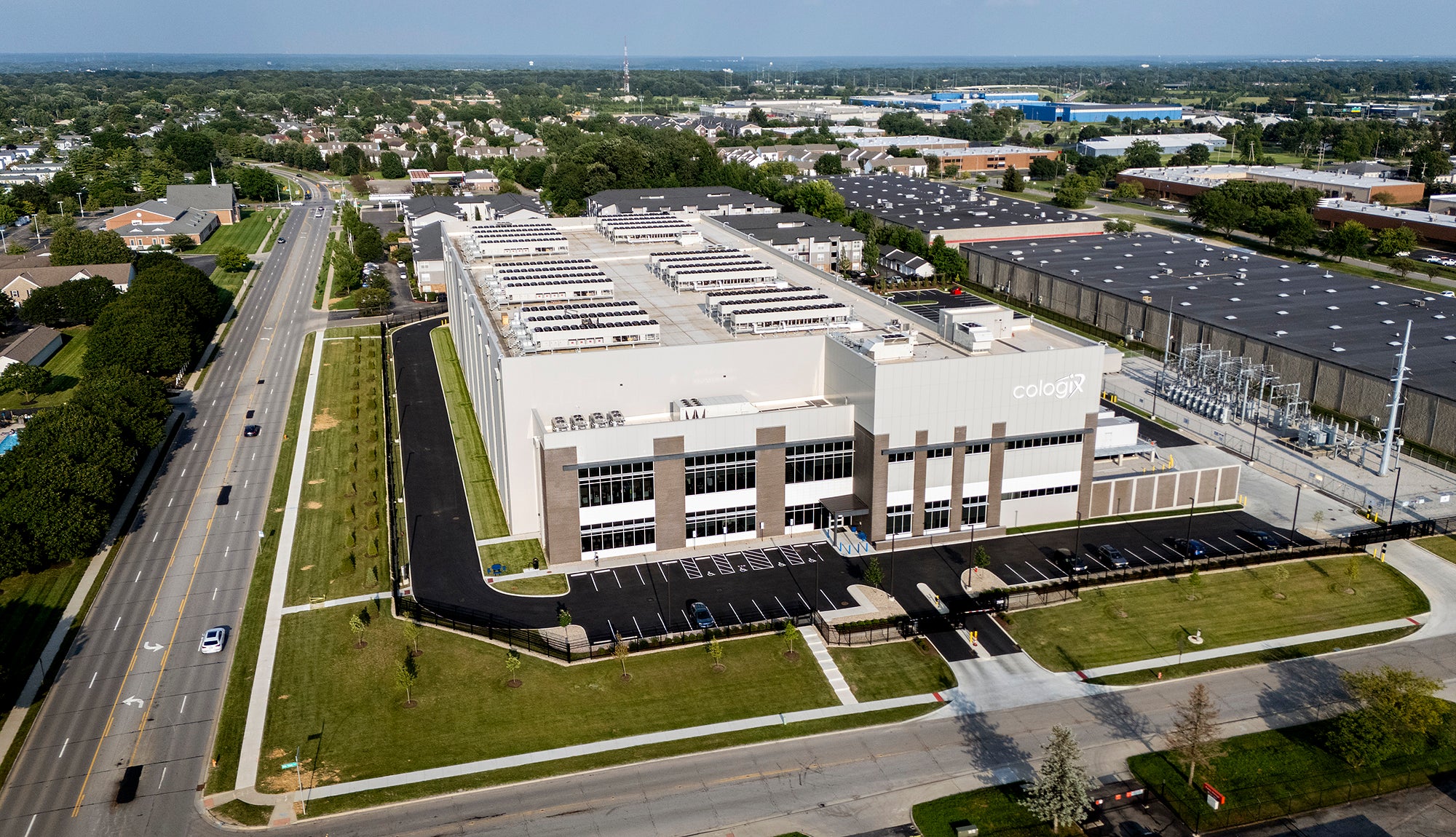
They are enormous facilities that run 24 hours a day, often consuming energy equivalent to that of a whole city to power servers and cooling systems. The largest data centers being constructed today can sprawl over 2,000 acres.
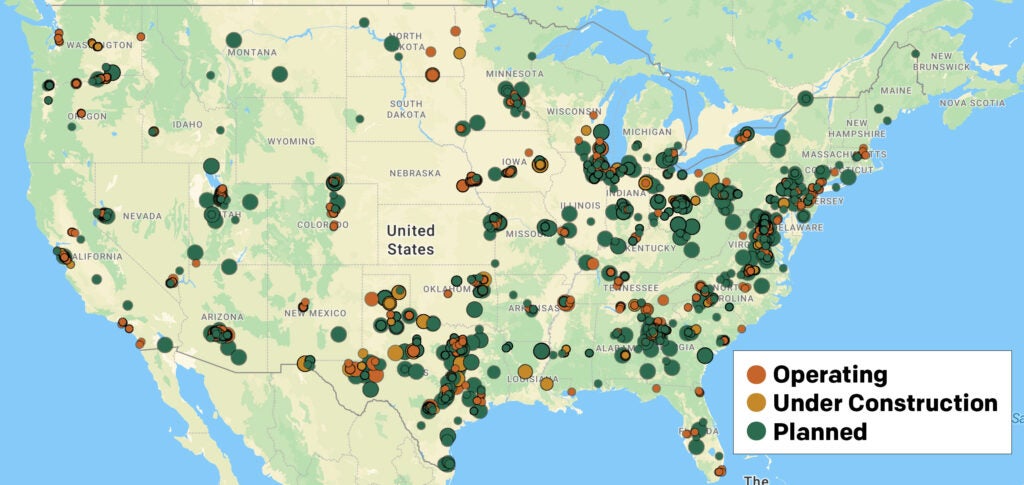
The Data Center Buildout. As of September 16, 2026, data centers in current operation, under construction, and planned can be found in nearly every state in the lower 48. Circle size indicates capacity in megawatts. (Map by Cleanview / ©MapTiler. ©OpenStreetMap contributors)
These new AI data centers are also consuming far more energy and water than before: Currently, 90% of existing data centers use less than 50 megawatts. The new generation of AI data centers includes proposals for massive complexes that would demand 1,000 to 4,000 megawatts (or one to four gigawatts) of electricity.
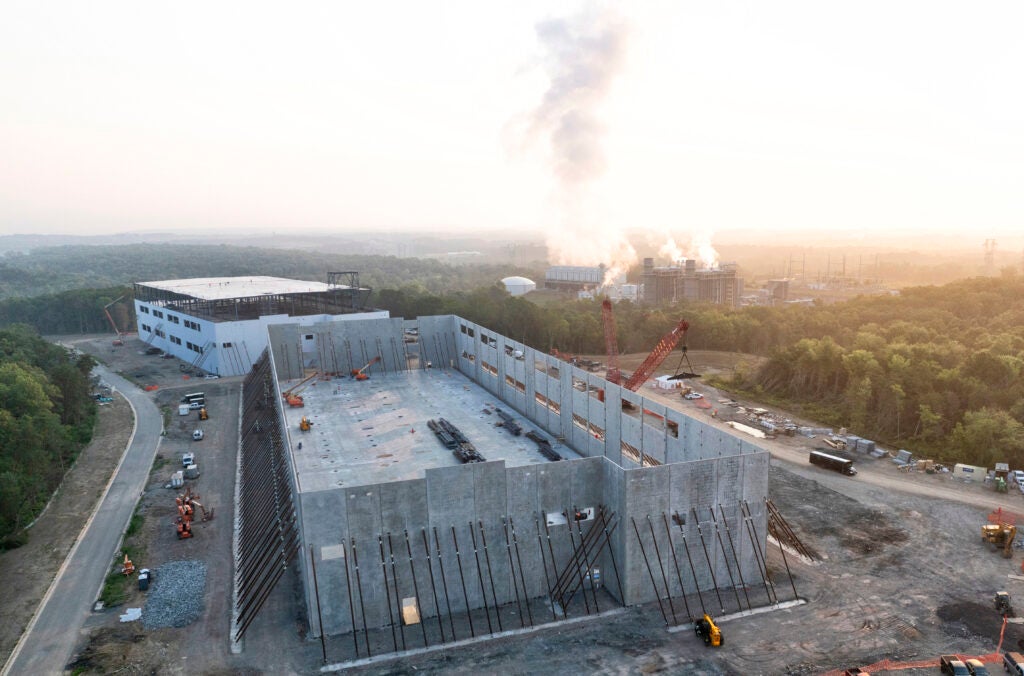
Data centers being built in Leesburg, Virginia, next to the Potomac Energy Center, a gas power plant. (Gerville / Getty Images)
How are data centers powered?
Data centers often ask utilities to build power plants just for them, most commonly gas-fired turbines that emit carbon, methane, and other harmful pollutants.
The scale of methane gas plants being proposed to meet the projected energy demand from data centers is unprecedented. For example, in Homer City, Penn., developers are seeking permits to build what would be the largest methane gas plant in the U.S., a 4.5 gigawatt (GW) facility to serve data centers. Meanwhile, in Indiana, a utility wants to build a 2.3 GW gas power plant on the site of a former coal plant.
In Louisiana, Meta broke ground on its largest data center yet, which will be powered by three methane gas power plants producing 2 GW of electricity. Earthjustice represented local groups that tried to stop the project.
What’s the environmental impact of data centers?
Unchecked electricity demand from data centers threatens to increase health and climate-harming pollution, deplete water supplies, and undermine our transition to clean energy. Nearby communities suffer from increases in local air and water pollution, electronic waste, and noise pollution.
AI data centers also require immense amounts of water for cooling, often one to five million gallons per day. Although less water-intensive technologies are available, most data centers still rely on inefficient evaporative cooling. Earthjustice represents communities concerned about data centers depleting water supplies in Florida, Colorado, and Indiana.
Rather than clean batteries, many data centers rely on dirty diesel generators for backup power, which emit toxic air pollution including nitrogen oxides, particulate matter, and carbon monoxide.
Current projections for the growing energy demand of data centers threaten to keep fossil fuel-burning power plants online, disrupting our transition to clean energy.
Utilities and their affiliated companies see the construction of new power plants as a lucrative opportunity for a guaranteed profit. That’s where Earthjustice attorneys come in. Our attorneys appear before state utility regulators to argue against the buildout of harmful, polluting methane gas plants for data centers. Our health and climate should not be sacrificed for big tech companies’ speculative bet on AI.
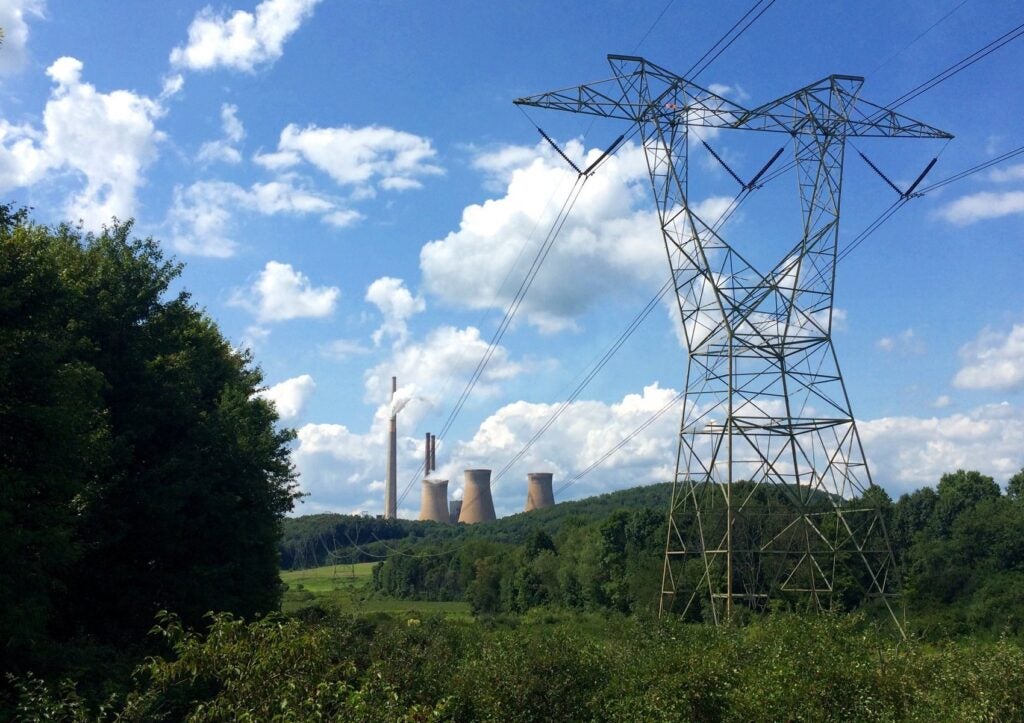
NRG Homer City Generating Station in Burrell Township, Pennsylvania. (Andre Carrotflower / CC BY-SA 4.0)
Will my electricity bill go up because of data centers?
Utilities spend billions to serve the immense energy demands of individual data centers, often leaving communities footing the bill.
The upfront costs for new power plants with grid infrastructure to serve data centers can exceed billions of dollars. Generations of customers could be on the hook to pay off those costs, unless utilities and regulators implement protections to ensure data centers pay their own way. Earthjustice attorneys appear before public utility commissions to demand provisions to safeguard customers.
Data center companies often negotiate secretive, special contracts for discounted power rates with utilities that shift costs onto regular household utility bills. Data centers are also raising wholesale electricity prices. In the biggest electricity market in the country, PJM, data centers caused wholesale costs to increase by $7.3 billion in a recent auction. They were also responsible for an additional $4.4 billion in transmission projects in 2024 alone.
Tech companies need to pay their fair share. Households should not be subsidizing electricity for some of America’s largest, wealthiest companies. Earthjustice attorneys are contesting proposed consumer rate hikes driven by data centers in Pennsylvania, Michigan, and Florida.
How are tech companies and utilities getting away with it?
Tech companies often use non-disclosure agreements (NDAs) and confidential contracts to hide information about their contracts and rates from public view. Even local government officials are forced to sign NDAs.
The public has a right to know what these companies pay for electricity, and how much water they consume. Especially when local communities bear the burden of increased pollution and costs.
Earthjustice attorneys push for greater public transparency from tech companies and utilities. When a Louisiana utility proposed building new gas plants at a cost of $3.2 billion for a massive Meta data center, our attorneys filed a motion with the public service commission to force Meta to disclose how much electricity it would use and verify how many local jobs it would create. In Montana, we are contesting a utility’s effort to keep the public in the dark about proposed data centers by claiming they are trade secrets.
Microsoft, Google, Meta, and Amazon continue to extoll their commitments to reaching net-zero emissions. We cannot afford for them to renege on those commitments now. Tech companies should develop sources of new clean energy such as solar, wind, geothermal, and batteries to power their data centers and support innovative clean energy projects that can reduce costs.

Trucks pass by the site of Meta’s Richland Parish Data Center in Holly Ridge, Louisiana. (Sophie Bates / AP)
What else is Earthjustice doing about the impact of data centers?
Earthjustice attorneys represent community groups opposing proposals for data centers in Louisiana, Mississippi, and New York. In many more states, Earthjustice attorneys focus on getting regulators and utilities to ensure that data centers pay their fair share.
Earthjustice attorneys argue that utilities and regulators must ensure data centers manage their demand, improve their energy efficiency, and bring new clean energy online to power their operations. Our decades of experience before public utility commissions prepare us to go up against utilities and the biggest tech companies.
Maryland recently passed a law that requires the Public Service Commission to create a new rate specifically for data centers to ensure that everyday people don’t foot the bill. Earthjustice advocates will use it and others as models for other states looking to reduce spiraling energy costs associated with the speculative explosion of data centers.
Earthjustice attorneys continue to fight at the state, regional, and national levels to protect residential and small business customers from subsidizing dirty energy for data centers.
- Seeking legal help? Request assistance through our form. We will review your inquiry and will contact you by phone or email if we believe that we may be able to aid you.
Originally published on December 17, 2025.
Earthjustice’s Clean Energy Program uses the power of the law and the strength of partnership to accelerate the transition to 100% clean energy.