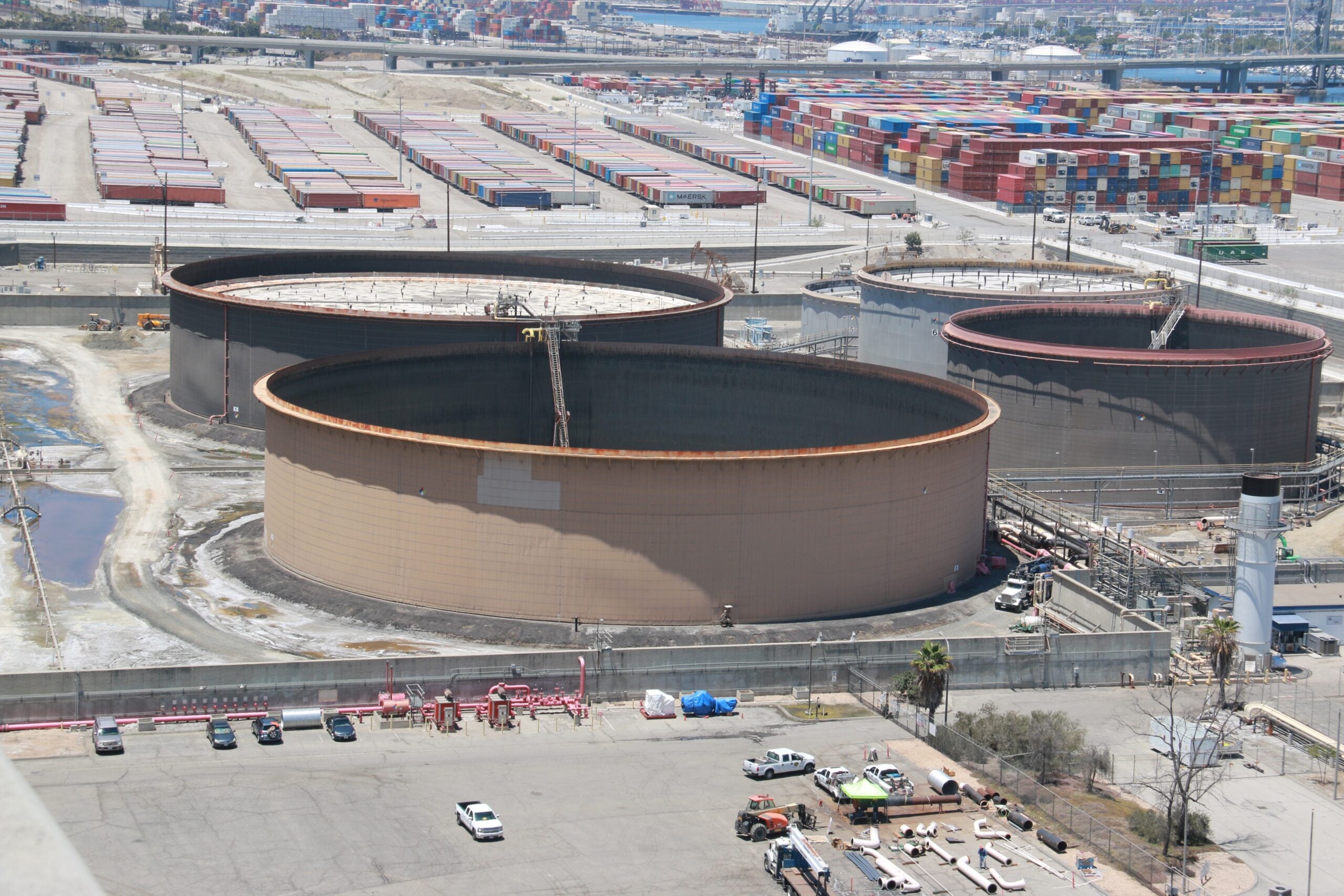

The City of Long Beach Approved Yet Another Oil Storage Tank Project.
Neighbors say enough is enough.
In Southern California, children in Wilmington, Carson, and West Long Beach are forced to breathe in pollution from nearby oil refineries while at school and daycare. Miles of congested freeways and busy rail yards cut through residential areas, leaving diesel and toxic waste lingering in front yards, on playgrounds, and by hospitals.
The twin Ports of Long Beach and Los Angeles are directly adjacent to these communities and are the largest ports in the country and collectively the single largest fixed source of air pollution in Southern California. People who live and work in the area are forced to endure chronic health issues like asthma, reduced lung function, and cancer. The dangerous air quality caused by the countless sources of pollution have led some to call the area the “diesel death zone.”
As this public health crisis rages, the City of Long Beach continues to dismiss community outcry and approve more polluting projects. One such project proposed by Ribost Terminal — the World Oil Installation Project — would significantly expand crude oil storage capacity at the Port of Long Beach.
The Ribost Terminal, doing business as World Oil Terminals, currently contains seven storage tanks holding a combined 502,000 barrels of petroleum products. The new project proposes to construct two additional massive storage tanks, which would bring the facility’s total to nine tanks with a combined capacity of over 23 million gallons of crude oil and petroleum products.
The City of Long Beach approved the project in November 2024. Communities for a Better Environment, represented by Earthjustice, promptly sued the City for violating the California Environmental Quality Act (“CEQA”). CBE is rooted in place-based organizing and works alongside community leaders in the South Bay to build people’s power in California’s communities of color and low-income communities. CBE’s mission is to achieve environmental health and justice by preventing and reducing pollution and building green, healthy, and sustainable communities and environments.
The project authorizes World Oil to move crude oil from two of its existing storage tanks to the two new tanks it proposes to construct. World Oil will then lease out the two existing tanks to unidentified third parties. Because the existing tanks storing crude oil are underutilized, the tanks have the capacity to store even more crude oil than they are storing now — a critical detail that the City ignores.
These tanks are a significant source of air pollution. Tanks release pollution into the environment, including several cancer-causing pollutants like benzene and toluene. Exposure to toxic air contaminants, like the ones emitted from crude oil, increases nearby residents’ cancer risk. Indeed, families living near the proposed project already have significantly higher cancer risks compared to other families in the surrounding region.
Besides the increased harms to air quality, these storage tanks also create hazardous conditions that threaten public health and safety. For example, crude oil from storage tanks creates toxic sludge that must be routinely monitored and removed from the tanks. This oily sludge contains heavy metals that are not degradable and cause serious health risks to people and the surrounding environment. Moreover, storage tanks are inherently dangerous and are prone to spills, explosions, and fires caused by malfunctions and natural disasters.
Despite the Project’s harmful environmental impacts, the City of Long Beach did everything in its power to avoid thoroughly reviewing the proposed project from the start. The city initially greenlit an expedited approval of the project in October 2020. Community members fought back on the approval, and World Oil agreed to prepare an environmental impact report (EIR) under CEQA to fully evaluate the project’s environmental effects.
But the EIR failed to adequately disclose or evaluate the project’s environmental impacts. Instead, the EIR concluded that the project would have no environmental impacts, even though the project allows for increased storage of crude oil. The EIR also failed to consider the severe environmental harms that already exist in the region, ignoring the hundreds of nearby storage tanks and oil refineries.
The Long Beach City Council approved the project over the public’s objections in November 2024. At the hearing, the City Council was required to hear objections from all interested members of the public. Instead, council limited public comments to only those that were “personal” in nature.
The City of Long Beach’s blind faith approval of the oil tank expansion project is just the latest example of why there must be a moratorium on new fossil fuel infrastructure in the region. Long Beach decisionmakers lack the political courage to protect their citizens and constituents from the environmental harms that come from expanding oil infrastructure despite all the known harms to health and the environment.
On March 9, 2026, residents of Wilmington, Carson, and West Long Beach will finally have their day to challenge the city’s approval in court. The city will no longer be able to ignore the voices of those forced to endure the consequences of their decisions and reality on the ground.
Earthjustice’s Community Partnerships Program works hand-in-hand with frontline communities fighting for a safe, just, and healthy environment.
Earthjustice
Media Relations, Earthjustice
media@earthjustice.org