
New Yorkers’ Energy Bills Are Too High. National Grid Wants to Unlawfully Raise Them Even Higher.
Granting National Grid’s petition would violate New York’s Public Service Law and Climate Law, and allow National Grid to skirt the scrutiny, transparency, and public participation opportunities that the law guarantees to New Yorkers.
On May 29, 2026, the gas utility National Grid filed a petition with the New York Public Service Commission (PSC) purporting to stabilize gas rates. However, the petition uses technical jargon — which is impenetrable to anyone who is not familiar with utility ratemaking — to essentially ask for a credit card to continue expanding and reinforcing its gas system, and for the right to hold customers on the hook for paying an inflated bill starting in 2028. Now, during Climate Week, we should be especially cautious about making massive investments in aging fossil fuel infrastructure as we pivot to a future powered by clean energy.
Earthjustice dug in on behalf of Alliance for a Green Economy and submitted comments to the PSC explaining why granting the petition would violate New York’s Public Service Law and Climate Law, and allow National Grid to skirt the scrutiny, transparency, and public participation opportunities that the law guarantees to New Yorkers.
National Grid is trying to circumvent the typical ratemaking process and exploit accounting mechanisms to artificially hold rates high and raise them even higher for years to come. Although granting the petition would keep rates constant for one year, doing so would also lock in exorbitant rate hikes in the future.
National Grid is not freezing its spending — it’s actually proposing a $1.7 billion plan to shore up the gas system in parts of New York City and Long Island during the year that rates would be held stable, and wants to kick the can down the road and collect high bills from customers later. Moreover, the longer National Grid delays collecting from ratepayers, the more those costs grow due to high carrying charges.
As background, this year National Grid’s two downstate gas utilities were expected to undergo the typical process for raising rates, called a rate case. In a rate case the utility files detailed testimony explaining how it proposes to spend ratepayer money and the PSC is required to publish certain key information about the proposal in plain language.
Members of the public can participate in rate cases by filing public comments, participating in public hearings, seeking discovery, and filing testimony. The public can also participate in settlement negotiations to reduce the utility’s proposed rates, propose environmental and safety guardrails on infrastructure projects, and participate in an evidentiary hearing where they can cross-examine utility witnesses. This extensive process results in thousands of pages of testimony, exhibits, and legal arguments that form the basis for a PSC decision on whether the utility’s proposed rate increase is justified.
In its last rate case, National Grid secured a rate plan that allowed the utility to spread the costs of large capital investments across customers’ bills for three years. In April 2027, those costs will be paid off, and without any action by the PSC, customer bills would drop and National Grid’s revenues would decrease by around $250 million.
The petition asks the PSC to instead allow existing rates to continue so that National Grid can use the money to continue expanding and fortifying its gas system. National Grid also asks for permission to spend up to $200 million on gas infrastructure and for a de facto guarantee that it can recoup those costs from customers starting in April 2028.
On top of that, National Grid proposes a surcharge mechanism to cover the costs of property taxes and environmental cleanup that it will incur between April 2027 and April 2028, which would be added to customers’ bills for years until those costs are paid off.
The problem for National Grid is that, under the Public Service Law, the PSC may not approve a “major change” in rates without going through the full rate case process. A “major change” is defined as an increase in the utility’s aggregate revenues of more than 2.5%.
National Grid is asking for far more — first, to raise rates by $250 million above the amount to which they would default in the absence of any Commission action, and then for many millions more in the coming years. As detailed in our comments, because National Grid is seeking huge sums of ratepayer money to which it would otherwise not be entitled without going through the rate case process, granting the petition would violate the Public Service Law.
New York’s Climate Law also prohibits the PSC from approving the petition. The Climate Leadership and Community Protection Act (CLCPA) requires state agencies to assess whether their decisions would impede attainment of statewide greenhouse gas reduction targets and, if so, provide a detailed justification and identify alternatives or mitigation measures. National Grid’s thin petition is devoid of any details about the capital investments it has planned or their potential greenhouse gas impacts, and certainly does not provide sufficient information on mitigation efforts.
The CLCPA also prohibits agency decisions that would disproportionately burden “disadvantaged communities,” which have been identified by the state based on historical pollution burdens, socioeconomic facts, climate risks, and other criteria. Earthjustice has determined that most of National Grid’s planned capital projects would be located in disadvantaged communities, but the utility has not provided the PSC with information about the projects’ potential pollution burdens or proposed mitigation measures to eliminate those impacts. Because the PSC cannot possibly conduct the analyses and make the findings required by the CLCPA before taking action, it cannot lawfully approve the petition.
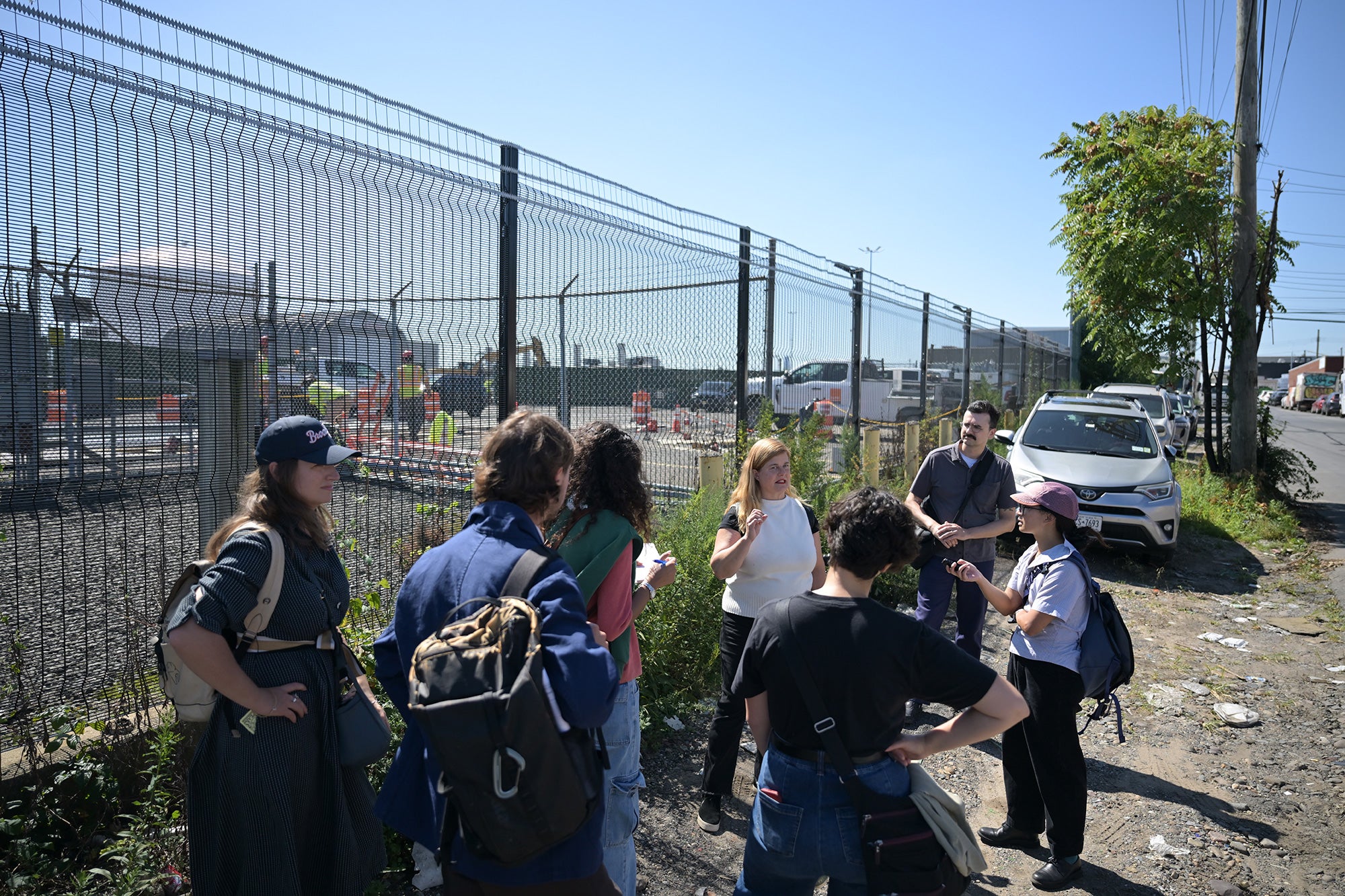
One particularly concerning example of a project in a disadvantaged community is National Grid’s outdated and heavily emitting Greenpoint Energy Center. National Grid’s Petition does not mention its plan to invest over $60 million into this aging and controversial liquified natural gas facility in North Brooklyn. The surrounding neighborhood has been subjected to emissions from this facility for decades, and broader pollution in the area extends back to the 19th century.

Kim Fraczek, Director of Sane Energy Project, leads a walking tour for Earthjustice attorneys, local politicians, and media at Greenpoint, Brooklyn, NY, on Sept. 15, 2026. (Carey Wagner for Earthjustice)
With New York’s grid increasingly being powered by clean energy, the long-term need for the Greenpoint LNG facility is seriously in doubt. Yet National Grid’s proposed capital investments would position the facility to either remain for decades, or shut down earlier and strand tens of millions of dollars in unnecessary costs that ratepayers would cover. Moreover, National Grid wants to slip ratepayer money into the facility for projects that the PSC has previously questioned or denied in other proceedings.
New Yorkers have a right to understand and participate in decisions that shape our energy future. We hope the PSC will reject National Grid’s attempt to hide the growing costs of its polluting gas system from public scrutiny and deny the petition.
Established in 2008, Earthjustice’s Northeast Office, located in New York City, is at the forefront of issues at the intersection of energy, environmental health, and social justice.
Nydia Gutiérrez
Public Affairs and Communications Strategist, Earthjustice
ngutierrez@earthjustice.org