
Court-Ordered Spill Provides a Lifeline for Columbia Basin Salmon
Additional water spilled over Columbia Basin dams is crucial for migrating juvenile salmon.
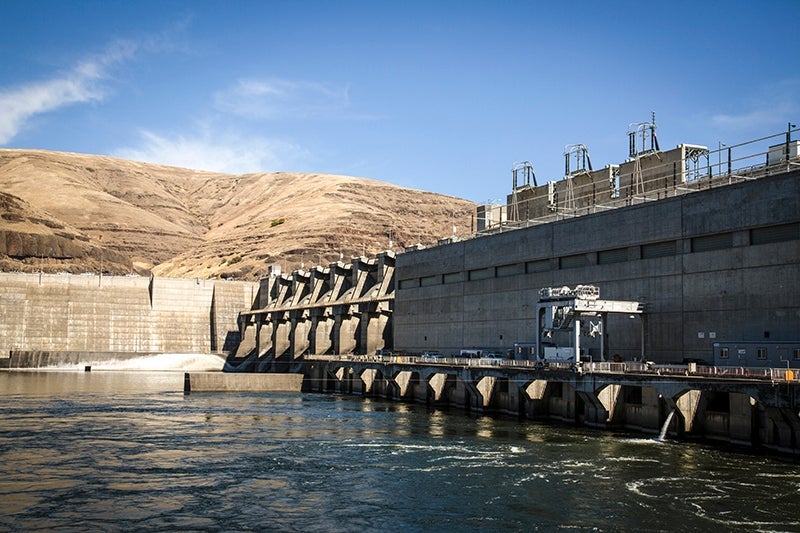
For over two decades, litigation in the Columbia River Basin over the operation of federal hydropower dams has resulted in a series of court orders that have provided a crucial lifeline to struggling salmon and steelhead that are protected by the Endangered Species Act (ESA). The most recent order is supported by a collection of states, Tribes, and fishing and conservation groups, and like previous court orders, includes additional water spilled over eight lower Columbia and Snake River dams to assist the downstream migration of juvenile fish. The order requires varying spill levels throughout the year — tailored to water availability and the needs of fish — peaking in the spring and tapering down during the summer months as river flows drop.
We are providing this Q&A to explain some of the key issues around the court’s order.
Why is spill important?
Spill is critical for salmon. Juvenile salmon that spawn higher in the Snake River must make it past eight separate dams on their journey to the Pacific Ocean. Spill reroutes river flow over the dams to spare the fish moving down the river from repeated exposures to lethal dam powerhouses.
Not only is the science supporting spill conclusive, but it has been so for quite some time. As far back as 2000, the government recognized that “juvenile survival is highest” when they travel through the dams’ spillways rather than the powerhouses. Spill has been a centerpiece of court-ordered protective measures for many, many years, and the district court recognized that the weight of the scientific evidence demonstrates that spill “offers immediate benefit to [ESA protected] species.” The Fish Passage Center, a scientific body funded by the Bonneville Power Administration and directed by the region’s salmon managers, warned that reductions in spill would “decrease life cycle survival for juvenile salmon migrating downstream in 2026.”
There is simply no credible dispute on the benefits of spill.
Have there been problems this year with implementing the court’s order?
Generally, no. Spill began in the spring and has not resulted in any major disruptions to the operation of the river system.
The Army Corps of Engineers, in charge of the dam operations, produces monthly reports. The reports from April, May, June, and July confirm that operations have been uneventful, including when spill was at its peak during the spring.
The court’s order was specifically designed to allow for adjustments to spill to accommodate hydropower needs and to respond to any difficulties for adult salmon migrating upstream. In May, for example, hourly spill was reduced (and power production increased) at three of the Lower Snake River dams to compensate for an unexpected outage at Grand Coulee Dam, the Basin’s largest power producer. The flexibility built into the court’s decision allows the Corps to respond to unanticipated contingencies exactly like this, rare as they may be.
Is the amount of spill ordered by the court unusual?
Not at all.
The court’s order changed one element of previous years’ spring spill, increasing it from eight hours a day at John Day Dam to 24 hours a day. Even this relatively modest bump up overstates the actual operations this April and May: the Corps’ reports reveal that the average amount of spill during both months was less than the total targeted by the order. And yet during all of April and for the first half of May adult salmon returns matched the 10-year averages. Even had the spill this spring reached the maximum set in the court’s order, there’s no reason to believe that salmon would have suffered any ill effects as a result. Spring spill in 2022 exceeded the targets that are being used this year, and yet even those “extended exceedances” had no detectable effect on upstream survival.
In fact, the spring spill ordered by the court matches what the Northwest Power and Conservation Council proposed in its most recent Fish and Wildlife Plan because of the clear benefit to juvenile salmon. The Council, made up of representatives of Washington, Oregon, Idaho, and Montana, is the regional entity responsible for balancing hydropower operations with the needs of vulnerable salmon and steelhead.
The idea that the spill levels this year are at all untested or experimental is simply untrue.
Why have some dam proponents been complaining about the spill?
Interest groups like the Public Power Council (PPC), an industry association that represents Northwest utilities, have made baseless claims that salmon have been harmed by spill.
PPC maintains that upstream migration of adult salmon was negatively affected in late May by the additional spill at John Day Dam on the Lower Columbia River, insisting that after the court-ordered spill in April and early May, upstream migration declined. PPC is wrong multiple times over: spill is vital to protecting salmon in the Columbia River; claims about adult salmon delaying their upstream migration are exaggerated, and if anything, the court order is an unremarkable protective measure, closely resembling recent levels of spill.
Were adult salmon delayed this year when migrating upstream?
The real question is whether there have been any consequential migration delays. The answer to that is a resounding “no.”
The Fish Passage Center has repeatedly questioned the data used to claim that there have been migration delays, criticizing the underlying tool as “not provid[ing] a biologically meaningful representation of adult passage.” Crucially, it is more important to look at the time it takes for fish to move through an entire river reach rather than progress at any single dam — but it is the latter that PPC is narrowly focused on and it is what has been used at times to justify decreasing spill.
The true migration metric is the ultimate success of the adults’ upstream journey, and “[d]uring years with high spill and during years with low spill, adult upstream survival is consistent.” So while adult salmon fare about the same regardless of the amount of spill, the science is clear that higher spill improves the downstream juvenile survival, which is the reason spill is supported by the region’s salmon managers
PPC also raised concerns about movement past Lower Monumental Dam on the lower Snake River but ignored the fact that adult fish have moved through that entire reach on a timeline that is typical for upstream migration. Although spill was briefly interrupted by the Corps in response, fisheries experts from tribes and states as well as federal fish biologists all supported quickly restoring the court-ordered spill there.
What does lead to slower adult migration?
Sometimes adult salmon move up the river in fits and starts, temporarily slowing based on various environmental conditions. Factors such as water temperature and turbine unit configuration are known to affect upstream migration. And, in fact, at John Day Dam, there was a 5-degree temperature differential in one of the fish ladders as well as a change in turbine operation during the time period spotlighted by PPC. The alleged adult passage delay that occurred there was observed the day after the turbine operation change, and the Fish Passage Center found there to be multiple confounding factors at work during the whole episode. But again the issue is the overall time it takes to complete the journey, not the time spent in any one location.
So why are there claims that spill is bad for fish?
Consider the source.
Claims by hydropower proponents about the benefits to salmon from pumping more water through the dams’ lethal powerhouses should be viewed with a healthy degree of skepticism. It is more than a little ironic for an industry group that is opposed to spill to suddenly — and so enthusiastically — take up the cause of salmon protection, and unsurprisingly, their most recent claims about the court’s order do not stand up to scrutiny. The actual salmon managers with an interest in salmon restoration, including the states of Washington and Oregon, the Nez Perce Tribe, and the Yakama Nation, strongly support the enhanced spill and have not found spill to have interfered with adult passage.
Attempts to whittle away at spill can have serious negative consequences. Overreacting to perceived adult delay by reducing spill leads to worse outcomes for the downstream migrating juveniles now and correspondingly worse returns for the number of upstream migrating adults in the future. Rather than follow the science or the specific facts here PPC has chosen to spread misinformation about spill, the aspect of the dams’ operations that is currently doing the most good for salmon overall. Responsible states and Tribes will continue to monitor the Army Corps’ implementation of the court’s order to counter the needless alarmism that that can actually harm the fish.
Established in 1987, Earthjustice's Northwest Regional Office has been at the forefront of many of the most significant legal decisions safeguarding the Pacific Northwest’s imperiled species, ancient forests, and waterways.
Elizabeth Manning
Public Affairs and Communications Strategist, Earthjustice
emanning@earthjustice.org