Mega-Warehouses Can be Better Neighbors
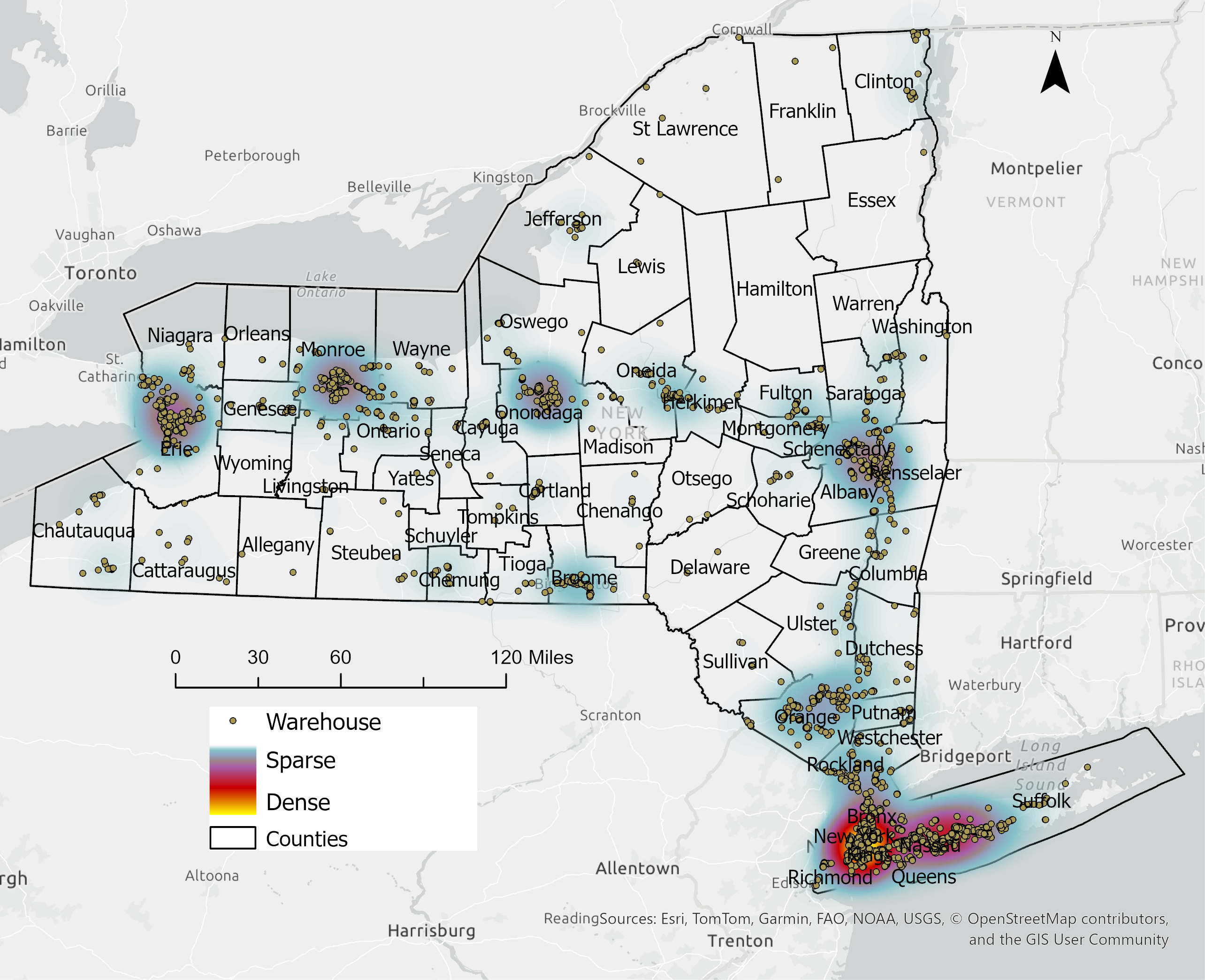
In New York, mega-warehouses have clustered in communities already dealing with heavy air pollution. Smart policies can improve air quality.
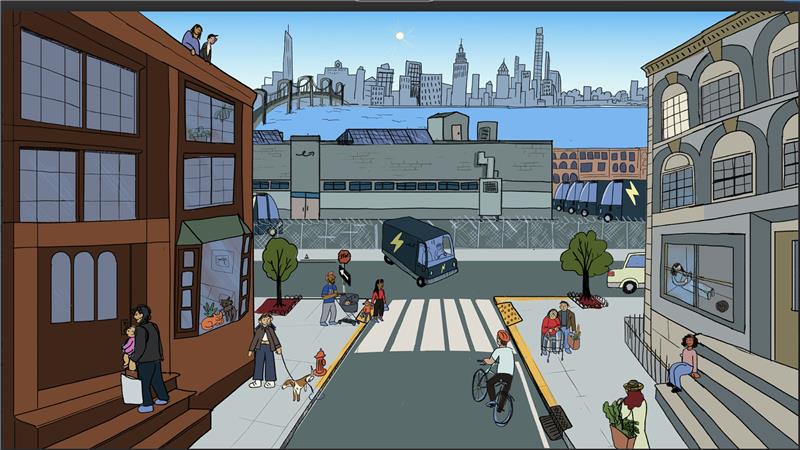
(Lily Padula for Earthjustice)
All New Yorkers have experienced it: that feeling when you step outside your apartment on a sweltering hot summer day only to be hit smack in the face by the heat and stifling smell of diesel exhaust from a delivery truck. Unfortunately, this is becoming an increasingly common experience as more giant mega-warehouse facilities spring up across the state.
Today, five million New Yorkers live within a half mile of a sprawling warehouse, which means more people are forced to deal with the truck traffic that makes our neighborhoods loud, hot, and polluted. Every single day, these massive facilities generate hundreds, sometimes thousands, of vehicle trips, and they’re mostly using dirty-diesel trucks — the worst polluters on our roads. This pollution is linked to asthma in kids, heart disease, cognitive problems, and even early death.

(Lily Padula for Earthjustice)
Presently, the warehousing industry in New York is like the wild west. There are no clear rules or regulations for how these facilities operate, and this needs to change. Warehouses in New York, through their truck traffic, often emit the same amount of pollution as heavily-regulated power plants, and state policy needs to reflect that.
That’s where the Clean Deliveries Act comes in. The statewide legislation would help New York build the modern goods movement of the future — without the pollution. Picture this: quiet non-polluting trucks with no tailpipe pollution delivering the goods that power our lives, warehouses powered by the sun with batteries to store that energy, and state-of-the art on-site charging stations. The Clean Deliveries Act would get us to this future by requiring New York to review emissions related to the operations of all e-commerce warehouses over 50,000 feet so that policymakers can get a sense of the scale of the problem. Then, warehouse operators would work with the state to create site specific plans for how they would reduce their pollution, including committing to acquiring more zero-emission vehicles and charging infrastructure, installing solar panels and air filtration systems or paying additional fees.
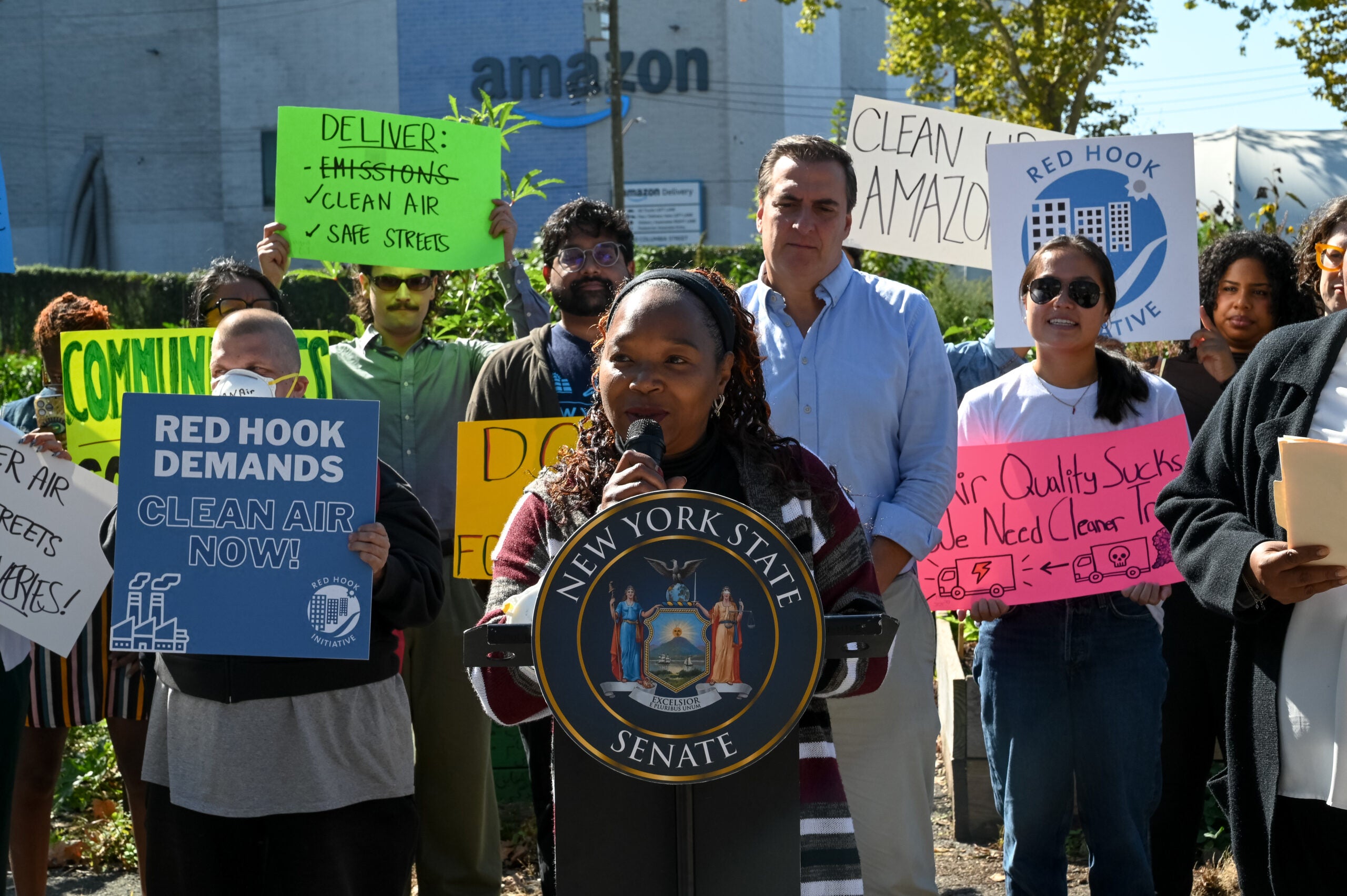
Advocates hold press conference before hosting a walking tour of Brooklyn’s Red Hook neighborhood. Mega-warehouses have clustered in this neighborhood bringing diesel truck traffic and air pollution. (Red Hook Farms Initiative)
If this sounds ambitious, consider that a similar program already exists in Southern California. Newly published findings show that California’s program is working as intended. The 4,000+ mega-warehouses in the region are complying with the policy, earning 3.5 times more points than the rule called for. Plus, even though the warehousing industry cried wolf claiming the policy would lead to an apocalypse for warehouse operators, that simply hasn’t happened. Since the regulation was adopted, the warehouse industry has steadily grown in the region, adding 100 million square feet of new warehousing. For a sense of scale, this is the equivalent of adding more than 1,200 Madison Square Gardens in warehouse square footage. Southern California has proven that businesses can grow while still doing their part to protect communities from deadly air pollution.
With the kick off of congestion pricing, we’ve all seen firsthand how smart transportation policies can transform our lives and tangibly improve our quality of life. Despite an endless barrage of attacks on the program from the Trump administration, the cameras are still on and the good news about the policy keeps rolling in. In the first six months of congestion pricing, PM2.5 pollution fell by 22% in the toll zone. We’ve also seen traffic speeds increase by 23% for vehicles entering and exiting the toll zone, and the fewest traffic deaths in recorded history. Fatalities are down 19% from 2024. It has been inspiring to see Governor Hochul fight to keep the program in place and to hear the Governor herself called the program a “once-in-a-lifetime success story.”
Why stop there?
We should build on these successes by putting our foot on the accelerator and pursuing sound policies that improve public health while modernizing our economy.
The stakes couldn’t be higher. While the Trump administration gives a blank check to polluters, New York can forge ahead and get on board with where the rest of the world is already heading. Research from Mckinsey found that exports of Chinese heavy-duty trucks to the Middle East and North Africa grew by an astonishing 73% annually while exports to Latin America rose by 46%. Plus, Chinese vehicle manufacturer BYD just became the largest electric vehicle maker in the world, outpacing Tesla.
New York has the opportunity to make the Clean Deliveries Act law this spring. For three years in a row, the State Senate has committed to the improvements embodied by the Clean Deliveries Act and passed the legislation. However, the State Assembly has taken a backseat by leaving it on the table while streets get hotter, our air is dirtier, and we’re falling behind the rest of the world in modernizing transportation. New York can be on the cutting edge of the modern goods movement economy if the Assembly joins the Senate in passing the Clean Deliveries Act this year.
Established in 2008, Earthjustice’s Northeast Office, located in New York City, is at the forefront of issues at the intersection of energy, environmental health, and social justice.
Zoe Woodcraft
Public Affairs and Communications Officer, Earthjustice
zwoodcraft@earthjustice.org