

Court Orders Emergency Actions to Protect Imperiled Columbia Basin Salmon
Victory
Federal defendants ordered to change Columbia Basin hydropower operations to protect endangered salmon and steelhead
Contacts
Amanda Goodin, Senior Attorney, Earthjustice, agoodin@earthjustice.org
Elizabeth Manning, Communications, Earthjustice, emanning@earthjustice.org
Jacqueline Koch, Communications, National Wildlife Federation, kochj@nwf.org
A federal court in Oregon today ordered federal agencies to change operations of the Columbia Basin hydropower system in critical ways to help improve salmon survival.
The Court unequivocally recognized the dire situation of Columbia Basin salmon, noting that “one of the foundational symbols of the West, a critical recreational, cultural, and economic driver for Western states, and the beating heart and guaranteed resource protected by treaties with several Native American tribes is disappearing from the landscape.”
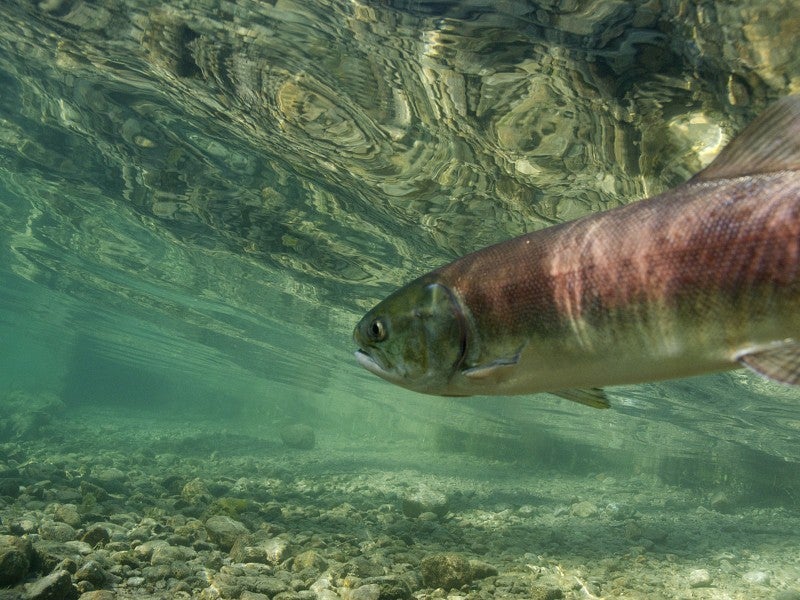
To help imperiled salmon and steelhead, the Court ordered the federal agencies that operate the hydropower system to increase spill over eight dams on the lower Columbia and Snake Rivers, allowing juvenile fish to pass over the dams instead of through lethal turbines. The court-ordered spill includes additional water flow over the dams in the spring and summer, when increased spill is critical to aid in the recovery of wild Chinook salmon.
The Court found that similar emergency measures had been implemented before and were needed again: “The Court recognizes the dire situation these species are facing. … It appears that the 2020 BiOp and 2020 FEIS follow this disappointing history of avoidance and manipulation instead of sincere efforts at solving the problem and genuinely remediating the harm.”
The Court also said it was not persuaded by information from federal defendants, saying evidence challenging the benefits of spill to salmon “primarily was created for this litigation and is contrary to the scientific evidence in the record.” The Court also noted that, “the majority of the spill has been implemented over the years without such negative repercussions, and the Court does not anticipate such calamities will ensue from the current spill order.”
Conservation, fishing and clean energy groups represented by Earthjustice, joined by the State of Oregon, requested these changes in a preliminary injunction request that was also supported by the State of Washington, the Nez Perce Tribe, and the Yakama Nation who joined as amici (friends of the court). The parties returned to court in October, ending a four-year pause in litigation, after the Trump administration last summer unilaterally and abruptly ended the Resilient Columbia Basin Agreement aimed at restoring imperiled native fisheries to healthy abundance while investing $1 billion over a decade in the region.
Following are quotes from plaintiffs and Earthjustice:
“The changes to the hydropower system ordered by the court today are immediate and reasonable steps to prevent salmon extinction,” said Earthjustice Attorney Amanda Goodin. “Salmon need help now, and we’re encouraged the court has granted immediate, commonsense relief that will help protect imperiled Northwest salmon and steelhead.”
“Because the federal government threw out a comprehensive plan that would have restored the Columbia Basin while investing in the region, returning to court is the only tool we have left to prevent the collapse of imperiled salmon and steelhead populations,” said Mike Leahy, senior director of wildlife, hunting and fishing policy for the National Wildlife Federation. “While these emergency measures are implemented, we’ll keep our eye on our long-term goal of helping the Tribes and the states restore Snake River salmon for the generations to come.”
“This court decision secures badly needed improvements to hydropower operations to protect the Columbia Basin’s iconic salmon and steelhead runs that are essential to Tribal cultures and our Northwest heritage,” said Sierra Club Snake/Columbia River Salmon Campaign Director Bill Arthur. “We can avoid extinction and restore healthy salmon runs while making long-term investments to provide ample, reliable, affordable energy for the region. Since the Trump administration reneged on the Resilient Columbia Basin agreement, we are seeking other ways to achieve these goals. This court decision helps protect salmon and keeps us on that path.”
“These are the immediate and decisive actions we need to help prevent salmon and steelhead extinction,” said Idaho Rivers United Conservation Director Nick Kunath. “The court recognizes that we must listen the advice that fisheries managers and scientists have been sharing for decades before it’s too late.”
“These emergency measures required by the Court of the federal government will help prevent salmon extinction while we continue our work with others in the region toward a comprehensive solution to restore the Columbia Basin,” said Northwest Sportfishing Industry Association Policy Director Liz Hamilton. “These emergency measures granted by the court will increase survival for the young salmon leaving the river next year and provide hope for those whose livelihoods and culture depend on Columbia River Fisheries.”
“There’s no surprise that the federal government’s decision to walk away from a comprehensive agreement, without any alternative plan, resulted in a serious setback for the Northwest,” said Idaho Conservation League Salmon Program Senior Associate Abbie Abramovich. “These emergency measures offer wild Columbia and Snake River salmon populations a much-needed lifeline.”
“We absolutely can have clean energy and restored salmon runs, and today’s ruling is an important step in the right direction,” said NW Energy Coalition Regional and State Policy Director Zachariah Baker. “The ruling helps protect salmon, while the region continues to collaborate on the comprehensive, strategic solutions envisioned in the Resilient Columbia Basin Agreement the administration withdrew from, including how to ensure abundant, affordable, and reliable clean energy across the Northwest.”
“The hydropower interests that convinced Trump to break the Resilient Columbia Basin Agreement got what they wanted,” said Miles Johnson, Legal Director for Columbia Riverkeeper. “Because of their actions, today’s ruling is necessary to protect fish and fishing in the Columbia River — and it will not disrupt energy production or reliability in the Northwest.”
Background
Earthjustice has represented conservation, fishing, and renewable energy groups, who have fought alongside the Nez Perce Tribe, other Columbia Basin Tribes, and the State of Oregon, in successful court battles for more than 30 years to protect threatened and endangered salmon in the Columbia River Basin. These groups are the National Wildlife Federation, Pacific Coast Federation of Fishermen’s Associations, Institute for Fisheries Resources, Sierra Club, Idaho Rivers United, Northwest Sportfishing Industry Association, NW Energy Coalition, Columbia Riverkeeper, Idaho Conservation League and Fly Fishers International, Inc.
The changes to the hydropower system ordered today by the Court affect the following lower Snake and lower Columbia River dams: Ice Harbor, Lower Monumental, Little Goose, Lower Granite, Bonneville, The Dalles, John Day and McNary.
Columbia Basin salmon and steelhead, particularly those that return to the Snake River to spawn, persist at dangerously low abundance and many continue to decline toward extinction. Of the 16 salmon and steelhead stocks that historically return to spawn above Bonneville Dam, four are extinct, and seven more are listed under the Endangered Species Act as endangered or threatened, including all that return to the Snake River. For most of these ESA-listed salmon species, by far the largest threat in their freshwater life stage is the harm caused by federal dams. These dams kill and harm salmon as they attempt to migrate past each dam and by transforming the river into a series of slack water, warm reservoirs.
The Resilient Columbia Basin Agreement, which stemmed from mediation efforts with the federal government, was based on a comprehensive salmon recovery plan developed by the states of Washington and Oregon and four lower Columbia River Treaty Tribes — the Confederated Tribes and Bands of the Yakama Nation, the Confederated Tribes of the Umatilla Indian Reservation, the Nez Perce Tribe, and the Confederated Tribes of the Warm Springs Reservation of Oregon. That plan is called the Columbia Basin Restoration Initiative and remains the guiding document for Columbia Basin salmon and steelhead recovery.
Additional Resources
About Earthjustice
Earthjustice is the premier nonprofit environmental law organization. We wield the power of law and the strength of partnership to protect people's health, to preserve magnificent places and wildlife, to advance clean energy, and to combat climate change. We are here because the earth needs a good lawyer.