Posts tagged: Environmental Protection Agency

unEARTHED. The Earthjustice Blog

Environmental Protection Agency


    SIGN-UP for our latest news and action alerts:
   Please leave this field empty

Facebook Fans

Featured Campaigns

Everyone has The Right To Breathe clean air. Watch a video featuring Earthjustice Attorney Jim Pew and two Pennsylvanians—Marti Blake and Martin Garrigan—who know firsthand what it means to live in the shadow of a coal plant's smokestack, breathing in daily lungfuls of toxic air for more than two decades.

Coal Ash Contaminates Our Lives. Coal ash is the hazardous waste that remains after coal is burned. Dumped into unlined ponds or mines, the toxins readily leach into drinking water supplies. Watch the video above and take action to support federally enforceable safeguards for coal ash disposal.

ABOUT EARTHJUSTICE'S BLOG

unEARTHED is a forum for the voices and stories of the people behind Earthjustice's work. The views and opinions expressed in this blog do not necessarily represent the opinion or position of Earthjustice or its board, clients, or funders.

Learn more about Earthjustice.

View Terry Winckler's blog posts
01 July 2010, 10:20 AM
Earthjustice demanded ingredient information, will seek expert opinions
Dispersant sprayed in Gulf of Mexico

<Update 7/1: EPA has released results of its first round of chemical testing of dispersants used in the Gulf. The report downplays toxicity, but as scientist/blogger Richard Denison points out - the report offers little new information and still leaves unresolved the bigger questions, such as what toxicity occurs when dispersants and oil combine, and what happens when that highly dispersed oil/dispersant brew is spread across vast areas and throughout the water column.>

<Update: A month after promising to test the toxicity of dispersants used against the Gulf oil spill, the EPA has yet to complete those tests - meanwhile more than 1.4 million gallons have been dumped in the Gulf with unmeasured consequences, reports Mother Jones. EPA's position is that the dispersants are less toxic than the oil, but that raises the question: are we just adding to the total toxicity of the spill?

<Update: Check out the latest information on the toxic potential of ingredients in oil dispersants>

The government wouldn't dare let a doctor give out an experimental drug without years of extensive testing, yet it has allowed British Petroleum to flood the Gulf of Mexico with more than a million gallons of a secret chemical compound in an untested experiment on human communities, hundreds of animal species, and myriad ecological systems.

We're talking about Corexit and other dispersants, made up of classified chemicals and spread over and injected into Gulf waters to break up BP's oil spill. The spill alone is in many ways unmatched in human history, scientists say, and because of dispersants may be wreaking special devastation in the Gulf. Aside from the fact that dispersants never before have been used on such a vast scale, we have been forced to guess at the danger they pose because BP and the dispersants' manufacturer refused to reveal the ingredients.

Today, after Earthjustice demanded the information through a Freedom of Information Act request, the Environmental Protection Agency finally provided a list of what's in these chemical compounds. Now, we can turn to experts to assess their danger. Our clients, the Gulf Restoration Network and Florida Wildlife Federation, who have long worked to protect the Gulf, must know what is happening to its rich fisheries, sea turtles, birds, and entire ecosystem.

37 Comments   /   Read more >>
View Terry Winckler's blog posts
01 July 2010, 8:11 AM
With 140-million gallons of oil in the water, monster skimmer is needed

<Update 7/6: High seas have disrupted testing of the "A Whale" oil skimmer, the Coast Guard reports.>

<Update 7/1: Speaking of whales, a number of whale sharks have been spotted in the oil spill area, which is particularly bad for them, as they are plankton eaters—meaning they sieve the oil-laden waters. The species is among six described as most threatened by the spill, according to AOL. Other species listed are sea turtles, bluefin tuna, sperm whales, dolphins and brown pelicans.>

A record described as "notorious" in a USA Today headline is being reached today in the Gulf of Mexico as BP's oil spill tops the estimated 140-million-gallon mark. The previous record Gulf spill was 139 million gallons in the 1979 spill off Mexico's coast—but it took a year of gushing to get there. BP's spill has been gushing from its blown-out well since April 20 at up to 2.4 million gallons a day.

Even as that unhappy record is being achieved, the federal government has brought on scene the latest attempt to clean up the oil. A monster skimmer ship—3 1/2 football fields long and 10 stories high and named the "A Whale"—chugged in today, especially equipped to skim as much as 21 million gallons of oiled water per day—if the EPA gives the go ahead. The ship has never been tested.

View Terry Winckler's blog posts
29 June 2010, 4:51 PM
Gulf spill area like a cauldron waiting to be stirred
Tropical Storm Alex

<Update 7/1: All BP oil spill cleanup and containment efforts are on hold as wind and waves from the former Hurricane Alex push through the oil spill area. Although the storm stayed 600 miles to the west, it still had enough punch to not only stop the cleanup but actually push oil deeper into coastal wetlands and onto beaches.>

<Update: Alex has been upgraded to a hurricane and continues on course, veering away from any direct contact with the Gulf oil spill area, but still disrupting containment and cleanup efforts. Tar balls "big as apples" have been pushed deep into wetlands by the storm, reports AP. >

Wind and waves from Hurricane Alex are stirring up more questions than havoc so far at the BP oil spill site, hundreds of miles away. Pundits, scientists and outright guessers just can't agree on what's going to happen to that stew of oil and dispersants when a storm makes a direct hit on the spill scene.

Much of their uncertainty has to do with the chemical makeup of the dispersants, which have been strewn like a giant lab experiment over thousands of square miles of spilled oil, and shot into the oil at seabed level as it escapes. After Earthjustice demanded answers from the EPA, the agency revealed the ingredients, but toxic effects of those ingredients—especially in combination with the oil it binds to—are hard to tie down. And there seems to be nothing but conjecture when it comes to figuring out the added factor of hurricanes.

At this moment, it appears Alex will temporarily halt oil containment/clean up efforts, which are recovering about half of the estimated 60,000 barrels of oil gushing into the Gulf every day. By the time it hits land Wednesday, probably near the Mexico/U.S. border, the storm will have lobbed enough energy eastward to push globs of oily goo deeper into coastal wetlands and along a much broader expanse of beaches in relatively untouched states such as Florida and Mississippi.

But, imagine if Alex's 75+ m.p.h. winds were directly ravaging the spill area, pulling trillions of gallons of that toxic water into its vortex and raining it down over a many-states area.

3 Comments   /   Read more >>
View Raviya Ismail's blog posts
28 June 2010, 12:33 PM
Port Arthur, TX residents continually exposed to toxic emissions
Hilton Kelley of Port Arthur, TX.

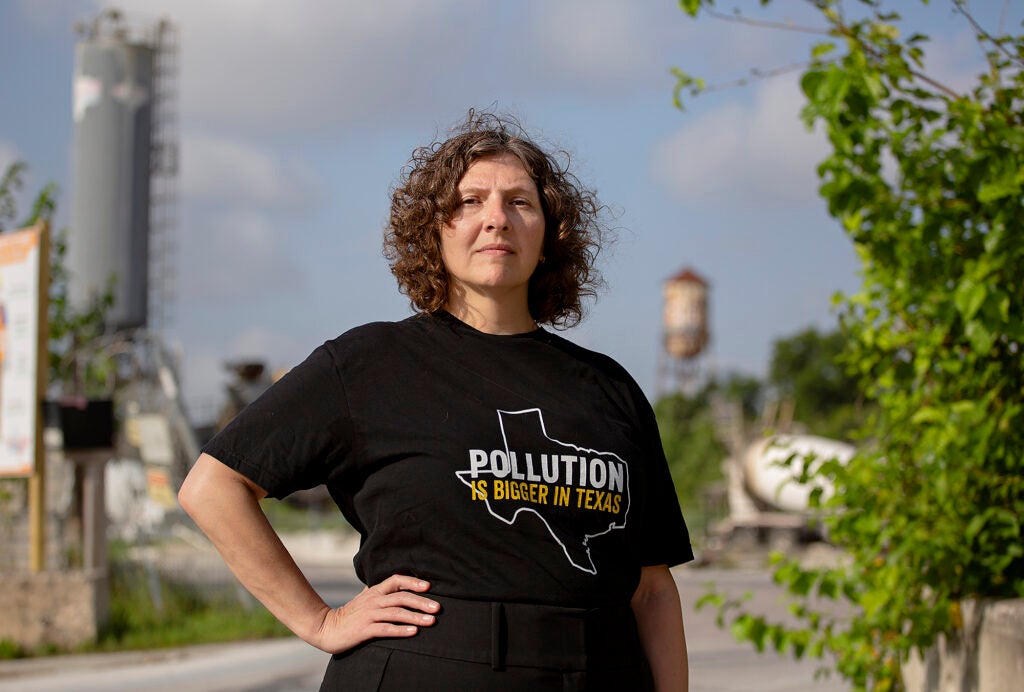
When Hilton Kelley of Port Arthur, Texas moved back to his hometown more than a decade ago, he didn't realize that he'd spend the ensuing years battling for clean air. And on a muggy Tuesday afternoon, he drove 90 miles west toward Houston to attend yet another EPA hearing to comment on air pollution rules.

Kelley, 49, lives in an area where there are 20 facilities, small and large, continuously pumping chemicals into the air.

"We have become the dumping ground for America's toxic waste," said Kelley. The Port Arthur community is comprised of residents that often times need two or three jobs to make ends meet, he said. "It's an area of least resistance."

2 Comments   /   Read more >>
View Raviya Ismail's blog posts
24 June 2010, 9:19 AM
Industry complains of economic woes, Houstonians fear polluted air

Concerned Houston citizen Rosalie Guerrero recently visited a young mother who lives near a facility pumping chemicals in the air. The mother had given birth to a baby with half a brain. The baby suffered for 6 months before dying.

“I’d like to see how much that life costs,” said Rosalie, testifying at a U.S. EPA hearing in Houston on the detrimental effects of living near facilities that emit lead, mercury and cadmium in the air. “There is a cost associated with that.”

Advocates for clean air testified alongside industry representatives at hearings in Houston and Los Angeles Tuesday regarding recent EPA proposals to cut emissions of hazardous air pollutants like mercury and other toxic metals at nearly 100,000 facilities nationwide.

View Sam Edmondson's blog posts
23 June 2010, 3:02 PM
Clean air advocates tell EPA at public hearings to cut toxic emissions

Clean air advocates, many sporting "Don't Trash Our Lungs" t-shirts, spoke out yesterday at public hearings in Los Angeles and Houston for much-needed reductions in toxic air pollution. Held by the U.S. Environmental Protection Agency, the hearings focused on recent EPA proposals to cut emissions of hazardous air pollutants like mercury and other toxic metals at nearly 100,000 facilities nationwide.

While aspects of the EPA's proposals will result in significant benefits to public health if finalized, the agency also made an irresponsible and dangerous offering to industry in the form of a loophole that would allow many facilities to burn industrial wastes without any meaningful oversight or pollution controls.

I attended the L.A. hearing to ask that EPA issue final standards that are maximally strong and protective of public health and ditch the loophole that endangers communities across the country. Hundreds of Earthjustice supporters in the L.A. area, which is notorious for its poor air quality, also submitted comments asking for the same, and I was able to read excerpts from many of these during my testimony.

1 Comment   /   Read more >>
View Jared Saylor's blog posts
21 June 2010, 9:06 AM
Agency offers two options for coal ash: one good, one very, very bad

The U.S. Environmental Protection Agency started the 90-day clock for public comments on its plans to set federal safeguards for millions of tons of dangerous coal ash wastee currently being stored in dry dumps and waste ponds. This means we've got three months to set the EPA on a straight course towards the first ever strong, federally enforceable safeguards for coal ash. And judging from the current proposal, it seems like the EPA can use our help.

The EPA has set two separate options for regulating coal ash. The first option classifies the nasty byproduct of coal-fired power plants as a "special waste," with strong, federally enforceable requirements for water monitoring and cleanup of the hundreds of dry dumps and wet waste ponds across the country. The second option, which is the favored approach by the polluters and companies responsible for the coal ash, offerws only guidelines that leave many communitites at risk of exposure to the toxic pollutants found in coal ash.

1 Comment   /   Read more >>
View Terry Winckler's blog posts
18 June 2010, 11:26 AM
Report says river flow can be turned up to keep oil at bay
Works that divert 30 percent of Mississippi River

Now that human technology has failed to keep oil out of Gulf coast wetlands, some scientists think the solution lies with one of nature's most ancient techniques—flooding of the Mississippi River.

The scientists have concluded that powerful river flows kept oil from the BP/Gulf spill from invading large areas of wetlands. But as winter runoff diminished, so too did the river flow, and now oil is making a destructive invasion. The strong flow could be restored, however, by simply adjusting dams upstream that are diverting water out of the river bed.

It almost seems too simple, but as a report in Popular Mechanics points out, the Army Corps of Engineers is considering the idea and no one seems to oppose it. PM magazine says the idea was first presented last week to the EPA by Paul Kemp, a former professor of marine science at Louisiana State University and current vice president of the National Audubon Society's Louisiana Coastal Initiative.

Here is how the magazine writes about the idea:

2 Comments   /   Read more >>
View Jessica Knoblauch's blog posts
11 June 2010, 4:32 PM
Hazardous waste exemption, oil dispersants, BP goes Orwellian

Some top stories from the past week at Earthjustice…

This week, Earthjustice scored a big victory for our lungs with the announcement that the EPA is finally abandoning a dangerous rule—granted by the Bush administration—that would permit the unregulated burning of hazardous waste.

BP's latest effort to clean up its soiled image took it into even murkier waters after the oil giant recently began buying search terms like "oil spill" on Google and Yahoo search engines so that the company's official web site would be the first link to appear on a search page.

Amidst a vote on Sen. Murkowski's (R-AK) resolution to bail out big polluters, Earthjustice President Trip Van Noppen called on the Senate to put aside partisan politics and protect the American people by voting against this bill. Thankfully, the Senate has voted 53-47 against the bill.

Campaign manager Brian Smith reported on Interior Secretary Ken Salazar's recent announcement of a memorandum of understanding to establish the Atlantic Offshore Wind Energy Consortium, which has the goal of tapping into the estimated 1 million megawatts of potential wind power that exists off the east coast.

Earthjustice was curious to know just what's in all of those chemical dispersants that we're dropping into the Gulf of Mexico by the millions of gallons, so we filed a Freedom of Information Act request to get more information. Here's what we found (hint: it's not good).

View Trip Van Noppen's blog posts
09 June 2010, 1:29 PM
Vote down Sen. Murkowski's resolution to bail out big polluters
Sen. Lisa Murkowski (R-AK)

Yesterday the White House took a firm stand against an effort to undermine the 40-year-old Clean Air Act, reverse a Supreme Court decision, and block the federal fuel efficiency standards that were finalized this past spring, which will reduce the nation's consumption of oil by at least 455 million barrels.
 
The effort at hand is a seldom-used congressional "Resolution of Disapproval" by Sen. Lisa Murkowski (R-AK), on the Senate floor for a vote tomorrow, June 10. The resolution, which was influenced by oil- and polluter-industry lobbyists, is at the center of a fury of political positioning and partisan politicking. Its purpose is to block the EPA's ability to regulate greenhouse gases, authorized by the Clean Air Act and reaffirmed by the 2007 Massachusetts v. EPA Supreme Court decision.
 
In an official statement yesterday, the White House threatened to veto the resolution if it is passed by the Senate tomorrow. Meanwhile, Sen. Murkowski and her Republican allies held a press conference to solicit public attention and support for this vote. The rest of the Senate and, more importantly, the public, should see through their smoke-and-mirrors routine. After all, the connection between reducing our national dependence on oil and controlling fossil fuel pollution are two sides of the same coin.

6 Comments   /   Read more >>