Posts tagged: fracking

unEARTHED. The Earthjustice Blog

fracking


    SIGN-UP for our latest news and action alerts:
   Please leave this field empty

Facebook Fans

Featured Campaigns

Everyone has The Right To Breathe clean air. Watch a video featuring Earthjustice Attorney Jim Pew and two Pennsylvanians—Marti Blake and Martin Garrigan—who know firsthand what it means to live in the shadow of a coal plant's smokestack, breathing in daily lungfuls of toxic air for more than two decades.

Coal Ash Contaminates Our Lives. Coal ash is the hazardous waste that remains after coal is burned. Dumped into unlined ponds or mines, the toxins readily leach into drinking water supplies. Watch the video above and take action to support federally enforceable safeguards for coal ash disposal.

ABOUT EARTHJUSTICE'S BLOG

unEARTHED is a forum for the voices and stories of the people behind Earthjustice's work. The views and opinions expressed in this blog do not necessarily represent the opinion or position of Earthjustice or its board, clients, or funders.

Learn more about Earthjustice.

View Tom Turner's blog posts
16 April 2013, 6:05 PM
Under pressure from Earthjustice and others, senators seek to rein practice in
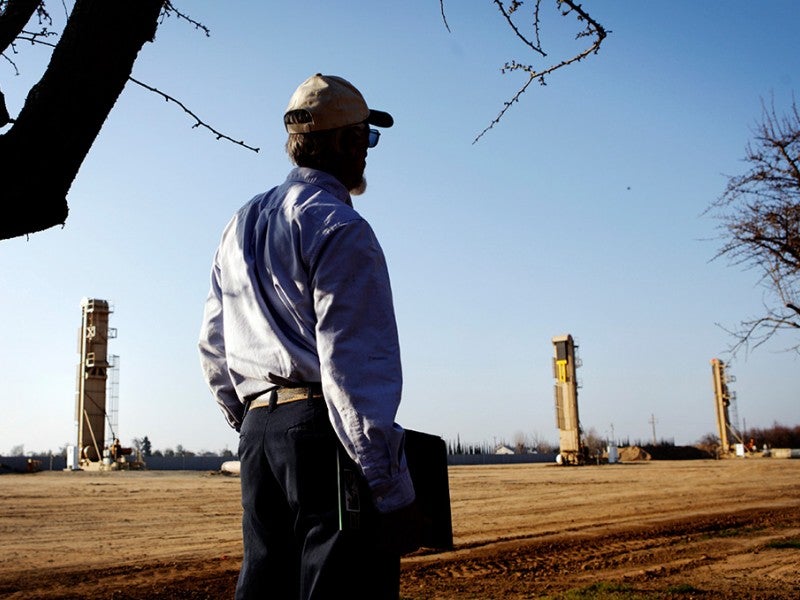
An almond farmer watches oil wells that have sprouted near almond orchards in the Central Valley town of Shafter, CA. (Chris Jordan-Bloch / Earthjustice)
See photo essay »

As reported in the current issue of Earthjustice Quarterly Magazine, oil fracking has become big news in California, where the practice is conducted in the shadows and is essentially unregulated—the Wild Wild West, if you will. (See: Extreme Energy: Out of Control Out West)

That may be about to change.

At least 10 bills have been introduced in the state legislature since the Magazine came out; three would impose moratoriums to halt fracking until regulations can be put in effect. Others would require disclosure of the chemicals being used, mandate groundwater monitoring before and after fracking operations, and classify wastewater from the fracking process as hazardous waste. A state-court lawsuit by Earthjustice is working its way through the system, and a federal court just ruled that failure by the Bureau of Land Management to study the environmental impact of fracking is illegal—but the judge declined to rescind the permits, so the practice continues.

15 Comments   /   Read more >>
View Trip Van Noppen's blog posts
03 April 2013, 2:46 PM
It's time to head in a clean energy direction
Fracking has been linked to both air and water contamination. (Courtesy of J.B. Pribanic)

Just as clean, renewable energy is lifting off and the impacts of climate disruption become ever more visible, fossil energy production is becoming dramatically more extreme. But extreme fossil energy production is exactly what we don’t need.

In just the last two years, I have seen the Louisiana coast’s oil-slicked marshes after the Deepwater Horizon blow-out, met with Pennsylvanians and Coloradans whose homes are under assault in the fracking boom, toured the Alaskan Arctic with a caribou hunter whose way of life is threatened by onshore and offshore oil development, and shared the outrage of West Virginians whose schools and streams are under siege from mountaintop removal coal mining.

Though these extreme energy projects differ in their methods of extraction, they have two things in common: their massive industrial scale, and how little we know about their potential impacts to our air, water and climate.

View Jessica Knoblauch's blog posts
25 March 2013, 12:09 PM
Plus: Buzzing over bee deaths and clean energy power up
Photo courtesy of @cdharrison (Flickr)

Bloggers think chemicals in macaroni are cheesy
Two food bloggers are campaigning against the use of chemical additives in the popular Kraft macaroni and cheese packaged meals due to concerns that the chemicals could pose health risks, reports the UK Guardian. Though found in foods sold in the U.S., the two additives, Yellow#5 and Yellow#6, are banned elsewhere in places like the UK, Norway and Austria amid claims that they can cause cancer or hyperactivity in children. The bloggers claim that since Kraft was able to replace the additives with alternatives in other countries (without a noticeable difference in taste), it should do the same in the U.S. So far, the bloggers’ petition, which highlights the larger issue of how ingredients banned elsewhere in the world can be found in items sold in U.S. stores, has gathered more than 200,000 signatures.

Environmental groups abuzz over insecticides linked to bee deaths
Several bee keepers and environmental groups have sued the U.S. EPA for failing to protect honey bees from toxic insecticides, reports Reuters. Bee colony populations have been taking a nosedive for some time now, and the collapse has many people worried about the nation’s food supply since bees pollinate everything from almonds and cranberries to avocados and pears. Studies have linked the collapse to the use of a class of super-toxic insecticides known as neonicotinoids, which plants absorb through their tissue, making them potentially toxic to insects. Though Europe has banned neonicotinoids, the toxic insecticides are used on more than 100 million acres of corn, soy and other food crops and even some home gardening products in the U.S. Currently, Earthjustice is working to stop or limit the use of the nation's most toxic pesticides, which often contaminate nearby waterways and negatively impact people's health.

View Chrissy Pepino's blog posts
18 March 2013, 1:05 PM
If gas is "natural," why is it exempt from the Clean Air and Clean Water Acts?
A scarred landscape from fracking pads. (EcoFlight)

The technological advance of horizontal drilling was a game changer for the oil and gas industry. When oil and natural gas were previously being harvested, vertical drilling was the only way to extract the fossil fuel. With horizontal drilling, wells can now be fracked and re-fracked, at different depths and in all directions. By increasing the area of exploration for natural gas, many previously untouched landscapes are now being scarred due to the fracking boom.

Fracking, shorthand for hydrologic fracturing, uses tons of water, sand and chemicals- under high pressure—to create cracks in the bedrock, allowing methane gas to escape. Some claim this process is “cleaner” than dirty coal, but, on a global warming potential basis, new research shows that natural gas, oil and coal, are all equally dirty on emissions.

1 Comment   /   Read more >>
View Jillian Hertzberg's blog posts
15 March 2013, 9:56 AM
House of Representatives legislation would protect air and water

Over the past few decades—with the help of Congress—Big Oil and Gas successfully chipped away at our bedrock environmental laws, carving out special exemptions for the fossil fuel drilling industry. In 1987, when Congress decided to implement new standards to control stormwater runoff pollution under the Clean Water Act, oil and gas companies got a pass. And in 1990 when the Clean Air Act was expanded to allow for control of more toxic air pollutants, the same industry got another pass. These exemptions from our fundamental air and water protections have left communities across the country exposed to dangerous health risks and threats to their environment from oil and gas operations right in their backyards.

Fortunately, activists engaged in the fight against fracking saw an important step forward, yesterday, with the introduction of two pieces of legislation in the House of Representatives. Rep. Jared Polis (D-CO) introduced H.R. 1154, the BREATHE Act, and Rep. Matthew Cartwright (D-PA) introduced H.R. 1175, the FRESHER Act. These bills call for common sense safeguards to protect water and air resources from pollution generated by the process of hydraulic fracturing, known as fracking.

4 Comments   /   Read more >>
View Raviya Ismail's blog posts
27 February 2013, 2:57 PM
Concern grows over methane leaks from oil and gas wells

With the fracking boom building, natural gas is touted as a clean energy source. But the hard truth is that the gas drilling sector—which includes the controversial practice of hydraulic fracturing or fracking—has worsened air quality in many areas. In some parts of the country undergoing such a boom, air quality has fallen below levels the EPA determined to be safe.

3 Comments   /   Read more >>
View Elijio Arreguin's blog posts
12 February 2013, 2:41 PM
Court agrees that Utah leases were granted improperly
Green River Butte.

Thanks to a recent federal court decision, visitors to Utah’s public wild lands can continue to raft the Green River in Dinosaur National Monument without seeing oil derricks around the river’s bends.

They can continue to enjoy the outlook from Canyonlands National Park’s Grand View Point without drill rigs littering the landscape.

And they won’t be forced to see the formations at Arches National Park as gateways to increased carbon emissions and environmental disruption.

1 Comment   /   Read more >>
View Jessica Knoblauch's blog posts
24 January 2013, 1:02 PM
Plus: Lead-poisoned parrots and climate change fairy dust
The City of Bath. (Photo courtesy of Daz Smith, Flickr)

Fracking may ruin spa time in UK’s historic City of Bath
People have taken part in the restorative waters in the city of Bath for thousands of years, but this centuries-old tradition may no longer be available if fracking companies are allowed to drill near the Mendip Hills, where the Bath water originates, reports the UK Express. Members of the Bath community are concerned that, if allowed, hydraulic fracturing or fracking, which involves drilling deep into the ground using a mixture of water, sand and chemicals to force gas to the surface, may contaminate the area’s pristine waters, or at the very least ruin the pristine image of the city. Up until now, the controversial drilling practice was banned by the government after it was linked to two earthquakes in Lancashire, a popular seaside resort in Britain. But recently government officials were enticed to lift the ban, most likely because fracking offers a new revenue stream that might boost the weak economy. Unfortunately for the fracking industry, the British are just as freaked out by fracking as many Americans, perhaps even more so because the UK lacks the wide-open spaces where U.S.-based fracking operations often take place. Of course, now that fracking is beginning to show its ugly head in iconic, popular tourist attractions like Cooperstown, NY, Americans and Britons now have one more thing in common besides the English language and our love of pubs.

1 Comment   /   Read more >>
View Kathleen Sutcliffe's blog posts
18 January 2013, 11:21 AM
Earthjustice attorneys in court to expose industry secrets
Tap water is lit on fire, as seen in the fracking documentary Gasland.

New uncovered documents show that fracking company Range Resources persuaded the Environmental Protection Agency to drop its investigation into water contamination of a Texas home—in spite of the fact that preliminary testing showed that the company could have been responsible for cancer causing benzene and flammable methane in the family’s drinking water.

Take the time to read this very well-reported exclusive from Associated Press. It’s nothing short of infuriating to hear how industry and regulators colluded and hid the truth from this family—and the American public. From the AP article:

For Steve Lipsky, the EPA decision seemed to ignore the dangers in his well, which he says contains so much methane that the gas in water pouring out of a garden hose can be ignited.

"I just can't believe that an agency that knows the truth about something like that, or has evidence like this, wouldn't use it," said Lipsky, who fears he will have to abandon his dream home in an upscale neighborhood of Weatherford.

8 Comments   /   Read more >>
View Maria Beloborodova's blog posts
27 December 2012, 10:00 AM
Readers were most inspired by stories of the wild
Two of the first five calves born at Ft. Peck Indian reservation this year. (Bill Campbell)

Blog posts about Earth's magnificent places and creatures were the most popular themes for unEarthed readers in 2012. By far the most-read post concerned Arctic drilling, followed by reports of bison being restored and wolves losing protection. Not shown in our top 10 blog posts, below, are the delightful tales of curious critters painted in words by our own Shirley Hao. Posts written years ago by Shirley are still being discovered and read by thousands of people every year.

And, now, for your enjoyment, we present our most-read posts of 2012: