Saving the Endless Mountains

For generations, visitors have flocked to the Endless Mountains in Northeast Pennsylvania to enjoy the region's river gateways, rolling hills, family farms and quaint rural villages—helping to feed the state's $26-billion-a-year tourism industry. But the Central New York Oil and Gas Company wants to install an industrial gas pipeline that would replace wooded mountains and pastoral landscapes with 39 miles of pipeline, additional miles of lateral gathering lines, access roads, massive compressor units and other industrial machinery.


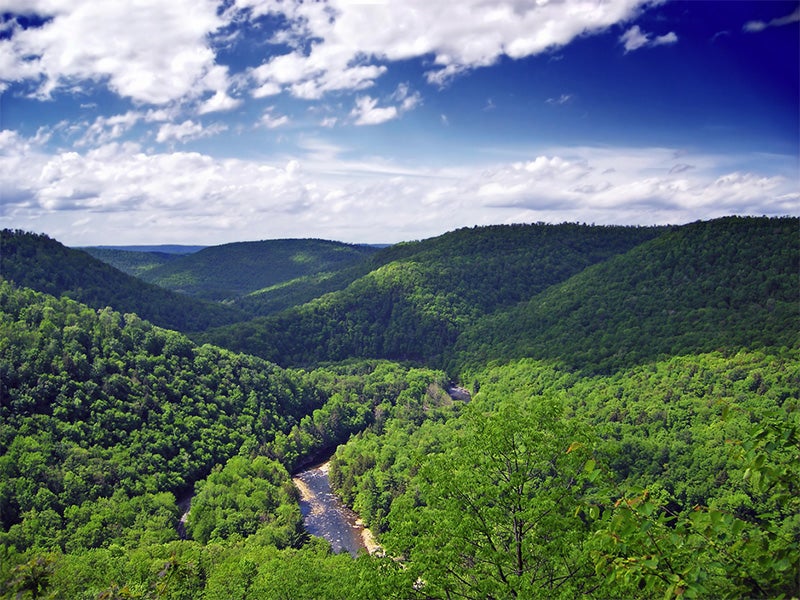
World's End State Park, part of the Endless Mountains, and the adjacent state forest where gas drilling has been proposed.

The park is listed on the National Register of Historic Places.

© Michael Forster Rothbart / mfrphoto.com

The 39-mile gas pipeline project would slice through the Endless Mountains region of Pennsylvania and tear up almost 600 acres of land.

The pipeline would bring with it threats to public health and the environment that have yet to be thoroughly analyzed.

© Michael Forster Rothbart / mfrphoto.com

Business owners, year-round and seasonal residents kicked off the 2011 summer tourist season in Pennsylvania's Endless Mountains with a picnic—and a plea to local, state, and federal officials to preserve the region's way of life in the face of a proposed gas pipeline project in the Marcellus Shale.

The event took place on May 26, 2011 in Laporte, PA.

© Michael Forster Rothbart / mfrphoto.com

Business owners and year-round and seasonal residents fear that if the pipeline project goes through as planned, it could mean the end of summer as they've known it in the Endless Mountains.

© Michael Forster Rothbart / mfrphoto.com

Barb Jarmoska of Responsible Drilling Alliance speaks with the audience.

The Sullivan County courthouse is reflected in her sunglasses.

© Michael Forster Rothbart / mfrphoto.com

The pipeline proposal comes as other parts of the state struggle with an explosive rate of gas drilling and an outbreak of industrial accidents and pollution related to rushed and irresponsible development.

© Michael Forster Rothbart / mfrphoto.com

Resident Dave Wasilewski. Unlike New York, Pennsylvania has allowed Marcellus shale gas development and infrastructure construction to proceed without any comprehensive environmental analysis.

© Michael Forster Rothbart / mfrphoto.com

'As summer 2011 begins let's not forget what summer is about. The Endless Mountains are precious and irreplaceable,' said John Trallo, organizer and a Sullivan County resident.

'Nobody wants to take a vacation in an energy park.'

© Michael Forster Rothbart / mfrphoto.com

Earl Fraim and his wife, residents of Estella, PA.

Earl said, 'I worked for the oil industry in Delaware. We live in the woods. We retired here ten years ago because it was peaceful. Now they're fracking 1,500 feet from my house, on the gun club property. I wake up and night and it feels like I am back at work.'

© Michael Forster Rothbart / mfrphoto.com

The Central New York Oil and Gas Company wants to install an industrial gas pipeline that would replace wooded mountains and pastoral landscapes with 39 miles of pipeline, access roads, massive compressor units and other industrial machinery.

© Michael Forster Rothbart / mfrphoto.com

Dr. Arno Vosk, Emergency Room Doctor, Williamsport Hospital and Medical Center: 'The residents of the Gulf coast thought the fish and tourism industry was safe and so did the people of Fukushima. The potential for a major disaster is real and we can't possibly be prepared.'

© Michael Forster Rothbart / mfrphoto.com

'I came here in 1969 and keep coming back,' said Michael Stasiunas, Owner, Forksville General Store. 'As they say, once you dip your foot in Loyalsock Creek, you always come back.'

© Michael Forster Rothbart / mfrphoto.com

Groups believe that an Environmental Impact Statement is necessary and should take into account the effect not only of the pipeline itself, but the additional gas drilling the pipeline will spur.

© Michael Forster Rothbart / mfrphoto.com

Andrea Young and Drake Saxton, owners of the Creekview Country Cottage Bed & Breakfast.

'My guests come here because they enjoy the beautiful serenity, the starlight, the sun and moon dancing off the creek,' said Andrea.

'The pipeline would disrupt all the peace my guests have come to expect.'

© Michael Forster Rothbart / mfrphoto.com

For generations, visitors have flocked to the Endless Mountains in Northeast Pennsylvania to enjoy the region's river gateways, rolling hills, family farms, river towns, historic districts and quaint rural villages—helping to feed the state's $26-billion-a-year tourism industry.

© Michael Forster Rothbart / mfrphoto.com

Earthjustice and its clients are calling on federal regulators to thoroughly review the cumulative environmental impacts of the project before any decision to construct the pipeline is made.

© Michael Forster Rothbart / mfrphoto.com

A turtle crosses World's End Road.

World's End State Park is home to a variety of wildlife, including deer, black bears, wild turkeys, and over 200 species of birds.

© Michael Forster Rothbart / mfrphoto.com

Children play in Loyalsock Creek in near Forksville, PA.

More than 60 miles long, the creek is popular with hikers, trout fishermen, and white water kayakers.

The Central New York Oil and Gas company is proposed to blast through bedrock streambeds for pipeline construction.

© Michael Forster Rothbart / mfrphoto.com

The Endless Mountains form a dissected region of the Allegheny Plateau, a landscape covering most of northern Pennsylvania.

© Michael Forster Rothbart / mfrphoto.com

The 39-mile pipeline would be built and operated by the Central New York Oil and Gas Company.

It would run through Bradford, Sullivan and Lycoming Counties in Pennsylvania, crossing high quality streams in the Endless Mountains and disturbing some 610 acres and leaving 238 acres permanently altered.

Earthjustice is representing the Sierra Club, Damascus Citizens for Sustainability and the Lycoming County-based Coalition for Responsible Growth and Resource Conservation.

© Michael Forster Rothbart / mfrphoto.com


More Photo Slideshows:

Phosphorus and nitrogen poison Florida's waters, running off agricultural operations and fertilized landscapes. These images document harmful algae outbreaks triggered by the runoff.
Of all the places Earthjustice works to protect, few are as iconic and misunderstood as the Arctic. View a slideshow of Florian Schulz's Arctic photography, showcasing the beauty of the Arctic and the threats the region faces from industrialization and climate change.
National forest lands are the largest source of drinking water in the U.S., providing fresh water to some 66 million people. In addition to giving many of us the water we drink, our forests also are cherished grounds of our nation's outdoor legacy.
The TransAlta coal-fired power plant is Washington State's largest single source of air pollution. It produces industrial carbon pollution, fills rivers with mercury, and obscures national parks with haze.