

Community Advocates join Members of Congress in Broad Opposition to Planned Attack on National Forestlands
A diverse array of stakeholders representing Tribes, hunters, conservationists, firefighters, and business owners rebuke the Trump administration’s plan to roll back the Roadless Rule
Contacts
Becca Bowe, Earthjustice, rbowe@earthjustice.org
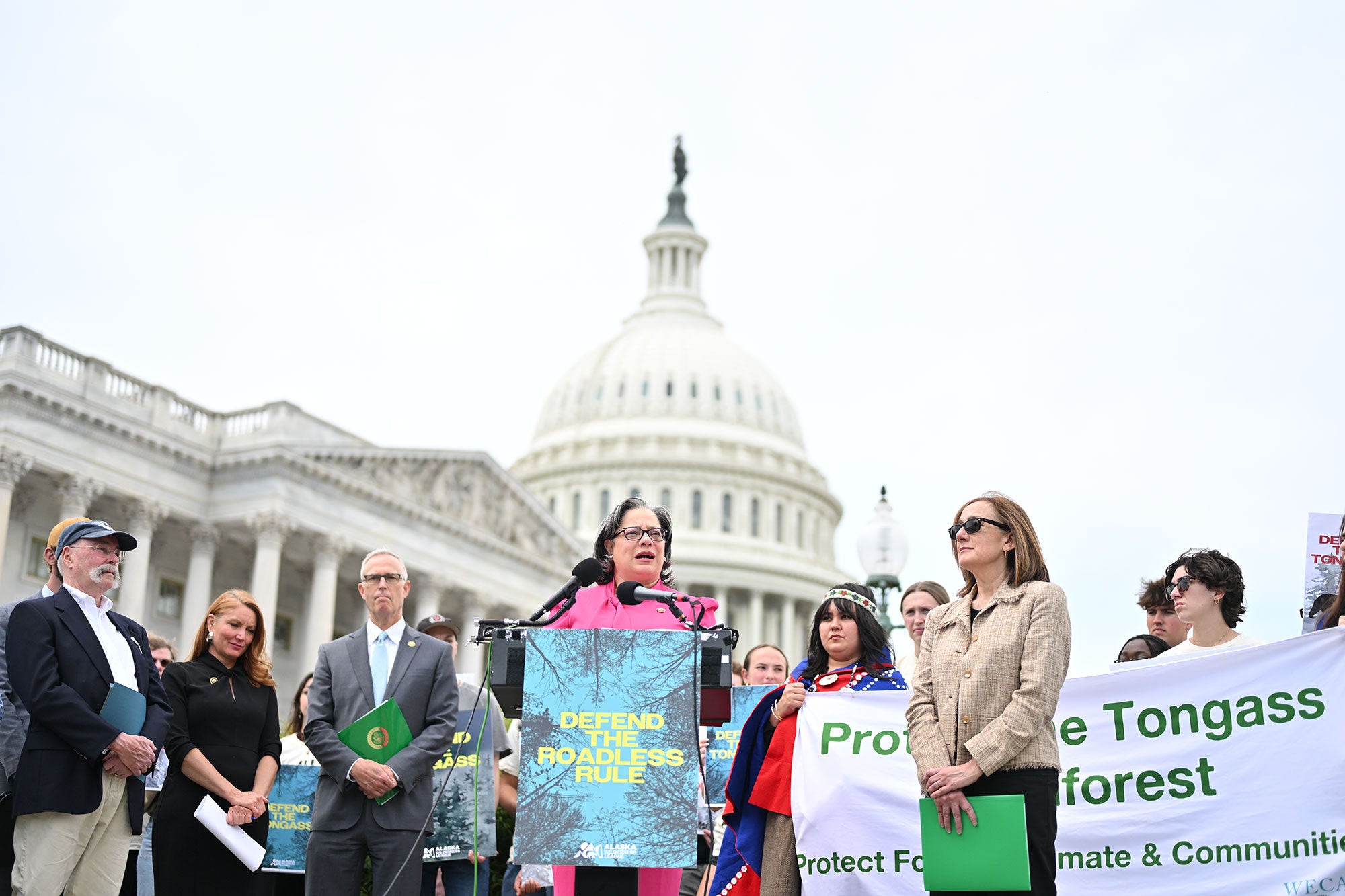
Today, multiple Members of Congress joined a broad array of advocates from across the country in opposition to the Trump administration’s plan to rescind the Roadless Area Conservation Rule.
Enacted in 2001, the Roadless Rule has long held broad public support in protecting 58 million acres of national forestlands from logging and roadbuilding. Yet in June 2025, U.S. Department of Agriculture Secretary Brooke Rollins announced that the Forest Service would undo this rule, sparking a major public backlash from hundreds of thousands of Americans, including Tribal representatives, hunters, conservationists, firefighters, and business owners.
U.S. Senator Martin Heinrich (D-NM), Reps. Andrea Salinas (D-OR), Jared Huffman (D-CA), Gabe Vasquez (D-NM), Melanie Stansbury (D-NM) and Jennifer McClellan (D-VA) joined the diverse group of stakeholders for a press conference outside the Capitol, calling attention to the widespread harm rolling back the rule would have on public lands, wildlife, frontline communities, and regional economies.
Members of Congress and stakeholders offered the following comments:
“Any day now, the Administration is expected to advance its reckless rollback of the Roadless Rule, and Americans from both sides of the aisle see this move for what it is — a push to put corporate interests above hunters, anglers, wildlife, Tribes, and users of our nation’s wildest public lands,” said Rep. Vasquez. “A unilateral rollback of the Roadless Rule threatens the very landscapes, forests, and public lands that make us the envy of the world. I will continue to fight to protect places like the Gila and Tongass national forests for future generations.”
“In the face of a world that seems to get louder and busier every day, our public lands offer us the chance to get away from the noise, reflect on ourselves and appreciate the natural world. For 25 years, the Roadless Rule made this possible,” said Congresswoman McClellan. “At this critical moment, we must fight for conservation. Not just for the millions of Americans who support preserving our public lands now, but for the future generations who deserve access to the landscapes, wildlife and opportunities that the Roadless Rule protects.”
“During the 21-day comment period last fall, more than 625,000 people submitted comments, nearly all opposing the repeal. But despite the resounding voice of the American people, the Trump administration is threatening to throw the Roadless Rule into the dustbin of history. This is just another move in the assault on our collective inheritance,” said Sen. Heinrich. “It’s not lost on me that without the Roadless Rule, many of the treasured landscapes, public lands, and habitats that we know and love simply wouldn’t exist today. So, this is our call to the American people: defend your lands. When the draft rule is released this month, make sure you raise your voice again. Our wild places, and our American identities, are depending on it.”
“Our national treasures belong to the American people, not to the highest bidder. The Roadless Rule protects 60 million acres of national forest land, including 2 million acres in Oregon,” said Rep. Salinas. Repealing the rule threatens the people who live near and rely on wilderness areas. It would increase the risk of deadly wildfires that could destroy people’s homes and livelihoods, and it could take away important sources of water for communities who are already struggling with shortages and drought conditions. I will continue to use every available tool I have to push back on these brazen attacks on our healthy environment and the communities that rely on it.”
“Rolling back these protections is not only a threat to our national forests – it is a threat to communities themselves,” said Rep. Stansbury. “These lands are at the root of what these communities are, who we are, and what we stand for.”
“The American people are with us – they are against all of these reckless environmental policies,” said Rep. Huffman. “Time and again communities around this country have opposed the selloff of our public lands. We know that the American people stand together to protect our public lands, and when they do that, we win.”
“The process to repeal the Roadless Rule is mired in corporate interests that do not represent the general public,” said Rebekah Sawers, Native Rights Activist and Tongass Representative with the Women’s Earth and Climate Action Network. “It seeks only to exploit the land and leave the people with the wreckage. An attack on the Roadless Rule would be a continuation of colonial violence and threat to our Indigenous Sovereignty.”
“Montana’s outdoor recreation industry is one of our state’s most important and robust economic sectors,” noted Marne Hayes, the director of Business for Montana’s Outdoors, a 380-member business coalition that engages businesses across Montana in advocacy for accessible, healthy public lands, and who has lived in Montana for over three decades. “Repealing the Roadless Rule would, without a doubt, have an irreparable, detrimental effect on this $3.4 billion economy, the tens of thousands of jobs, and the communities across the state built on the foundation of healthy, intact landscapes to support their business.”
Will Fischer is a Marine Corps veteran and the Public Lands and Conservation Director for Vet Voice Foundation. Fisher stressed that roadless areas safeguard clean drinking water for millions of families, buffer communities from wildfires, and protect some of our most awe-inspiring and vital ecosystems and landscapes. “Rolling back the Roadless Rule isn’t about safety — it’s about clearing the way for huge corporations to pillage our public lands, putting our fellow Americans, our public lands, and our security at risk,” Fisher said. “Veterans understand what’s at stake, and we’re proud to be fighting back against attempts to rollback the Roadless Rule.”
“Roadless areas allow us to express ourselves as full participants in healthy, wild ecosystems,” said Jamie Cameron, an outdoorsman from western North Carolina who pursues a lifestyle of sustainable food through hunting, fishing and foraging. “For backcountry hunters, anglers and foragers, the ability to enter these places and fulfill our ancestral role in nature is the most elemental freedom we will ever experience,” Cameron added. “To lose that would be to lose our identity.”
Carson States, a wildland firefighter from Oregon with experience across federal, state, and private fire organizations, also raised alarms about the dangers of rolling back the rule. “From where I stand, this is a firefighter safety issue,” States said. “Expanding roads into intact landscapes increases the number of human-caused ignitions, and with that comes more exposure, and more risk carried by the people doing the work.”
Christopher Servheen, Ph.D., who served as Grizzly Bear Recovery Coordinator at the U.S. Fish and Wildlife Service, warned that “increasing habitat loss and direct mortality due to roads will result in grizzly population declines and range reductions across the Northen Rockies wherever new roads are built. Rescinding or weakening the Roadless Rule will make this worse.”
Resources
Background
Since the Trump administration’s announcement to rescind the Roadless Rule last year, more than 600,000 comments have flooded the U.S. Fish & Wildlife Service to oppose the rollback and a wide variety of people and organizations have been speaking out in defense of forests. People’s hearings have also been organized nationwide in reaction to the Forest Service’s refusal to hold even a single public hearing over its plan. The agency is expected to imminently release a proposed rule and draft environmental impact statement advancing its intent to rescind this rule.
Additional Resources
About Earthjustice
Earthjustice is the premier nonprofit environmental law organization. We wield the power of law and the strength of partnership to protect people's health, to preserve magnificent places and wildlife, to advance clean energy, and to combat climate change. We are here because the earth needs a good lawyer.