Examining the Impacts of U.S. Gas Exports Through Mexico’s Gulf of California
A bad deal for marine mammals, and a worse deal for the Earth’s climate.
The U.S. is the largest exporter of methane gas in the world — the main ingredient in liquified natural gas (LNG) exports. Now the fossil fuel industry wants to export even more LNG, which is bad news for local communities and the planet. LNG export terminals can create health risks for neighboring communities and increase energy prices for people living in the United States. LNG also has a climate footprint that is 33% more harmful than coal, when processing and shipping are considered, according to a recent Cornell University study.
Faced with growing resistance from communities in the United States, fossil fuel companies have found a backdoor — Mexico’s pristine and highly biodiverse Gulf of California. Three new LNG export projects plan to import gas from the Permian Basin in Western Texas, convert it to LNG on the eastern shore of the Gulf of California, and then ship it on huge tankers to Asia where it will be burned.
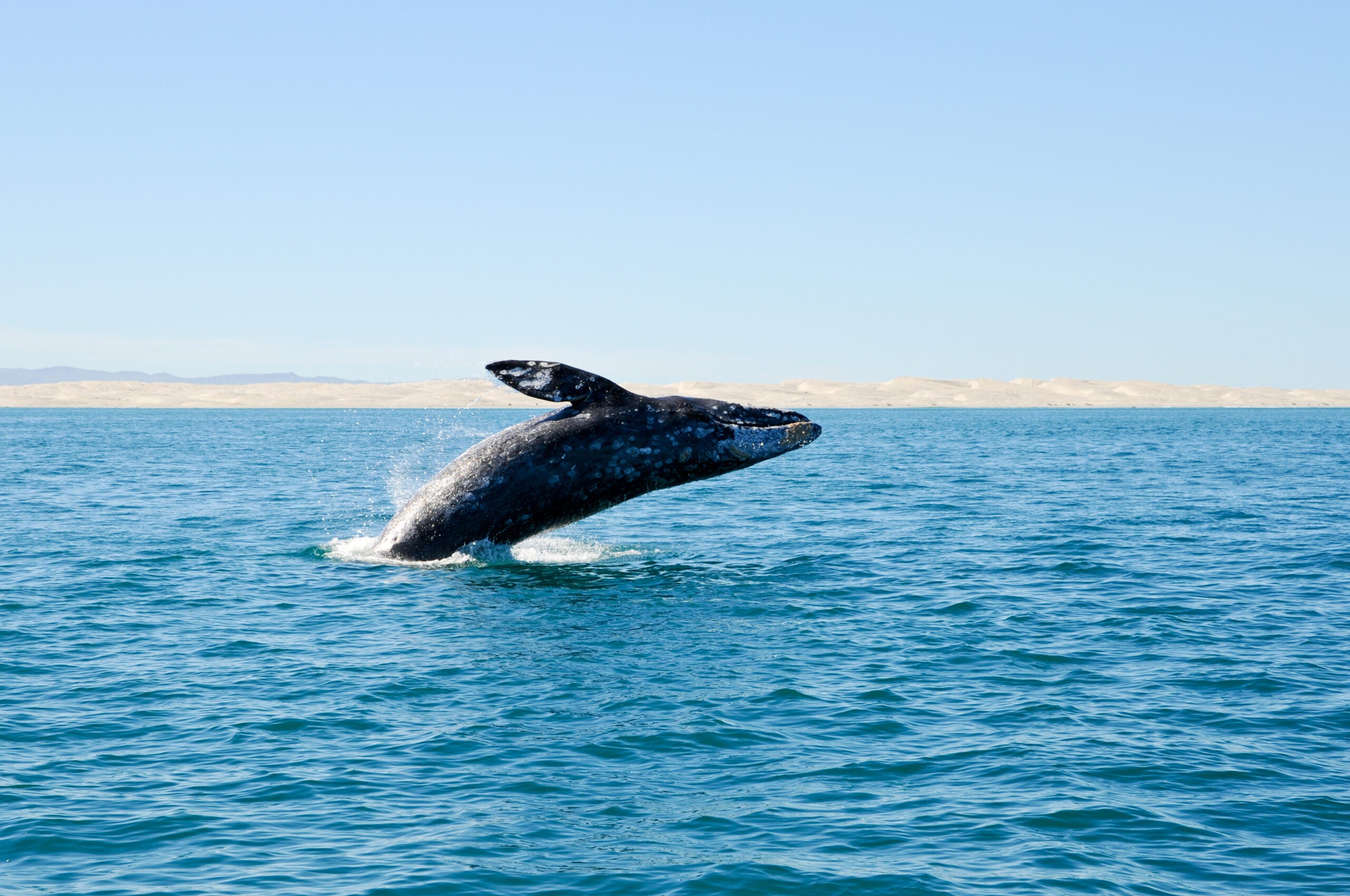
There is probably no worse place in the world for these projects than the Gulf of California. Famously dubbed “the world’s aquarium” by Jacques Cousteau, the gulf is a UNESCO World Heritage Site and a critical habitat for over 30 species of whales and dolphins.
Earthjustice is working with clients and partners in Mexico — Nuestro Futuro, CEMDA: The Mexican Center for Environmental Law, and DAN: Northwest Environmental Defense — to enforce environmental and international law to protect the environment and communities in the gulf.
We collaborated with experts who prepared two reports that examine Saguaro Energía, the LNG export terminal project planned for Puerto Libertad, Sonora. This is the largest of the three export projects planned for development in the gulf, and it is managed by Saguaro Energía, a subsidiary of the Texas corporation Mexico Pacific Limited (MPL).
Impact of the Saguaro LNG Energy Project on Cetaceans in the Gulf of California (2025)
This report was prepared by researchers at the Autonomous University of Baja California Sur, and it analyzes the impacts that the construction of Saguaro Energía would have on large marine mammals in the Gulf of California. Its findings include:
- Large tankers needed to transport LNG can cause injury and death to whales in the Gulf of California. If the project is built, LNG tanker traffic threatens to become the main cause of collision-related deaths of large whales in the gulf.
- This project would impact 30 different species of whales and dolphins, including endangered and vulnerable migratory species like blue and sperm whales.
- This project would create conditions that would cause the gulf to no longer be a suitable area for the reproduction and feeding of migratory whale and dolphin species that depend on it to survive.
- The impact assessment prepared by MPL and Mexican authorities is “insufficient to guarantee the protection of marine mammals in the Gulf of California.”
The authors recommend that the LNG production plant in Puerto Libertad not be built. This would prevent gas transport tankers from navigating through the gulf and threatening the marine diversity and abundance critical to whales’ breeding, rearing and feeding grounds.
Read the full report in Spanish (original) and English (AI-supported translation).
GHG Emissions Life Cycle Analysis of the Saguaro Energía LNG Export Project (2025)
This report was prepared by the Climate Institute of Mexico, and it examines the potential impact that the Saguaro Energía export facility would have on climate change. The authors perform a lifecycle analysis of the project’s GHG emissions from the gas production in the U.S. to its end-use in Asia. Their findings include:
- In total, the project will add up to 73 metric tons of CO2 equivalent per year to the atmosphere, or the same GHG emissions as 17.4 million lightweight vehicles driving for a year.
- The project will set back Mexico’s climate commitments: The GHG emissions generated by the project are equal to 38% of Mexico’s required reductions for the oil and gas sector according to its 2022 NDC.
- This project would displace the installation of up to 37.7 GW of wind capacity or 54.4 GW of solar capacity. This missed opportunity would represent 11% and 7% of the energy capacity required, respectively, to reach the IEA’s net zero emissions scenario.
- Because Mexico will only serve as a means of transportation of LNG, the economic contribution to the country is marginal.
This report concludes that the project, if constructed, would present a barrier to global climate efforts and recommends that the developer conduct a full accounting of the total greenhouse gas emissions from the Saguaro Energía LNG project.
Read the full report in Spanish (original) and English (AI-supported translation).
The International Program partners with organizations and communities around the world to establish, strengthen, and enforce national and international legal protections for the environment and public health.
Earthjustice’s Oceans Program uses the power of the law to safeguard imperiled marine life, reform fisheries management, stop the expansion of offshore oil and gas drilling, and increase the resiliency of ocean ecosystems to climate change.
Julie Hauserman
Public Affairs and Communications Strategist, Earthjustice
jhauserman@earthjustice.org