

Californians Deserve to Choose the Energy Source for their Homes — a New Bill Would Give Them the Freedom and Funds to Do So
The Home Energy Choice Act (AB 2313) is the biggest no-brainer of the state legislative session
Imagine this: the methane gas line connecting your home to the gas pipeline system in your neighborhood is say, 60 years old and your utility alerts you that it’s time to replace it. They want to bring in construction equipment and dig up your yard, putting in a new gas line. Who’s paying for the new line? Every utility customer is. We are all paying hundreds of millions of dollars every year for these replacements across California.
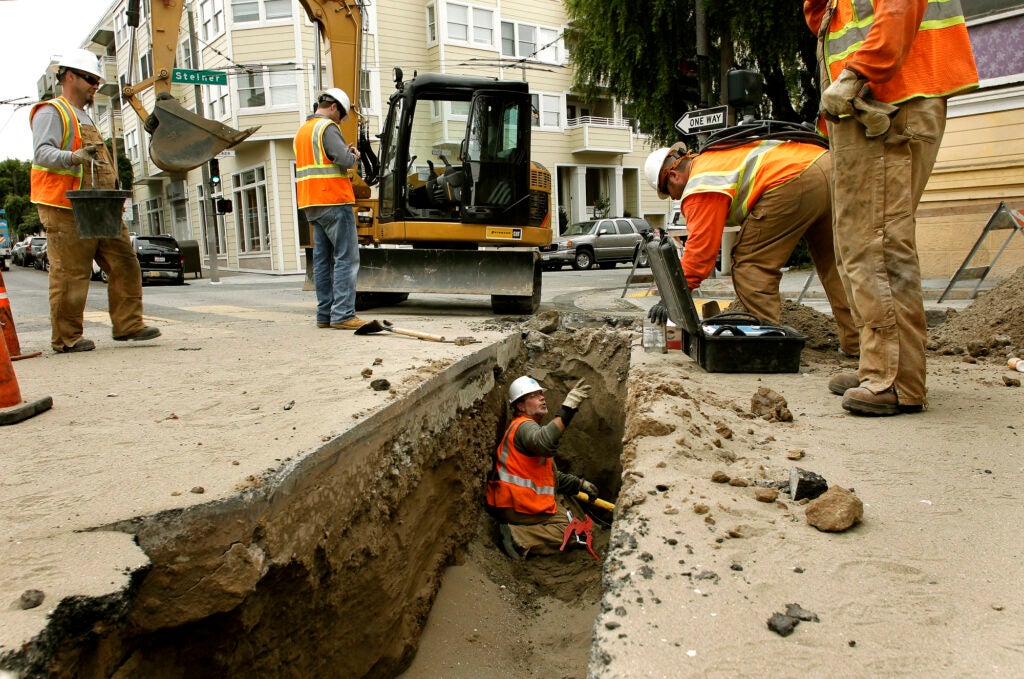
PG&E employees repair a gas line in San Francisco. (Michael Macor / The San Francisco Chronicle via Getty Images)
On top of that, gas utilities earn a profit off new pipelines they collect for over the next 50-plus years. This means that pipes replaced today lock gas customers into repaying these costs through at least 2080, despite California’s growing transition away from polluting gas appliances towards clean electric alternatives.
What if we didn’t have to do that?
The Home Energy Choice Act (AB 2313) offers California a better way. Instead of a letter from your utility notifying you of their plans to dig up your yard, the utility would offer you a choice: replacing your old gas service line OR getting you thousands of dollars for nonpolluting appliances to get your home off gas entirely. That sounds like a far better way to approach replacements on California’s old, polluting gas system.
Saving Costs for All Utility Customers
In PG&E’s territory, this would look like an offering of $15,000 to $17,500 per home for modern electric appliances. It’s not chump change — it’s enough to help Californians kick their gas appliances to the curb entirely and upgrade to nonpolluting appliances like heat pumps and induction stoves. The incentive could also be layered with other programs to help ensure all Californians are able to upgrade their home.
PG&E alone completes 15,000 service line replacements every year, leading to hundreds of millions of dollars passed on directly to customers’ gas bills. Over the last decade, utilities in the state have increased spending on the gas system by 72% even as gas use has gone down. The main driver of these cost increases? Spending to maintain an aging gas system.
The Home Energy Choice Act, on the other hand, won’t cost Californians a single extra dollar. In fact, the legislation would reduce overall costs for all customers at the utility.
UCLA’s Emmett Institute on Climate Change and the Environment recently published a report analyzing the bill, calling it a “promising way to avoid unnecessary and costly investments” and finding that it “would require relatively little effort on the utility’s part to implement.”
Today, Californians are weighed down by keeping the gas system running. UCLA’s research shows that customers can expect to pay $43 billion between now and 2045 to maintain California’s aging and leaky system.
A Clear No-Brainer this Legislative Session
By giving customers an alternative to unnecessary gas pipeline replacements, the Home Energy Choice Act lowers bills, gives Californians modern appliances, and cleans our air. The legislation does this all without any mandates.
This bill is clearly a no-brainer.
That’s why over 100 organizations around the state are throwing their weight behind the bill, and thousands of individual Californians have contacted their legislator and Governor Newsom to show their support (join them in supporting by using this handy action alert).
Rave Reviews in New York
California wouldn’t be the guinea pig for this type of approach. A similar program is underway in New York, and state leaders have already heard rave reviews from participating customers. Con Edison customers in single-family homes can receive up to $15,000 to remove and replace their gas appliances with efficient electric equipment. At the end of the process, the utility shuts off the customer’s gas line and the customer gets to use their modern appliances and breathe clean air.
One Queens resident cut her utility bill in half after switching to a heat pump water heater, clothes dryer, and induction stove. Another resident received all-new modern appliances at zero cost. A Westchester resident who participated in the program shared that her home is now far more comfortable than it was when she was forced to depend on aging appliances.
Heat Pumps to Beat the Heat

Heat pumps can warm and cool our spaces, heat our water, and dry clothes. (Lily Padula for Earthjustice)
Summer is here and so are record heat waves in California. Back in March, LA and San Francisco saw temperature spikes over 90 degrees (meteorologists declared it one of the most significant weather events they had ever seen, a phrase you hate to hear).
Many parts of California have enjoyed temperate weather for generations, which is why a quarter of Californians still don’t have air conditioning. But as temperatures continue to climb, and with a Super El Niño heading our way this summer, it’s clear that being able to cool our homes is a public health issue.
There is one clear solution that would help millions of Californians keep cool while limiting the pollution that contributes to climate change: getting more people to ditch using gas in their homes. Heat pumps, unlike gas furnaces or traditional air conditioning, provide both heating and cooling. That’s because heat pumps can move ambient heat either into a home to warm it, or out of a home to cool it.
Pair these with an induction stove, which can cook food without warming their entire kitchen, and many Californians would be looking at cooler summers at home. The Home Energy Choice Act would give thousands of Californians the option to make the jump to this better technology every year.

Induction stoves can cook food without warming the kitchen, a benefit in the summer. (gilaxia / Getty Images)
Cutting Red Tape for Clean Energy
While we’re talking legislation and heat pumps, I would be remiss not to mention the Heat Pump Access Act (SB 222) authored by Senator Scott Wiener. Today, California’s complex permitting system makes heat pump installation more expensive and arduous than it needs to be.
There are currently over 600 jurisdictions that have permitting authority over heat pump installations in California, and contractors often have to wait around an entire day for a simple installation inspection.
The Heat Pump Access Act would grease the wheels and make heat pump permitting easier and more affordable for homeowners and contractors alike, helping the state keep up with the growing demand for heat pumps, which have outsold their gas counterparts for the last four years.
It’s easy to feel glum about the federal government’s moves to boost coal and kill wind projects, but California can spark our own homegrown clean energy movement — every time we turn on a heat pump to cool our house, or cook a meal on our induction stove. Let’s pass commonsense bills to help every home in the state get there.
Earthjustice’s Clean Energy Program uses the power of the law and the strength of partnership to accelerate the transition to 100% clean energy.
Zoe Woodcraft
Public Affairs and Communications Officer, Earthjustice
zwoodcraft@earthjustice.org