

The AI Gas Rush: How “Bring Your Own Power” Evades Regulation and Drives Deadly Pollution
A new report examines the risks and consequences of “Bring Your Own Power” for AI data centers.
The race to scale artificial intelligence (AI) is driving an unprecedented buildout of gas-fired capacity for data centers. To bypass long waits for grid connections, AI data center developers are increasingly using “Bring Your Own Power” (BYOP) strategies: securing dedicated power generation rather than relying solely on grid electricity. But these largely unregulated, mostly gas-fired, power plants threaten public health and the climate while failing to deliver their purported benefits.
A new report from Better Data Center Project and Earthjustice, The AI Gas Rush: Risks and Implications of “Bring Your Own Power”, identifies and analyzes the proposed gas buildout tied to AI data centers. It provides a detailed review of how billion-dollar companies are able to sidestep laws and regulations meant to protect consumers and communities, the environment, and climate so they can begin powering their enormous AI data centers as quickly as possible.
For developers, the overriding priority is “speed to power” — obtaining large amounts of electricity quickly enough to operate AI data centers. But this approach threatens communities and climate goals and risks locking in gas infrastructure for decades.
The analysis reveals:
- The more than 177 GW of proposed gas power and capacity tied to BYOP data centers equals 23% of U.S. peak demand in 2025 and could power 65% of all U.S. homes.
- Nine proposed gas BYOP projects are at least 4.5 gigawatts (GW) each. Each one could power approximately 3.7 million homes.
- AI data center developers plan to build far more gas than renewables. Gas is expected to supply approximately 80% of the power generated by BYOP data centers coming online within the next five years.
- More than half of disclosed gas BYOP projects use gas generators that are less efficient and more polluting than typical large gas power plants.
- The proposed BYOP data centers, if built, could cause hundreds of premature deaths annually and between $5 and $10 billion in monetized health damages each year.
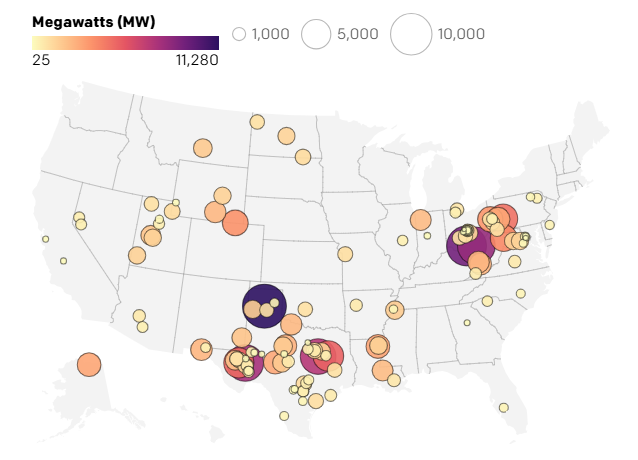
177 GW of gas for AI, enough to power 65% of all U.S. homes. View the interactive map. (Source: Better Data Center Project, Global Energy Monitor)
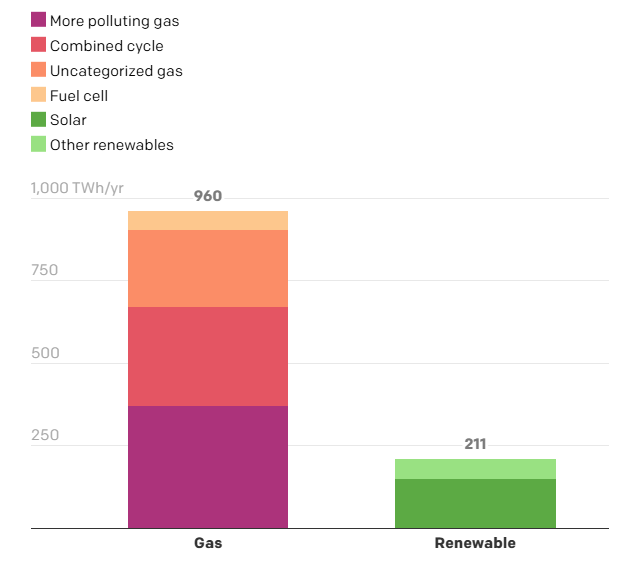
Gas power for AI will generate 80% of BYOP energy over the next 5 years. View the interactive chart. (Source: Better Data Center Project)
BYOP projects are often described as “behind the meter,” or BTM. Although many include a BTM component, emerging arrangements vary widely and often include some form of grid connection. Even facilities proposed as fully off-grid may eventually seek grid connection because the grid offers lower costs, additional services, and greater reliability. That likelihood makes rigorous regulatory scrutiny and oversight essential from the outset.
Regional transmission organizations, state governments, and the federal government increasingly promote BYOP as a way to purportedly limit grid impacts and protect ratepayers. Yet BYOP primarily solves developers’ “speed to power” problem, not the affordability problem, all the while fueling an unprecedented gas buildout, encouraging more-polluting technologies, skirting regulatory oversight, and excluding communities from decision-making.
BYOP projects are moving forward without sufficient oversight and can often bypass the usual planning or regulatory processes for new power plants, further limiting public involvement and necessary protections. Increasing efforts to dismantle federal environmental laws erode federal backstops, which are particularly important in states with weaker laws and some of the largest gas BYOP buildouts. Data center developers are further avoiding some permitting requirements by breaking up large projects into segments.
BYOP Is Not a Solution to Rising Energy Bills
Policymakers and AI data center companies increasingly frame BYOP as a response to rising electricity prices. Although BYOP facilities may delay, avoid, or reduce some grid-related costs, they can still increase household energy bills. Some experts warn that fully off-grid data centers may have the most severe near-term affordability impacts because they compete with utilities for specialized equipment and increase pressure on gas prices. BYOP facilities also avoid mechanisms that fund grid and transmission upgrades — even as they continue to benefit from tax subsidies and other incentives.
Health and Environmental Harm from Dirtier Gas
The consequences of this proposed gas buildout are profound. If the 129 identified BYOP gas plants operate at a 60% capacity factor, they would emit more than 400 million metric tons of carbon dioxide equivalent each year — a 23% increase over current U.S. power-sector emissions. The projects could also cause hundreds of premature deaths annually and between $5 and $10 billion in monetized health damages each year.
More than half of proposed BYOP gas projects plan to use less-efficient, and more-polluting technologies than typical gas plants. These include repurposed jet engines and generators historically used only for backup power or meeting peak demand. This equipment emits more greenhouse gases and harmful air pollutants than traditional combined-cycle gas turbines. Instead of running only a few hundred hours a year for backup or peak demand, current proposals would operate these dirty, noisy generators as baseload power for thousands of hours annually.
For example, xAI deployed of dozens of unpermitted gas turbines to power its Colossus 1 and 2 data centers near Memphis, Tennessee. The turbines powering Colossus 2 in Southaven, Mississippi, are half a mile from an elementary school. The NAACP sued xAI over the company’s failure to obtain a permit for its power plant, alleging added health risks for families in North Mississippi and Memphis, and that the installation violates the Clean Air Act. Earthjustice and the Southern Environmental Law Center represent the Mississippi State Conference of the NAACP and the national NAACP.
How BYOP Evades Regulatory Oversight
To build as quickly as possible, AI data center developers are using several pathways to reduce or avoid oversight. Some state policies eliminate or limit public utility commission review of certain BYOP facilities. West Virginia’s so-called “Microgrid Law,” for example, explicitly exempts fully islanded power plants from standard utility regulatory processes. Reduced utility oversight can also exempt projects from renewable portfolio or clean energy standards that apply to retail or utility electricity sales. New Hampshire and New Mexico have codified such exemptions for islanded BYOP projects.
States are also streamlining or reducing environmental review. Ohio’s “shot clock,” for example, automatically approves project siting within 60 to 90 days unless regulators act. The risk is compounded because many projects are being proposed in states with already-weak environmental protections and energy regulation. At the federal level, efforts are underway to weaken protections under the Clean Air Act, Clean Water Act, Endangered Species Act, National Environmental Policy Act, and other laws that apply to gas BYOP projects.
Data center developers also use nondisclosure agreements and project segmentation to obscure a project’s full impacts. Common segmentation efforts include using different corporate entities to separate permits for data centers from permits for their power generation; filing separate permit applications for each nearby generation unit; and seeking separate permits over time for later phases of a buildout. This segmentation of large projects can mean developers evade stronger environmental laws that would apply if the pollution and emissions of the entire project were considered together. For example, Meta is contracting four separately permitted gas plants in New Albany, Ohio, all within a 2.5-mile radius.
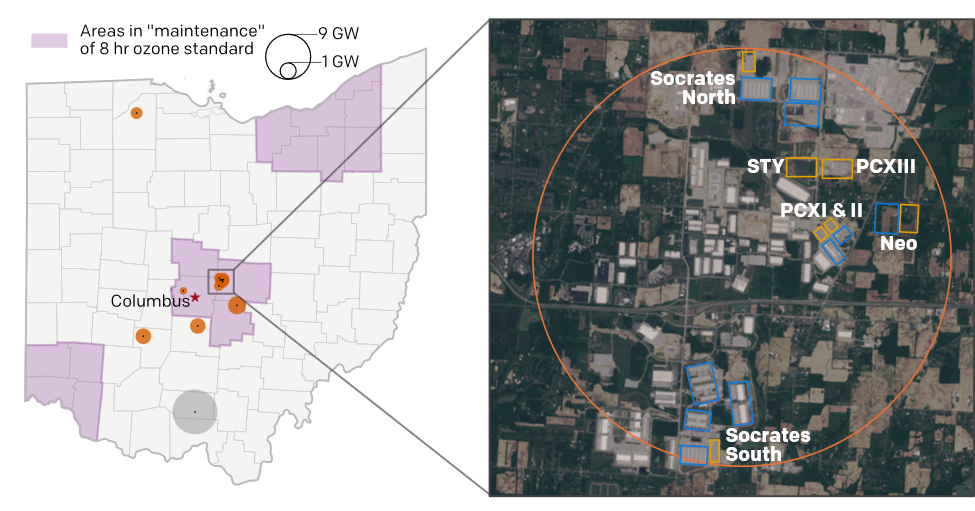
Map of Ohio’s BYOP gas plants and satellite imagery of seven Meta and PowerConneX projects in New Albany, Ohio: 2.7 GW of BTM gas concentrated in a 2.5-mile radius.
Communities Are Being Cut Out of Decision-Making
State and federal policies also threaten meaningful public participation. The U.S. Environmental Protection Agency, for example, recently proposed eliminating federal public-participation requirements for “minor” air pollution sources. This is especially concerning because of the segmentation strategies mentioned above, in which developers present a single project as a series of so-called “minor” sources rather than one major source. State laws can likewise restrict public access to key information: West Virginia’s new law makes project applications confidential and exempts them from the Freedom of Information Act.
Policies addressing BYOP must be developed in collaboration with frontline communities. Consultation on individual projects is not enough; communities need the power to shape the regulatory frameworks that govern AI data center development due to its unprecedented speed, size, and scale. Our policy review found no BYOP-focused laws that protect or expand community participation. Instead, many provisions restrict community self-determination. West Virginia’s law, for example, prevents local governments from enforcing zoning, permitting, and land-use rules while shielding BYOP data center applications from public disclosure.
Priorities include
- Ban nondisclosure agreements and require disclosure of key project information, including permit applications.
- Avoid all types of segmentation of permits; assess BYOP projects thoroughly for all community and environmental impacts
- Avoid “by right” zoning and other streamlined siting processes that limit public participation; Use participatory siting processes that give communities meaningful authority over whether projects proceed.
- Provide communities with sufficient time and resources to participate effectively; Provide Tribal Nations with additional resources or information requested by Tribal councils.
Existing Intervention Points
Communities can act now to challenge harmful BYOP proposals. Even when projects avoid some public-participation requirements, discretionary approvals and intervention points remain. Local land-use laws and state and local ordinances can establish transparency and protective siting requirements, safeguards against noise and air pollution, and limits on water use. All gas BYOP plants, regardless of grid connection, must also apply for air and often water permits. These permitting processes may provide the most important opportunities to submit comments and attend public hearings.
The Time to Act Is Now
This is a critical moment to protect the climate, public health, and community self-determination. Although the potential gas buildout could be enormous, most projects remain in the proposal stage. Policymakers and communities still have opportunities to establish guardrails that prevent companies from evading oversight, require strong environmental protections, and give affected communities real decision-making authority. To the extent BYOP projects do move forward, policies must require clean energy, and do so in a way that is transparent, verifiable, and creates sufficient new and near capacity to power data centers projects.
Our analysis identified more than 10 states that enacted BYOP-focused laws in 2025 and 2026. We expect significantly more proposals at both the state and federal levels in the coming year. For example, on September 30, after this report was finalized, the U.S. Senate introduced a broad bipartisan permitting-reform bill that includes provisions encouraging gas BYOP. Advocacy around this bill and future legislation will shape how BYOP projects are planned, operated, and regulated for decades.
Earthjustice’s Clean Energy Program uses the power of the law and the strength of partnership to accelerate the transition to 100% clean energy.
Kathryn McGrath
Public Affairs and Communications Strategist, Earthjustice
kmcgrath@earthjustice.org
