

The Trump Administration Says It Wants to Help Farmers. So Why Is It Taking Solar Away from Them?
USDA’s attack on REAP-funded on-farm solar projects hurts farmers by denying them a reliable source of energy and income.
On September 28, Earthjustice, together with the Environmental Law and Policy Center, filed a lawsuit against the United States Department of Agriculture (USDA) on behalf of farmers, solar project developers, and others, challenging its gutting of the Rural Energy for America Program, also known as REAP.
A bipartisan coalition of lawmakers in Congress established the program in 2002 to financially assist farmers and small businesses with the purchase of renewable energy systems, like solar arrays. Congress hoped REAP would provide affordable energy and cleaner air to rural communities. Senate sponsors of the program argued that “farm-based renewable energy generation can become one of the major cash crops of the United States, improving the livelihoods of hundreds of thousands of family farmers, ranchers, and others and revitalizing rural communities.”
For decades, REAP had been a smashing success story. Since 2014, 19,000 farms and rural small businesses across all 50 states received REAP awards from USDA. According to USDA, in 2024 alone, the program awarded over $1 billion in REAP grants and loan guarantees nationwide, and generated or saved enough energy to power more than 300,000 homes. As late as May 2025, USDA touted REAP success stories, including the purchase of a 1.5 MW solar array by a farm in Habersham County, Georgia, which would “realize $176,490 per year of income and will generate 2,206 MWh per year, enough to power 204 homes.”
Then, just three months later, USDA suddenly reversed course. During a press conference in Tennessee in August 2025, Brooke Rollins, the Trump administration-appointed Secretary of the USDA, announced that the Department would be ending the disbursement of REAP awards for virtually all solar projects. Then, in March 2026, USDA began applying this new Anti-Solar Policy retroactively to farmers who had already been selected for REAP funding. Secretary Rollins and USDA justified the about-face by arguing that solar projects displace or “consume” America’s “beautiful farmland,” making that farmland “more expensive and less available.”
On September 30, 2026, just two days after Earthjustice filed its lawsuit challenging the Anti-Solar REAP Policy, USDA issued new REAP grantmaking rules which, in effect, more deeply entrench the Anti-Solar Policy. The new USDA rules also more comprehensively gut the REAP program as a whole by, for example, prohibiting the disbursement of REAP funds for wind energy generation projects on cropland.
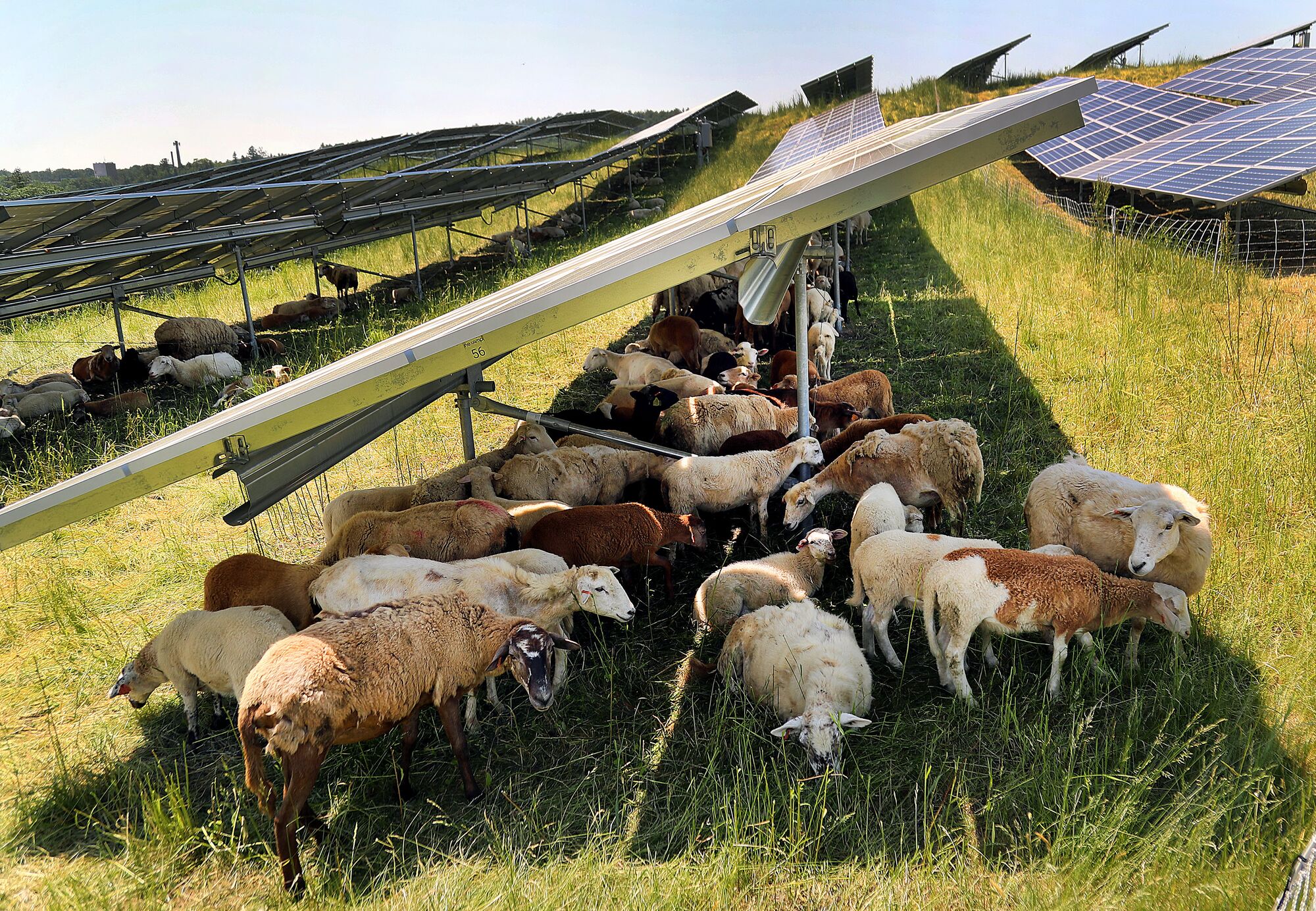
Fitchburg, MA – June 5: More than 200 sheep graze amidst 15,000 solar panels at the Fitchburg Renewables solar farm in Massachusetts. (John Tlumacki / The Boston Globe via Getty Images)
What about the Trump claim that it is protecting farmland?
USDA’s argument that its Anti-Solar REAP Policy protects farmland makes no sense.
First of all, solar projects are sited on only a tiny sliver (0.05%) of America’s abundant farmland. As a point of comparison, the corn ethanol industry — to which taxpayers and consumers pay billions per year with USDA’s support — currently uses more than 65 times that amount of land. Meanwhile, solar energy produces about 70 times the transportation energy per acre as corn ethanol. Even as the nation continues to build out solar projects to meet its growing need for renewable energy, solar projects are only expected to be sited on 0.3% of U.S. farmland by 2035. Of that 0.3%, many of the solar projects will be agrivoltaics — meaning that they will be designed to allow for the land to continue to be used for farming even as it generates solar energy. Indeed, most solar sites that were used for agriculture before installation continue to be used for agriculture after solar panels are up and running. Finally, in those instances where a share of agricultural land is converted, the change in land use is not permanent. A farmer can convert the land back to agricultural uses upon deciding that the solar energy generated is no longer needed. Indeed, as USDA has noted in the past, in such cases, “Giving soil a rest can maintain soil quality and contribute to the biodiversity of agricultural land.”
Second, farmers across the country view REAP-funded solar projects as beneficial, not harmful to their livelihoods. Indeed, according to USDA’s own REAP award data, obtained via a Freedom of Information Act request by the Environmental Law and Policy Center, 68% of REAP grant and loan guarantee awards between 2011 and the first quarter of 2025 were provided to solar projects. REAP-funded solar projects are popular with farmers because they provide financial, environmental, and productivity benefits, just as Congress intended.
When farmers lease their land for solar projects or directly sell solar energy, they grow, diversify, and stabilize their income stream. Solar projects thereby shield farmers from fluctuations in the price of the crops they sell and the farm inputs they must buy, like fertilizer. Solar energy generation projects can increase a farm’s economic value by between 8% and 30%. For example, a Purdue University study tracking an Indiana corn-soybean rotation farm found that net farm income averaged just $125 per acre since 2007. Solar energy project leases, by contrast, commonly run more than $1,000 per acre, fixed for a term of years and escalating.
Moreover, not all farmland is suitable for growing crops. As USDA itself acknowledges, some is only “marginally productive in most crop production years.” Farmers may find that turning over such marginal or degraded farmland to solar energy production helps keep the rest of their farming operations solvent. By doing so, the farmer can preserve a larger share of farmland than would be the case in the absence of the solar project.
Given the benefits solar projects provide to farmers and farmland, USDA’s justifications for the Anti-Solar Policy are so absurd that some Department officials have had trouble explaining them to journalists. Freedom of Information Act emails obtained by Earthjustice show one Department official writing, “let’s let the comms shop find . . . the rationale behind” statistics used to justify the policy to the public. The emails also show that USDA had not even bothered to estimate the acres of farmland that would be affected by the Anti-Solar REAP Policy.
The Trump administration has it out for Farmers, but Earthjustice is Fighting Back
Rather than helping farmers, the Trump administration Anti-Solar REAP Policy is pushing them into debt. For example, under the policy, USDA cancelled $446,000 in reimbursement for Earthjustice’s client, the Book Family Farms in Dixon, Illinois. Based on assurances from USDA, the Book Family Farms worked on constructing two solar arrays totaling 429 kilowatts to offset the energy costs of grain drying on their farms. Now, notwithstanding USDA’s assurances, they have been left holding the bag for these projects. The Book Family Farms are emblematic of countless others harmed by the Anti-Solar REAP Policy.
Adding salt to the wounds, the Anti-Solar REAP Policy was imposed on farmers at a particularly inopportune moment for farmers. As one journalist in HuffPost puts it: “A tariff war with Canada has increased the cost of fertilizer, pesticides and farm equipment… [and] Skyrocketing diesel prices have likewise greatly increased the costs of running farm equipment, and rising interest rates have made it much more expensive for farmers to take out loans.”
Federal investments in renewable energy projects could relieve some of these pressures, making life more affordable for farmers and the broader American public alike. But at precisely this moment of need, the Trump administration is doing the opposite, by rolling back longstanding, popular, and successful policies, like REAP, without adequate justification. Earthjustice’s lawsuit will aim to ensure that the administration follows the law and provides farmers with a path forward.
Earthjustice’s Sustainable Food and Farming program aims to make our nation’s food system safer and more climate friendly.
Nydia Gutiérrez
Public Affairs and Communications Strategist, Earthjustice
ngutierrez@earthjustice.org
