
The Laws Still Exist, the Consequences Don’t: America’s Vanishing Environmental Enforcement
With environmental enforcement at a historic low, it’s open season for polluters.
Imagine living next to a factory that dumps waste into the river behind your house to save on treatment costs. Or a refinery that shuts off its pollution controls because no one is checking. You don’t need to care deeply about environmental laws to know that’s wrong. And you don’t need to be a legal expert to know that if you break the law, there should be consequences.
But the consequences for polluting have all but vanished in the last eleven months, according to an Earthjustice review of government data. Under the Trump administration, federal enforcement of our bedrock environmental laws cratered, leaving a wide gap between what the law requires and what companies actually do.
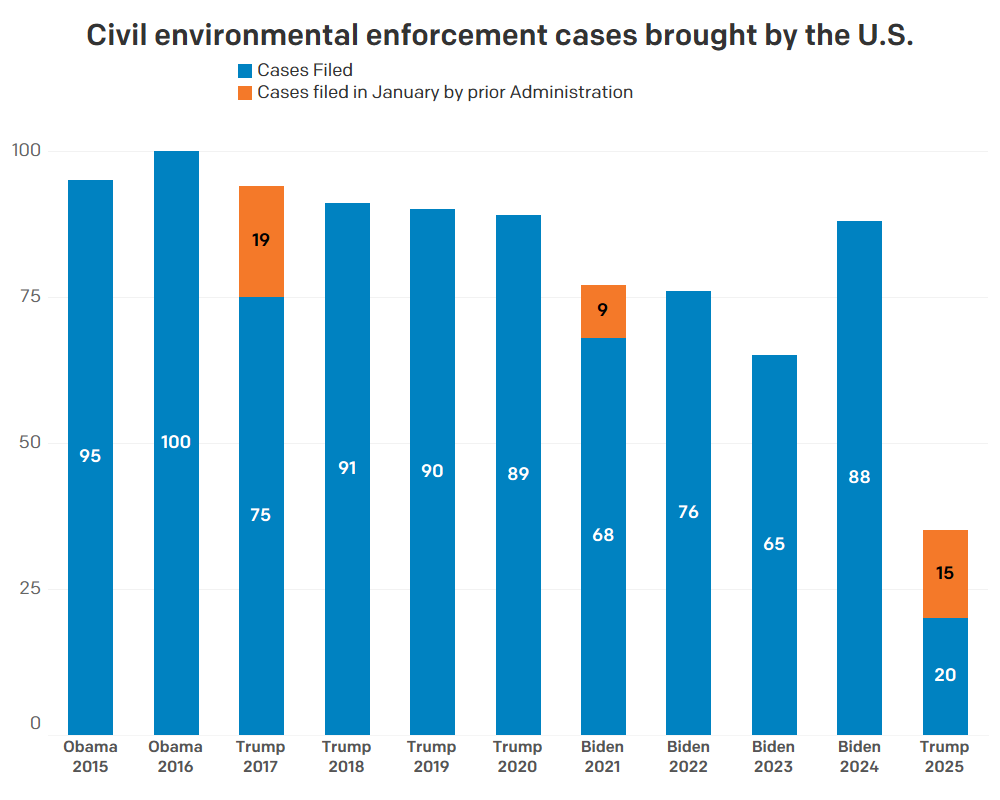
Since taking office, the Trump administration filed only 20 civil environmental enforcement cases in court. That’s less than a third of the cases filed by the federal government during the same period in 2024, and far lower than any year in modern history, including Trump’s own first term.
Penalties show the same alarming trend.
- In the first 19 days of 2025, before Trump took office, the Department of Justice (DOJ) filed settlements totaling $590 million in civil environmental penalties. In the months since, the Trump administration imposed just $15.1 million in civil penalties.
- By comparison, DOJ collected $1.88 billion in civil environmental penalties last year.
- And over the past ten years, DOJ has averaged hundreds of millions in penalties per year, with several years exceeding the billion-dollar mark.
This isn’t a dip. It’s a collapse. And it matters for our lives, our health, and our economy.
Without enforcement, environmental laws are just words on paper. Companies can dump toxic waste like coal ash in our rivers, release more soot and smog, spew cancer-causing chemicals into the air, and basically cut every corner that saves them a dollar but costs the rest of us in medical bills, lower property values, and premature deaths.
The administration hasn’t offered any real explanation for its failure to hold corporations accountable. It could be because DOJ’s environmental enforcement section lost half its attorneys since January (including me). Or because the Environmental Protection Agency, which investigates violations, shrunk its staff by nearly 23%. Trump’s disastrous environmental record suggests something more is at play. The administration has bent over backwards to help corporations escape their legal obligations, directing agencies not to enforce disfavored regulations, creating an illegal email-to-pollute scheme, granting blanket compliance exemptions that will increase toxic air pollution across the U.S., and issuing a policy that puts the ability to delay enforcement directly in the hands of polluters.
Whatever the reason, when enforcement disappears, polluting becomes a business strategy, and workers, families, and children pay the price. Enforcement is what makes the law real. It’s what keeps dangerous chemicals out of drinking water. It’s what forces companies to clean up their spills. It’s what prevents shortcuts that send kids to the ER.
If the administration truly wants “the cleanest air and water in the world,” as it claims, it must fully fund and embrace the enforcement needed to achieve it. Until then, Earthjustice will step in, ramping up our own enforcement work to protect communities and ensure that environmental laws are worth more than the paper they’re written on.
Lauren Wollack
Vice President, Public Affairs and Communications, Earthjustice
lwollack@earthjustice.org