
Earthjustice Program Report
Climate & Energy
Earthjustice staff and partners attend a Pennsylvania Public Utility Commission public input hearing for proposed rate changes by Philadelphia Gas Works.
Jess Benjamin for Earthjustice
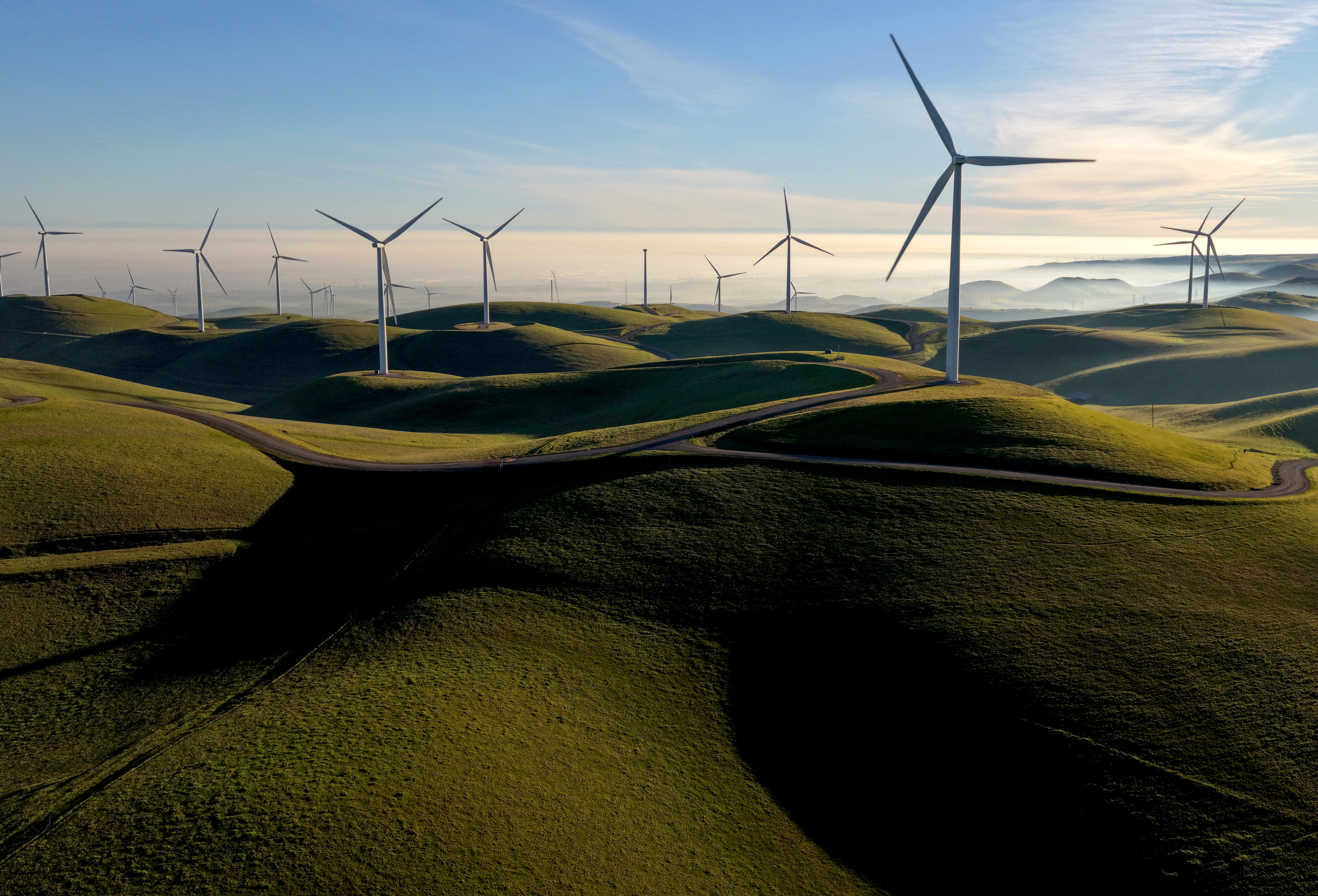
Clean energy solutions are already here. In May 2026, solar power produced more electricity in the United States than coal for the first time in history. As the largest environmental law organization in the U.S., Earthjustice is using all our expertise to advance climate solutions state-by-state and drive this transition forward.
But no matter how effective zero-emissions technology becomes, or how urgent our climate deadlines grow, the fossil fuel industry and its allies in government are doing everything in their power to hold back progress. So Earthjustice takes on the dangers of fossil fuels directly, whether we’re defending public lands from oil drilling or protecting utility customers from paying for coal and gas plants they don’t need. And after 55 years, we’re still finding new ways to win.
In this report, we’re pleased to share updates on a year spent advancing clean energy; electrifying our economy; and challenging handouts to oil, gas, and coal. With your help, we’re making progress toward a clean energy future that gets closer every day.
Advancing Clean Energy
Clean energy is coming onto the grid, even in the face of federal interference. In the first quarter of 2026, solar and storage made up 91% of all new electricity generation in the U.S. This shift is the result of decades of work — and with energy demand on the rise, we must keep pushing to prevent a backslide toward gas and coal. Earthjustice and our partners are using our legal and regulatory expertise to remove obstacles and fix a system rigged for fossil fuels.
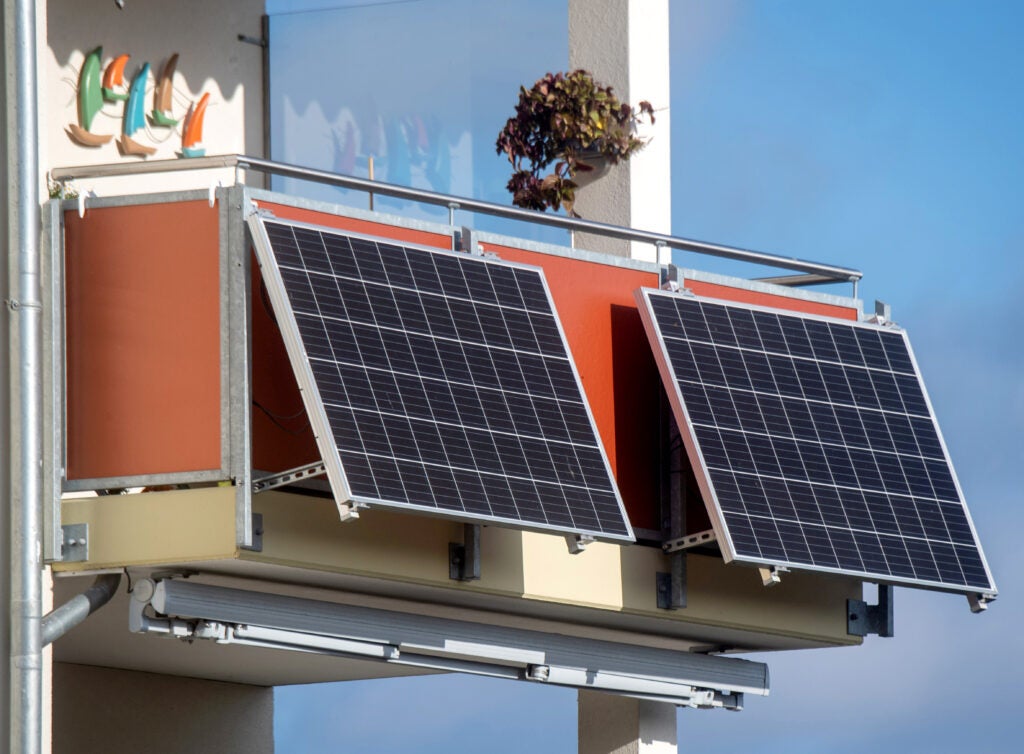
Winning for solar in the states.
Across the country, Earthjustice staff are arguing in favor of clean energy. Our attorneys have expertise in advocating before state public utility commissions (PUCs), where trial-like proceedings shape decisions about how utilities generate power, bill customers, and invest in new infrastructure. And our policy advocates are seizing opportunities to advance legislation that expands access to renewables. In the past year, we’ve secured victories for solar energy in:
 Arizona
We overturned approval of a utility charge that unfairly targeted rooftop solar customers.

 Colorado + New York
We supported successful bills that increase access and remove barriers to plug-in solar.
 West Virginia
We defeated a utility proposal that would have reduced net metering credits, which compensate customers for excess electricity they generate, for customers with solar.
We’ll continue using our litigation and policy knowledge to remove unfair barriers and speed up the clean energy transition.
Reforming energy markets.
Demand response programs compensate consumers for reducing their power use at certain times when demand is high. Reducing peak demand allows utilities to dial back new infrastructure spending, maximize solar and wind integration, and lower electricity bills. Earthjustice believes demand response could unlock thousands of megawatts of untapped clean energy potential in the Midwest.
However, when the Federal Energy Regulatory Commission first instructed wholesale markets to let demand response providers compete with power plant operators in 2009, it allowed states to “opt out.” Twelve states did so. Earthjustice launched a state-by-state litigation and advocacy campaign to convince states to reverse course.
Wisconsin (2021)
Legal victory
In 2021, we scored an important legal victory in Wisconsin that overturned a ban on demand response; we began pursuing similar wins in other states.
Iowa (2025)
State opts back in
In December 2025, Iowa chose to “opt back in” to allowing demand response after we indicated we would litigate.
Minnesota (2026)
Court victory
In January 2026, the Minnesota Court of Appeals ruled in our favor to strike down the state’s ban on demand response programs.
Indiana & Beyond
Continuing the fight
We’ve now filed litigation challenging Indiana’s opt out, and we will continue targeting remaining bans on demand response to ensure that consumers everywhere can benefit from this sensible, efficient approach.
Helping halt attacks on clean energy.
Earthjustice is helping our allies challenge the Trump administration’s assaults on wind and solar. When states and trade associations file lawsuits against federal actions, Earthjustice and other environmental groups can submit “amicus” briefs in support.
Amicus briefs inject our environmental expertise into a case, providing crucial context justices wouldn’t otherwise hear. Along with our partners, we’ve supported three wins for clean energy through amicus briefs this year:
After the Trump administration issued a moratorium on permits for new wind power projects, attorneys general from 17 states and Washington, D.C., filed a lawsuit.
The court ruled in our favor, and the decision is now on appeal.
A group of clean power associations sued the federal government over federal actions that adversely affect the development of wind and solar projects, including an order directing the agencies to base permitting decisions for energy projects on a metric that essentially guaranteed wind and solar would lose.
The clean power associations were granted an injunction in their suit – a major victory for clean energy development.
Under the Trump administration, the Department of Defense (DOD) froze its required reviews of proposed wind energy projects. Wind energy trade associations filed a lawsuit, which the federal government moved to dismiss.
The court denied the administration’s request and has granted a nationwide stay of DOD’s freeze.
Cutting Climate Pollution — And Costs
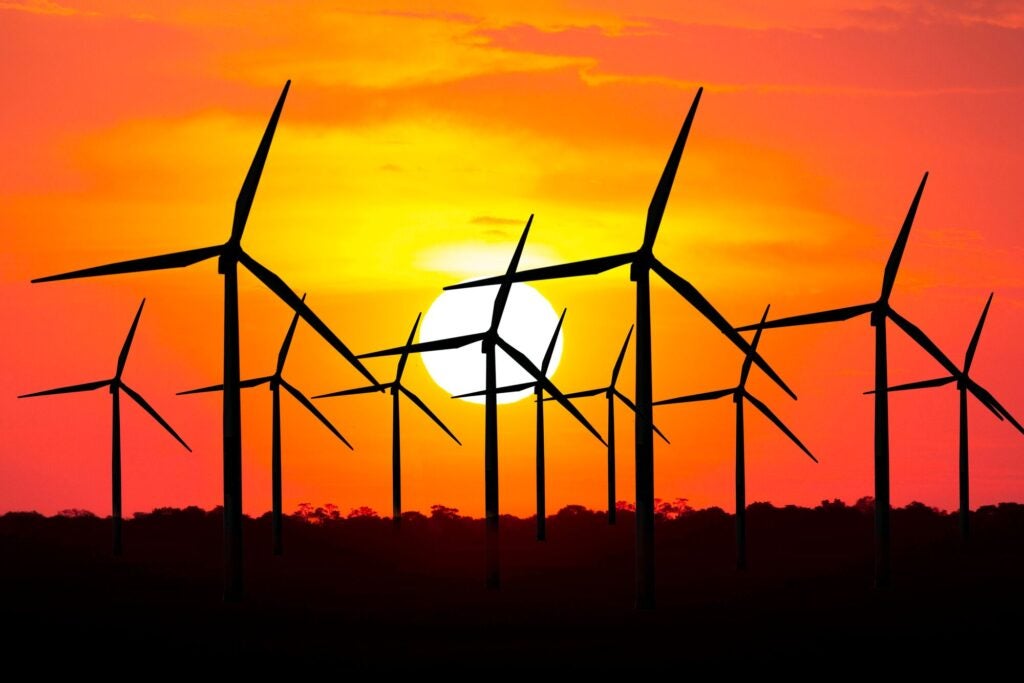
Earthjustice and our partners work to reduce greenhouse gas emissions and utility bills at the same time.
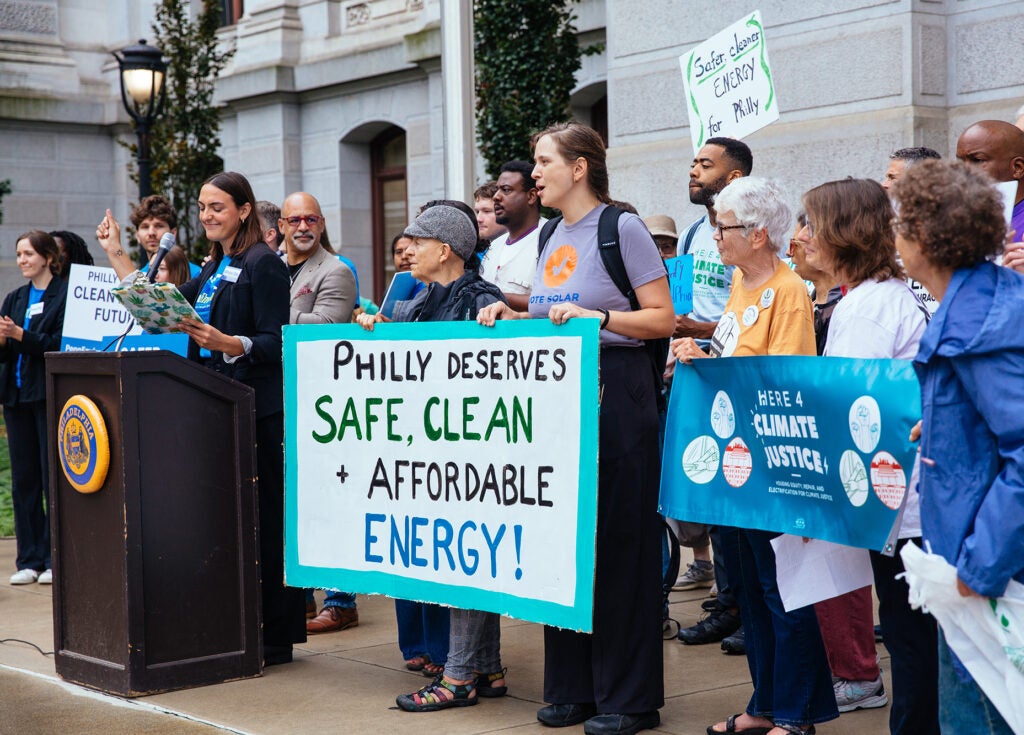
Photo: Philadelphians rally at City Hall in support of a proposed settlement with the city’s gas utility to lower the increase in heating bills and start expanding clean energy in the city. (Jess Benjamin for Earthjustice)
Electrifying Our Lives
An equitable, zero-emissions economy is possible – and we’re already making it happen.
By electrifying transportation, buildings, and industry through our Right to Zero campaign, we are reducing demand for fossil fuels coast-to-coast. Fewer vehicles, appliances, and equipment burning fossil fuels means less pollution that harms the climate and communities.
And while states and cities are advancing electrification, Earthjustice is also defending our zero-emissions future at the federal level.
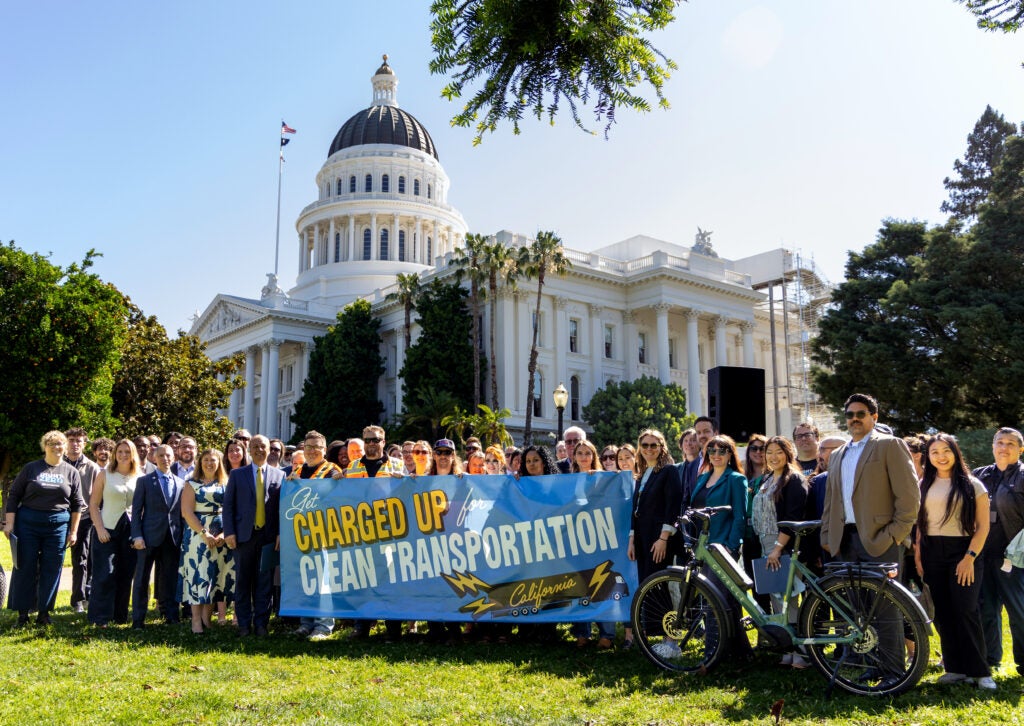
Reducing transportation pollution.
Cutting climate emissions from transportation requires supportive policies and funding — and Earthjustice has defended both this year.
In New York, we celebrated another victory in our defense of the city’s congestion pricing program. When the Department of Transportation attempted to rescind federal approval of the program, we intervened. Our win ensures the program can continue delivering big benefits. In its first year, the program raised $550 million raised for public transit, including the City's Clean Trucks Program.
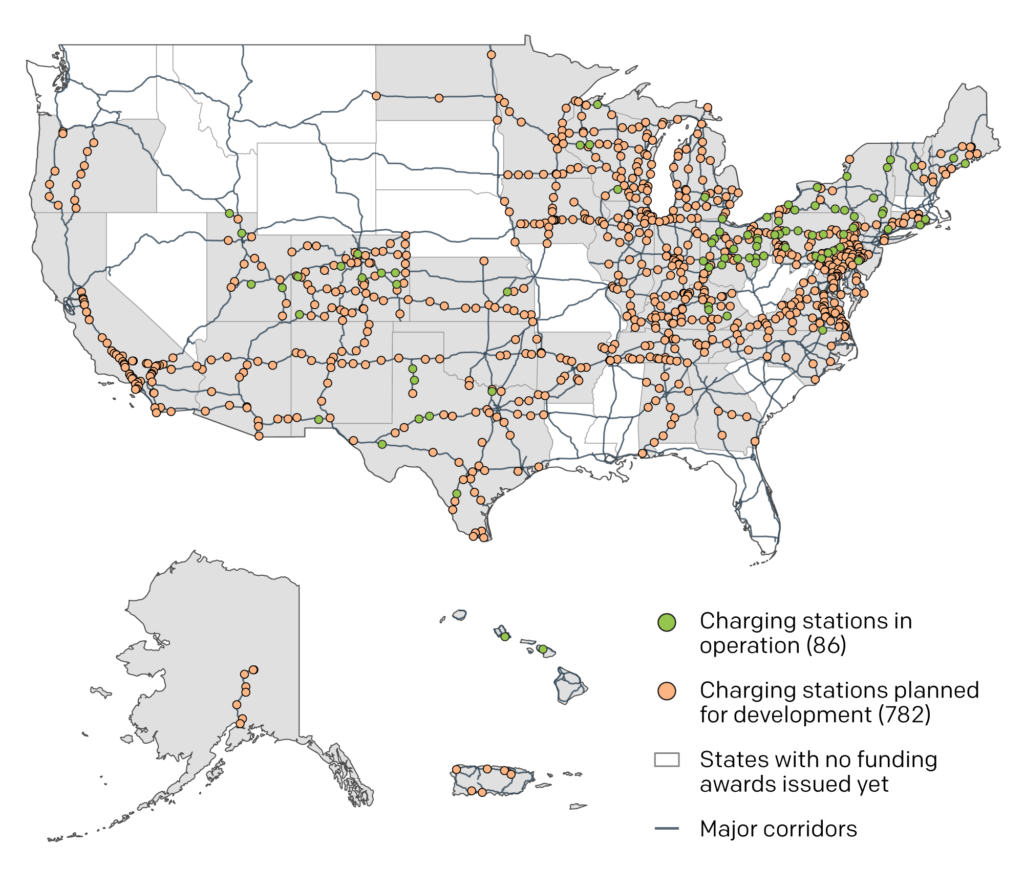
In 2025, the Federal Highway Administration and Department of Transportation (DOT) froze $2.8 billion of unspent funds for the National Electric Vehicle Infrastructure Formula program. All 50 states, as well as Washington, D.C., and Puerto Rico, had submitted plans to build reliable, high-speed electric vehicle charging infrastructure under the program. Earthjustice joined a lawsuit in which 17 states challenged the funding freeze — in part to ensure that funds would be protected in every state, not just the 17 states that sued. The resulting victory in U.S. District Court released the funds and permanently barred DOT from withdrawing states’ funds or interfering with project implementation. Billions in funding will now go to projects that enable longer-distance and lower-cost EV driving, increase investment in zero-emissions trucking, and reduce harmful air and climate pollution.
Advancing all-electric buildings.
The buildings sector alone produces roughly 13% of climate pollution in the United States. Earthjustice advocates for state and local governments to cut this pollution by facilitating the shift from gas-burning furnaces and water heaters to zero-emission alternatives like heat pumps in new buildings. But we have seen increasing attempts by the gas industry, and now the federal government, to fight this transition by arguing that these climate-friendly policies are pre-empted by federal law.
Over the past year, Earthjustice has contributed to several significant wins that successfully defended state and local building codes that reduce greenhouse gas emissions in Colorado; Illinois; New York; Maryland; and Washington, D.C.
We also defeated a similar challenge to Southern California’s landmark zero-emissions water heater and boiler regulation, which requires businesses to clean up air pollution from over one million pieces of industrial and commercial equipment.
Investing in a modernized grid.
A fully electrified economy depends on an updated power grid. While we push for policies that support zero-emissions transportation, buildings, and industry, we are also active before energy regulators to make sure our infrastructure is up to the task.
In Colorado, Earthjustice advocacy at the state PUC also led to the approval of over $1 billion in funding to facilitate transportation electrification by modernizing the grid.
AI data centers and the power sector
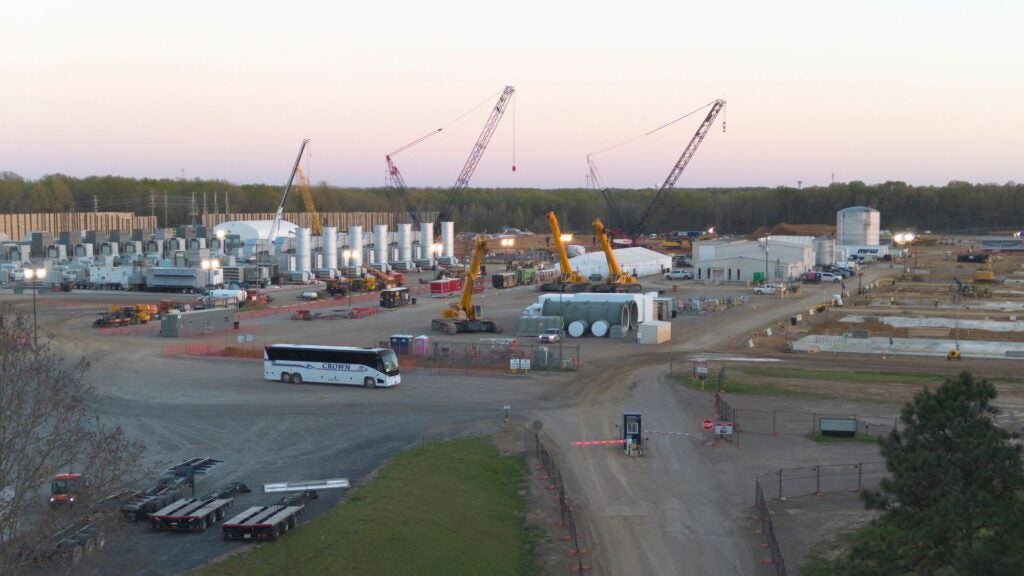
The rapid, unregulated buildout of AI data centers is threatening to lock in decades of increased fossil fuel emissions. As projected energy demand for AI data centers has increased, new and proposed gas capacity has tripled in the U.S. Without meaningful protections, AI data centers can also harm communities through air, water, and noise pollution, as well as rising utility bills. Earthjustice is pushing for much-needed guardrails, guided by these tenets:
Earthjustice’s recent work related to AI data centers includes:
- Shaping Michigan’s first large-load tariffs.
- Challenging unpermitted use of gas turbines at an xAI data center.
- Watchdogging against legislation that would exempt AI data centers from bedrock environmental laws.
Photo: Gas-powered turbines, with more being built, operate in Southaven, Mississippi, to power a large xAI data center just to the north in Memphis, Tennessee. The huge gas turbines occupy a sprawling 114 acres — the equivalent of nearly 87 football fields. (Brad Zweerink / Earthjustice)
Preventing an illegal coal revival
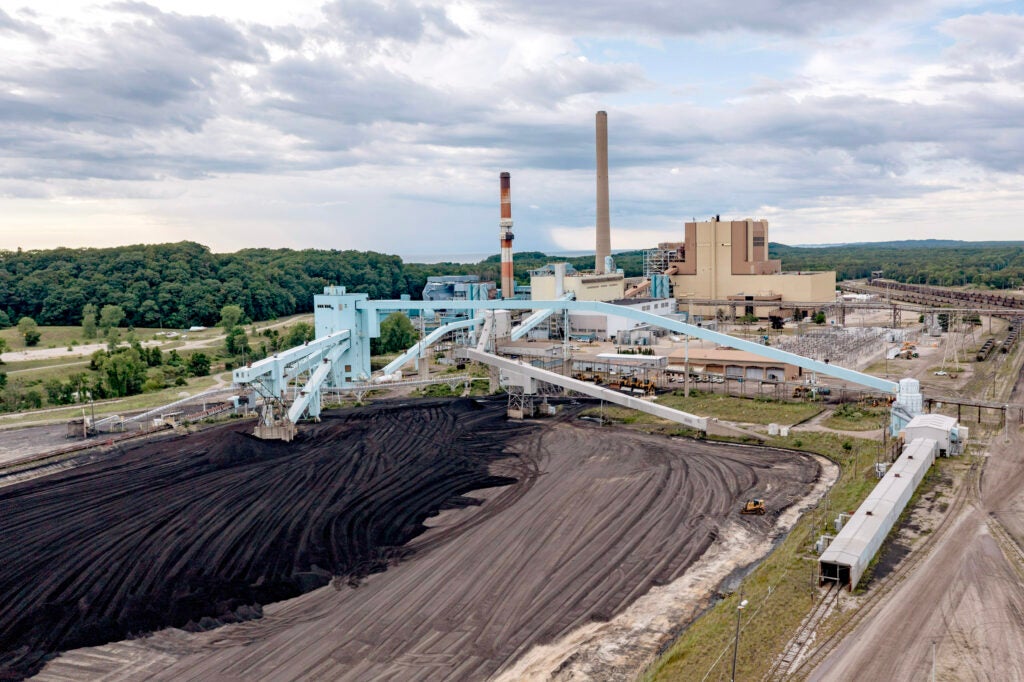
Earthjustice is using every tool in our toolbox — including litigation, communications, and policy advocacy — to challenge the Trump administration’s illegal orders that force coal plants to keep running.
Coal-fired power plants are dirty, inefficient, and expensive. That’s why so many have been scheduled to shut down. But since 2025, the Department of Energy (DOE) has been keeping multiple coal plants running past their scheduled retirement date by issuing unlawful “emergency” orders under Section 202(c) of the Federal Power Act. This is a disaster for the climate, public health, and utility bills. Overall, keeping these coal plants running since May 2025 has led to 12 billion pounds of carbon dioxide emissions and projected healthcare costs running into the hundreds of millions of dollars.
Earthjustice won’t let this continue without a fight.
“The consequences of the Department of Energy’s actions are massive costs being imposed on ratepayers to keep around these old, expensive, dirty coal plants,”
Michael Lenoff
Lead attorney for Earthjustice — “Trump’s Push to Keep Coal Plants Open Is Costing Hundreds of Millions,”
New York Times,
May 14, 2026
Photo: The J.H. Campbell coal-fired power plant in West Olive, Michigan. (Jim West / Universal Images Group via Getty Images
Fighting Unlawful Actions that Boost Fossil Fuels
Since launching a so-called “energy emergency” in 2025, the second Trump administration has doubled down on its longstanding favoritism for oil, gas, and coal, offering handouts and loopholes to the fossil fuel industry and their allies. But whatever tactics they use, we’re there to fight back in court.
Challenging federal abandonment of climate action.
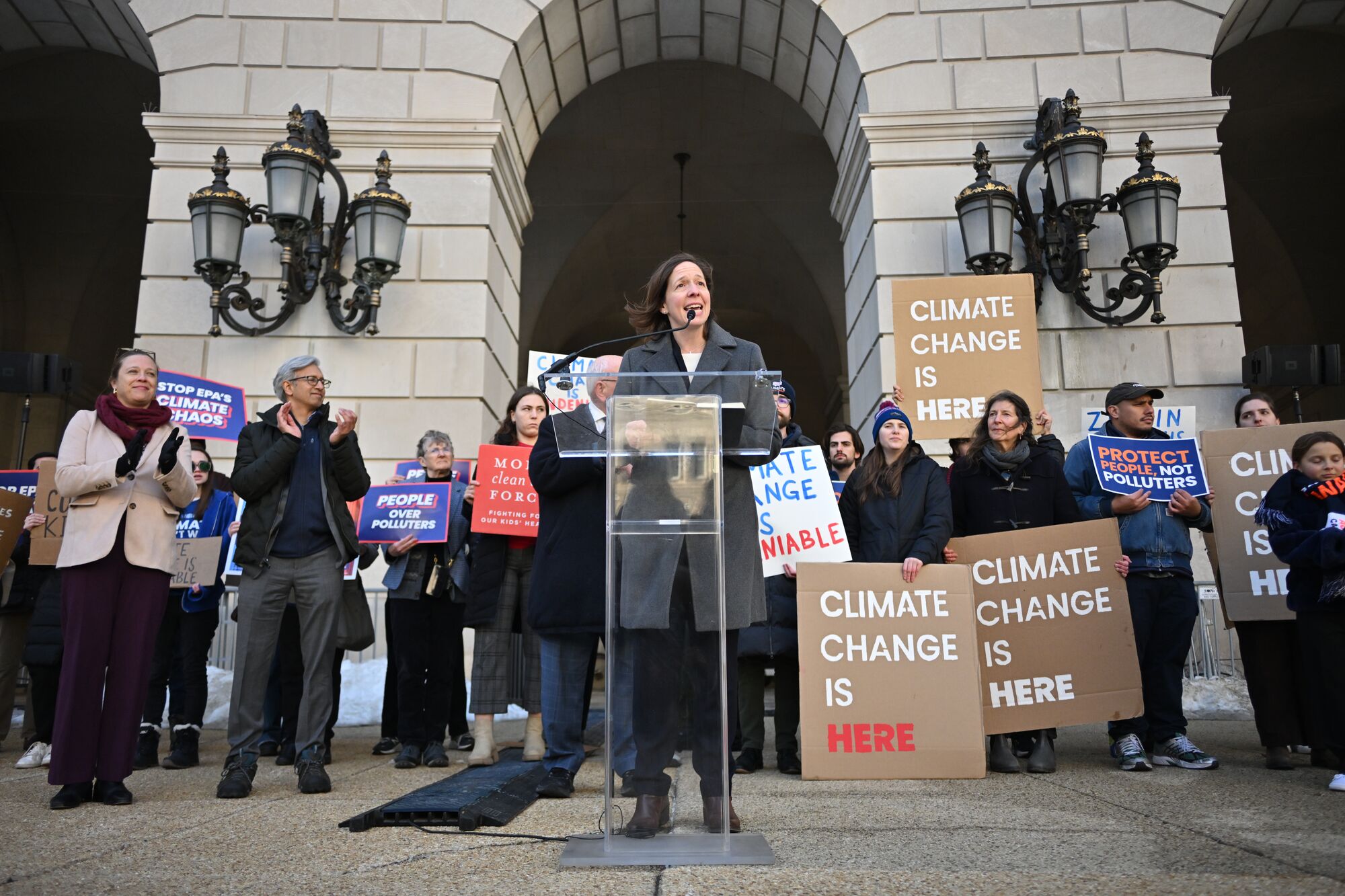
Earthjustice is fighting back against one of the most dangerous deregulatory moves we’ve ever seen: the EPA’s repeal of the “endangerment finding” for greenhouse gas pollution from vehicles. This move establishes a potential blueprint for future actions to remove federal greenhouse gas regulations for other sources, including power plants. It must be challenged, and the courts offer a pathway to do so.
2007
Landmark decision
In the U.S. Supreme Court decision Massachusetts vs. EPA, the court found that carbon pollution and other climate-warming pollutants (greenhouse gases) are “air pollutants” as defined by the Clean Air Act.
The court directed the EPA to make a final scientific determination whether these pollutants endanger health or welfare.
2009
Endangerment finding
The EPA found that greenhouse gases endanger public health and welfare and that emissions from vehicles contribute to that endangerment — meaning the agency had the authority and responsibility to regulate emissions of carbon dioxide, methane, and four other climate pollutants.
This determination is known as the “endangerment finding.”
2013 - 2014
Ongoing defense
When the endangerment finding was challenged multiple times by the fossil fuel industry, Earthjustice was part of the coalition that successfully defended it again and again.
July 2025
Proposed repeal
Under the second Trump administration, the EPA proposed a new rulemaking to dismantle the endangerment finding. During the public comment period for the proposed rule, Earthjustice and our partners began laying the groundwork for future litigation.
Working together, we filed over 500 pages of technical and legal comments opposing the repeal.
We also began a comprehensive communications strategy to mobilize the public around this issue. Ultimately, we motivated Earthjustice supporters alone to generate 78,000 comments.
These public, technical, and legal comments are now part of the evidentiary record for our legal challenge.
February 2026
Lawsuit filed
The EPA issued the final rule repealing the endangerment finding, along with the elimination of carbon emission standards for vehicles.
Minutes after the final repeal was posted in the Federal Register, Earthjustice sued the EPA in the D.C. Circuit, along with a large coalition of public health and environmental groups.
April 2026
Additional challenge
Earthjustice filed an additional lawsuit on behalf of a separate body of environmental groups and Alaskan tribes.
Ongoing
Climate accountability
While our litigation proceeds, Earthjustice will communicate the connection between climate pollution and the ever-worsening extreme weather that endangers us all.
Defending life-saving power plant regulations.
Under the previous administration, Earthjustice and our partners landed a groundbreaking suite of pollution regulations for power plants and other sources of dangerous emissions. These regulations are essential to health and the clean energy transition. Some directly regulate climate emissions. Others force the fossil fuel industry to cut air and water pollution. Now, the Trump administration is attacking these rules in a variety of ways: handing out exemptions, flipping positions in ongoing litigation, delaying compliance deadlines, and ultimately “reconsidering” and rolling back rules and issuing weakened final versions.
Our successful defense of the soot rule shows how we’re pushing back. The 2024 National Ambient Air Quality Standard for particulate matter (soot) is projected to save 4,500 lives and $46 billion in health savings per year. But the Trump administration undermined the rule in two ways: swapping sides in an existing lawsuit to join polluting industries in attacking the rule, and missing key deadlines to identify communities whose air quality doesn't meet the rule's standards.
Earthjustice and our clients were ready to respond on both fronts. We had already intervened in the existing lawsuit, so we stepped in and defended the soot rule when the government wouldn't. And when the EPA missed its deadlines, we sued on the first day the law allowed, with many states and local governments joining our litigation coalition. We won both cases.
Together, these decisions uphold the new soot standards and force the EPA to implement them. And they demonstrate the importance of our work to defend this regulation — and many others — in the court of law.
Intervening in fossil fuel giveaways.
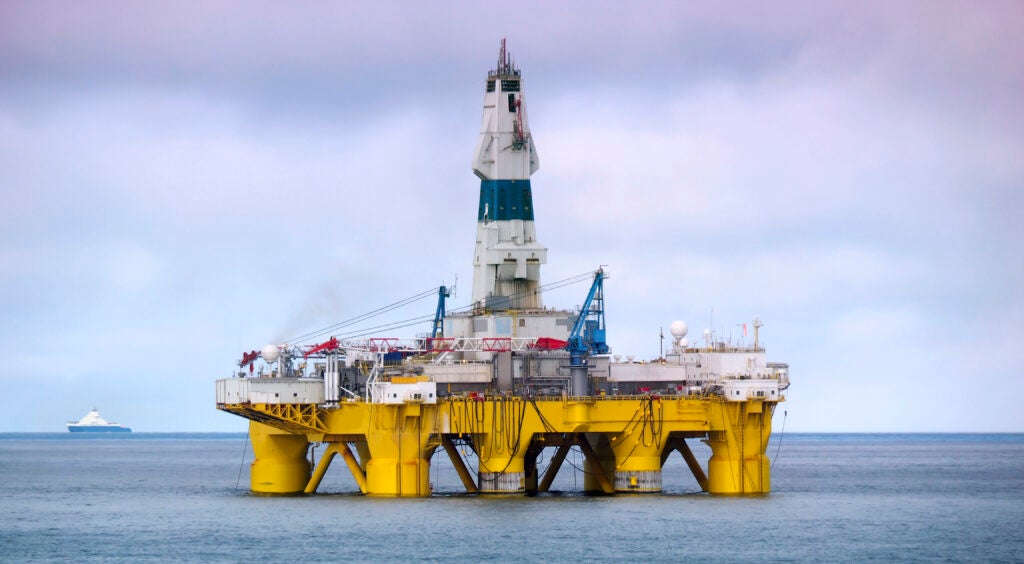
Under the guise of its manufactured “energy emergency,” the Trump administration is doubling down on fossil fuels at the expense of public lands and waters. As part of this push, the Interior Department is using emergency permitting procedures to fast track the approval of fossil fuel projects, mining, and other destructive developments. When these maneuvers break the law, Earthjustice is there to intervene.
For example, the law does not allow for multiple deepwater ports in the same area. Deepwater ports serve some of the largest oil tankers in the world and can export up to 2 million barrels of crude oil per day. There is already one deepwater port project approved near Houston, Texas; but in 2025, the Trump administration approved a second one anyway, despite the increased risk of oil spills, air pollution, and habitat loss. We challenged that approval in court on behalf of a community-based group representing local residents. A federal appeals court sided with us and vacated the approval, handing our clients a major victory and the oil export industry a major loss.
Victory
Protecting the Great Lakes from Line 5
In July 2026, Michigan’s Supreme Court sided with our clients and dealt a blow to a Canadian oil company’s plan to tunnel the Line 5 pipeline under the Straits of Mackinac. A key permit for the project now goes back to regulators for a re-do.
We’ll be prepared to defend Tribal rights and the Great Lakes in that proceeding — and we continue to support other challenges to Line 5 in both Michigan and Wisconsin.
Photo: Whitney Gravelle, of our client Bay Mills Indian Community speaks after arguments before Michigan’s Supreme Court. Our co-counsel in this case is the Native American Rights Fund.
Seizing Every Opportunity
Environmental progress can’t wait, so Earthjustice is showing up in every way we can.
Why It Matters In 2025, the International Court of Justice affirmed that all governments have a legal obligation to prevent significant harm to the climate, and the United Nations passed a resolution supporting the decision in May 2026.
Earthjustice’s Role The next month, 10 Australians filed the first international case based on that obligation. The 10 claimants are represented by the Human Rights Law Centre, Environmental Justice Australia, and Earthjustice.
The Stakes Each of the claimants has been seriously harmed by extreme weather events, from catastrophic bushfires and heatwaves to sea level rise and flooding. Their claim asks the UN Human Rights Committee to declare that it is unlawful for Australia to continue approving coal and gas projects for export without a plan to keep Australians safe from dangerous climate change.
Photo: Each of the claimants has been seriously harmed by extreme weather events, from catastrophic bushfires and heatwaves to sea level rise and flooding. (Rebecca Parker)
Why It Matters Under the second Trump administration, the DOJ has abandoned federal enforcement of environmental laws and is encouraging non-compliance through unlawful exemptions. However, statutes like the Clean Air Act allow for regular people to protect themselves by taking polluters to court through “citizen suits” that enforce the law.
Earthjustice’S Role To support the growing need for citizen suits and address dangerous violations of the law, Earthjustice has established an Enforcement Team, led and staffed by former members of the DOJ.
Recent Actions Several of our active enforcement cases relate to harmful pollution from the burning or processing of fossil fuels and petrochemicals. For example:
- Earthjustice is representing the NAACP in a lawsuit against xAI over the company’s use of 69 unpermitted methane gas turbines to power an AI data center.
- In March 2026, we filed an enforcement suit against Dow and Union Carbide over plastics pollution in the San Antonio Bay on behalf of a retired shrimp captain.
- We recently scored an important victory reviving our enforcement suit over Suncor Energy’s decades of pollution at a Colorado oil refinery, sending the case back to trial court.
Photo: Robert Tipton Jr., president of the DeSoto County NAACP chapter, photographed on March 28, 2026 in Southaven, Mississippi. (Brad Zweerink / Earthjustice)

The Challenge While the federal government takes unlawful actions that harm the environment, state governments can take the opposite approach.
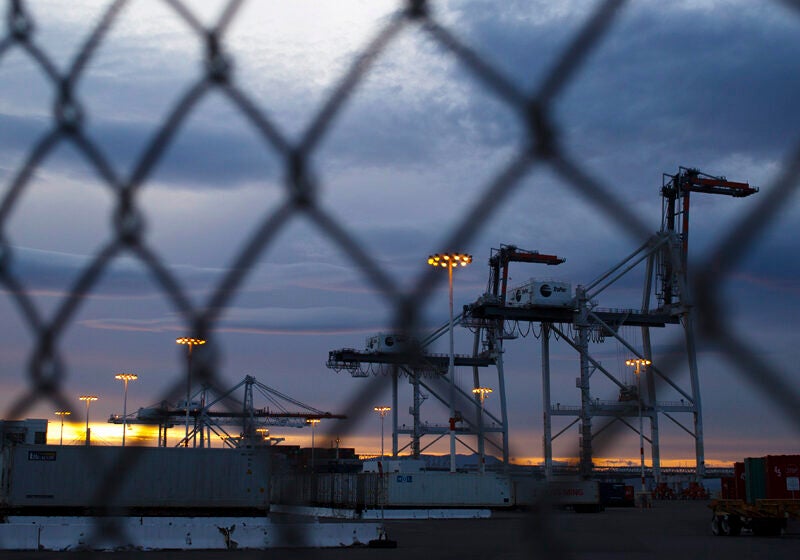
For example, in June 2026, the Trump administration announced it was directing $75 million for construction of a coal export terminal near the Port of Oakland — part of a suite of executive actions to bolster the ailing coal industry nationwide.
Earthjustice’s Response By contrast, Earthjustice is sponsoring AB 40, the Community First Coal Review Act: a bill in the state legislature that would require meaningful environmental review for new or expanded high-volume coal handling, storage, or export facilities.
What’s at Stake The proposed terminal would export up to 10 million tons of coal annually, undermining efforts to reduce West Oakland air pollution and advance California's climate goals.
We also have successfully shaped state legislation to mitigate the effects of the Trump administration's illegal coal plant orders, as described in the above feature story.
Photo: The Port of Oakland, CA. (Chris Jordan-Bloch/Earthjustice)
Each of the claimants has been seriously harmed by extreme weather events, from catastrophic bushfires and heatwaves to sea level rise and flooding. (Rebecca Parker)
Robert Tipton Jr., president of the DeSoto County NAACP chapter, photographed on March 28, 2026 in Southaven, Mississippi. (Brad Zweerink / Earthjustice)
The Port of Oakland, CA. (Chris Jordan-Bloch/Earthjustice)
Forging Ahead
Clean energy momentum won’t be stopped, and neither will Earthjustice.
We are securing important victories, slowing down destructive ideas, and even challenging ourselves to take on vital new work. We can navigate intense headwinds, because our North Star has never changed: an equitable, zero-emissions future for all.
We’re proud to be on this journey with a remarkable community of clients, partners, and supporters. Thank you.