

Earthjustice Takes on Big Ag’s Greenwashing
We’re suing one of the largest meat companies in the world for trying to deceive consumers about its climate impact.
For over a year, the meat company Tyson Foods has been trying to sell consumers a whole lotta snake oil, Earthjustice argues in a new lawsuit.
Tyson, one of the largest meat companies in the world, says it is committed to reducing its greenhouse gas emissions 30% by 2030 and to reaching “net zero” greenhouse gas emissions by 2050. The company also markets purportedly “climate-smart beef.” As alleged in our complaint, both of these claims are profoundly misleading.
That’s because beef has an enormous climate and environmental impact —with greenhouse gas emissions greater than any other major food product. But rather than sincerely working to reduce its emissions, we argue that Tyson appears to be trying to capitalize on consumer climate concerns by greenwashing its meat products.
Tyson’s claims reflect the fact that consumers show a growing interest in, and willingness to pay more for, climate-friendlier foods. However, our lawsuit asserts that the company has not provided a plan that’s adequate to significantly reduce its emissions, let alone achieve net-zero emissions by 2050. And the minimal steps that Tyson has claimed it will make are nowhere near up to the task of bringing Tyson’s tremendous climate impact to zero. For example, Tyson proposes spending a mere .08% of its revenue on shifting to climate-smart practices and does not even require any of its suppliers to adopt these practices. And the company spends only .2% of its revenue on all research and development, including research and development into climate-reducing technologies.
People have a right to know the truth about the products they purchase, which is why Earthjustice is suing Tyson under consumer protection law. This case is part of our broader and growing effort to rein in Big Ag — one of the most polluting industries on the planet.
When people think of climate villains, they likely think of dirty energy companies like Exxon Mobil, Shell, and BP. And rightly so. The fossil fuel industry is by far the largest contributor to global climate change, accounting for over 75% of global greenhouse gas emissions worldwide.
But dirty energy companies are hardly alone in their climate culpability. At least one-third of global climate change emissions come from the food system. And industrial animal agriculture drives the bulk of these emissions, with meat and dairy alone responsible for 14 to 20% of all human-induced emissions.
Industrialized meat production looks nothing like the industry’s bucolic-looking ad campaigns, and its climate-harming emissions are masked by these idyllic images. Cattle burp and fart climate-warming methane in prodigious amounts . And Big Ag builds giant “concentrated animal feeding operations,” or CAFOs, that generate city-sized amounts of waste that, once it breaks down, emits even more methane, as well as another potent greenhouse gas — nitrous oxide, a greenhouse gas almost 300 times stronger than carbon dioxide. Together, these outputs make agriculture the largest source of methane emissions in the U.S. — bigger than the entire oil and gas industry.
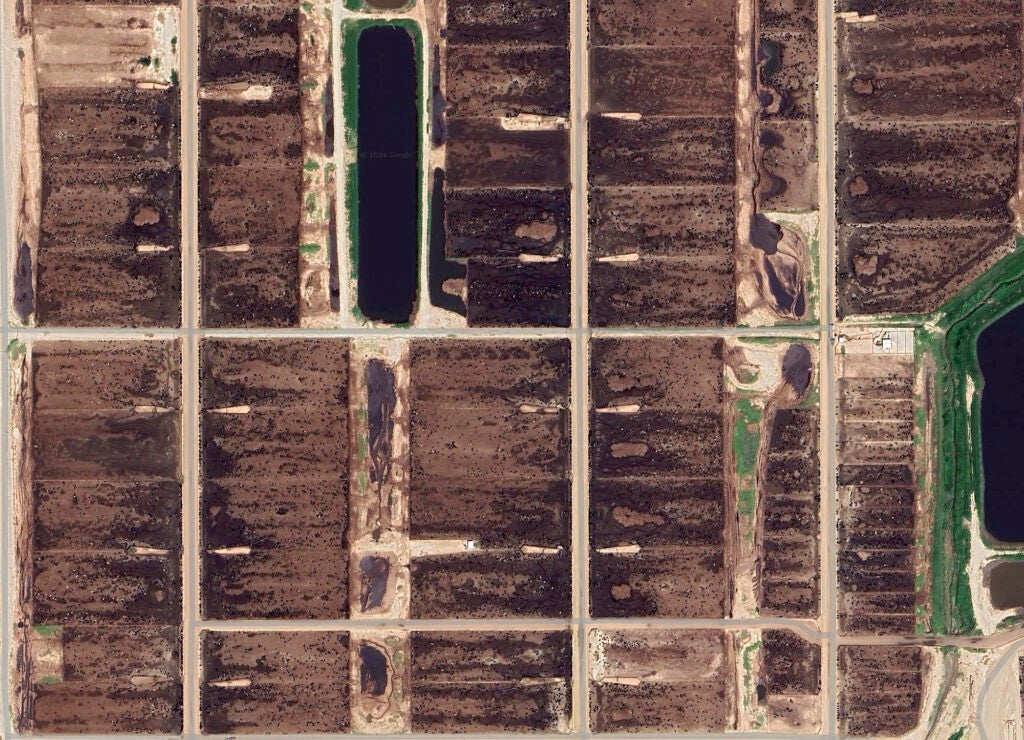
A satellite view of part of the Adams Land and Cattle feedlot in Nebraska, which is named by Tyson Foods as one of their “Climate-Smart Beef Program supply partners”. (Google Maps / 2024 Airbus, Maxar Technologies)
In addition, industrial animal production uses a tremendous amount of energy that adds to its climate footprint. And, according to the U.S. Department of Agriculture, industrial scale meat production occupies about 45% of all land in the contiguous U.S. for cattle grazing or animal feed production. Conversion of this land to agriculture releases huge quantities of carbon that had been stored in soils and reduces the land’s future carbon sequestration capacity, all magnifying the climate impact of meat production.
With enormous emissions unavoidably associated with beef production — it’s in a cow’s nature to grow slowly at first while grazing on land, belching methane, and eating and pooping a lot — Tyson simply cannot show that its industrially produced beef can ever be a “climate-smart” choice.
When you add it all up, suddenly Big Ag starts to look comparable to Big Oil when it comes to planetary harm.
“Tyson is making all these promises, even though it knows full well that it cannot truly eliminate its climate harming pollution by 2050,” says Carrie Apfel, deputy managing attorney of Earthjustice’s Sustainable Food and Farming Program. “Tyson is misleading consumers who are trying to make climate-conscious choices, and that’s not okay.”
Tyson acknowledges that the company itself doesn’t know the full extent of its greenhouse gas emissions — and it refuses to make public any meaningful effort to measure them. Thanks to extensive lobbying, Big Ag is not required to report these emissions the way almost all other industries are.
Says Apfel, “Big Ag has benefited from legal exemptions for far too long, and Earthjustice, alongside our partners and clients, is one of the few legal organizations holding them to account.”
Earthjustice attorneys are no stranger to taking Big Ag to task and shining a light on the industry’s polluting practices. For example, Earthjustice successfully brought a case against JBS, the largest meat producer in the world, challenging its net-zero claims before Better Business Bureau’s National Programs’ National Advertising Division. This victory later helped encourage the state of New York to sue JBS, accusing it of deceptive claims about its climate program. We’ve also sued the U.S. Department of Agriculture to get more records about meat production’s climate impact.
As we wrap up another year of record-hot summers and extreme weather, exposing the agriculture industry’s greenwashing efforts is particularly critical and time sensitive. The world’s top scientists warn that we must drastically cut greenhouse gas emissions from all sectors or risk planetary catastrophe.
We don’t have time to allow companies to mislead well-meaning consumers who want to do their part to reduce their own climate impact.
Jessica is a former award-winning journalist. She enjoys wild places and dispensing justice, so she considers her job here to be a pretty amazing fit.
Earthjustice’s Sustainable Food and Farming program aims to make our nation’s food system safer and more climate friendly.