

April 20, 2026
Why BP’s Kaskida Project Is a Recipe for (Yet Another) Disaster
The offshore oil drilling project would push into riskier, deeper waters than the infamous Deepwater Horizon rig
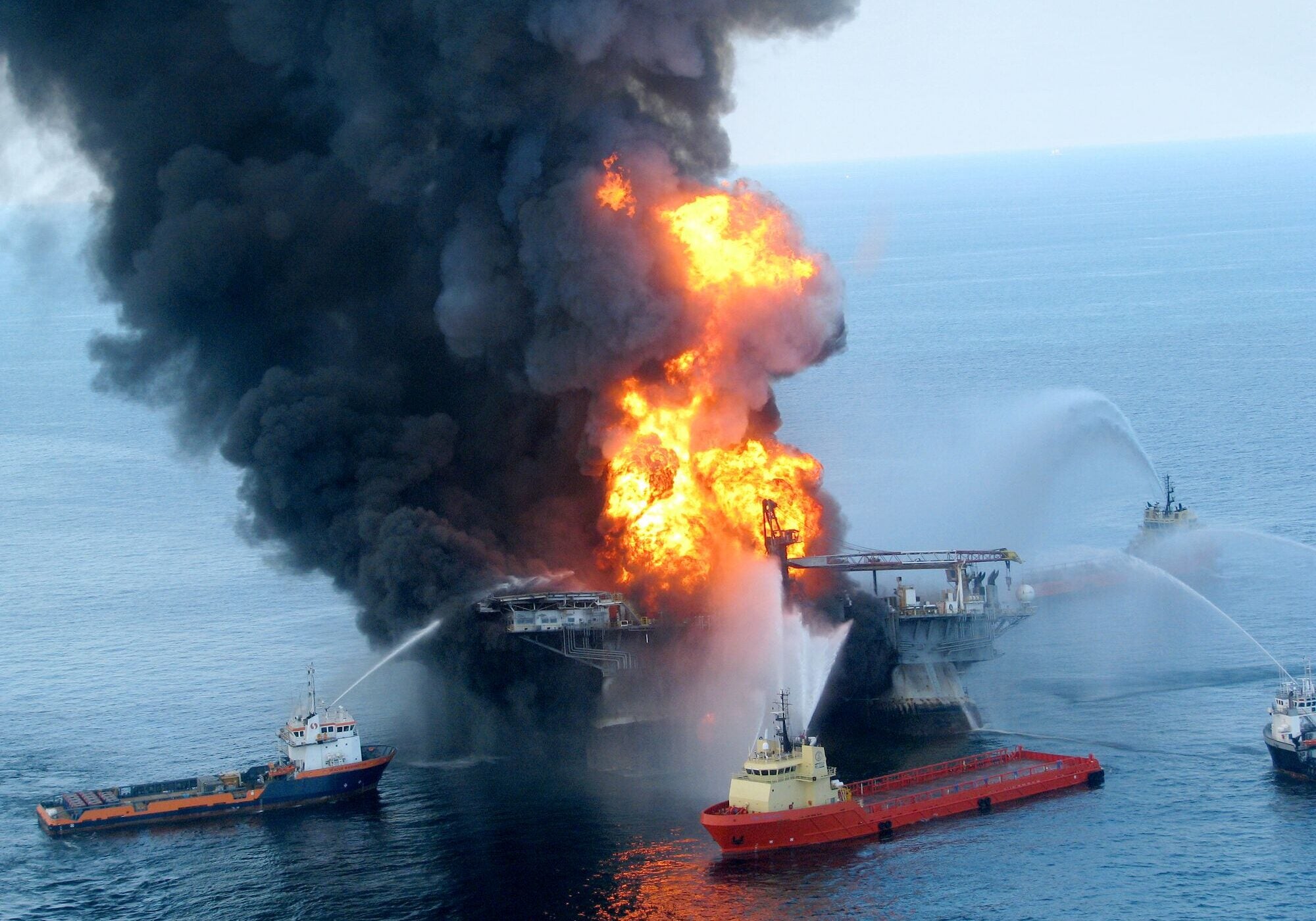
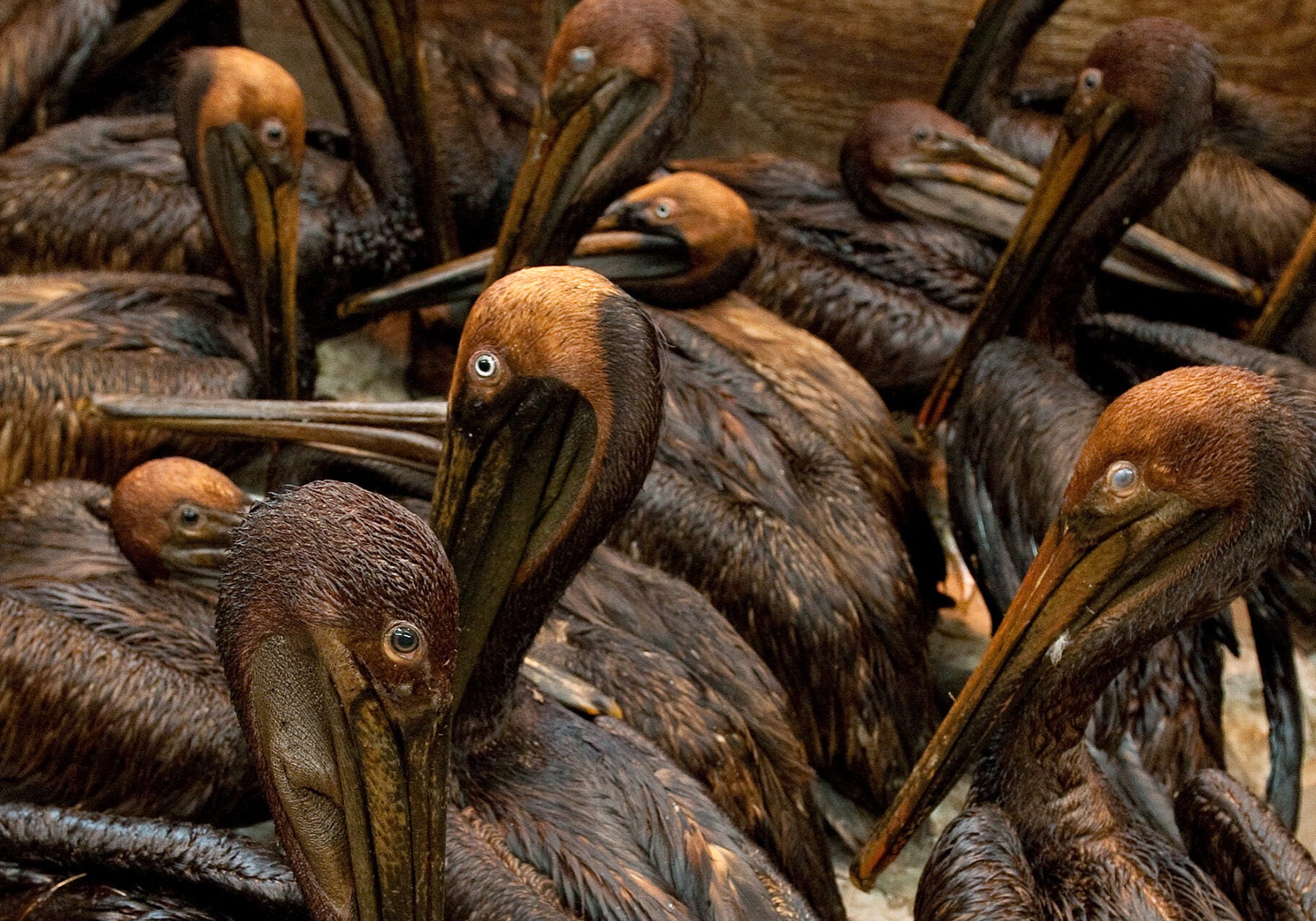
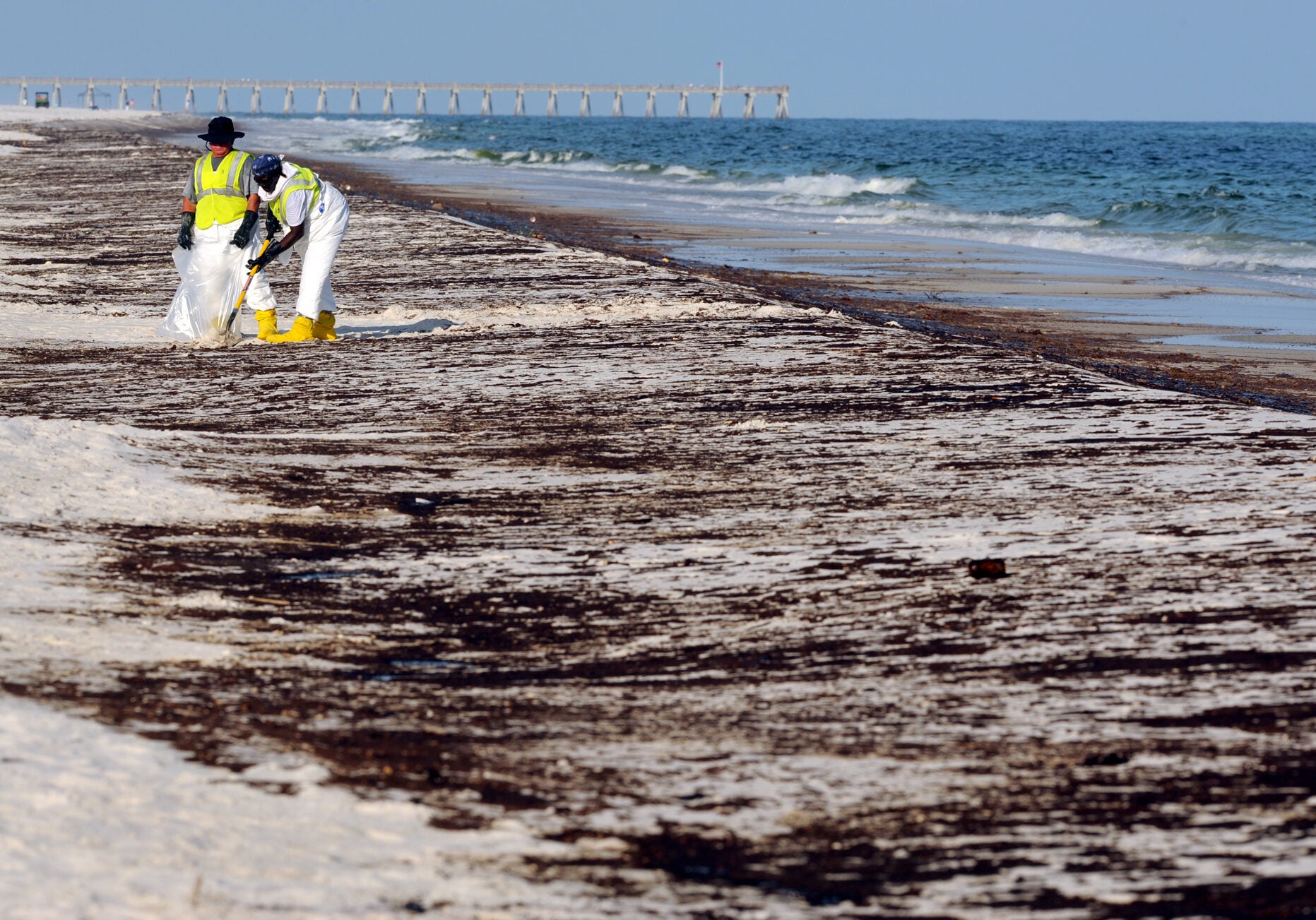
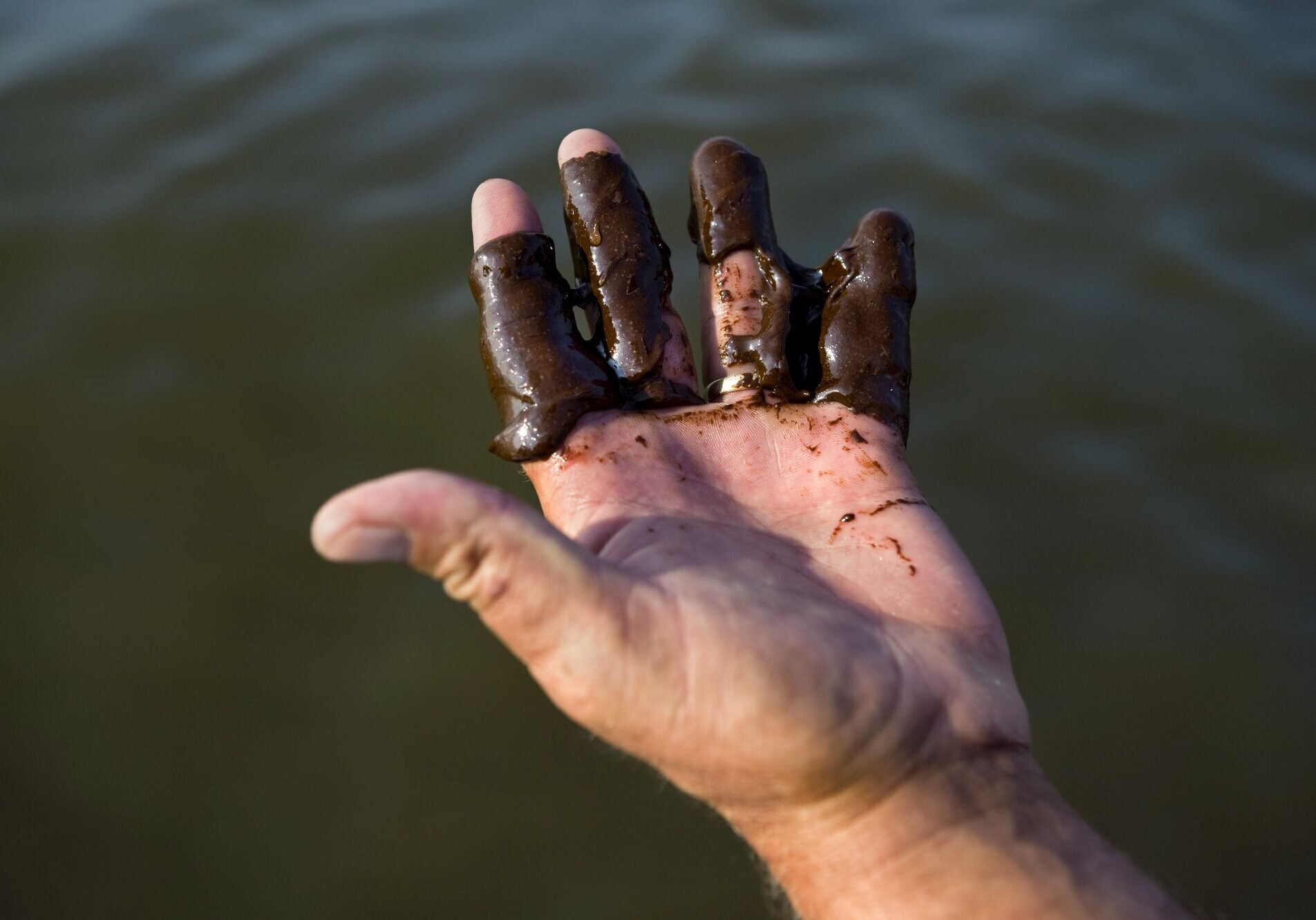
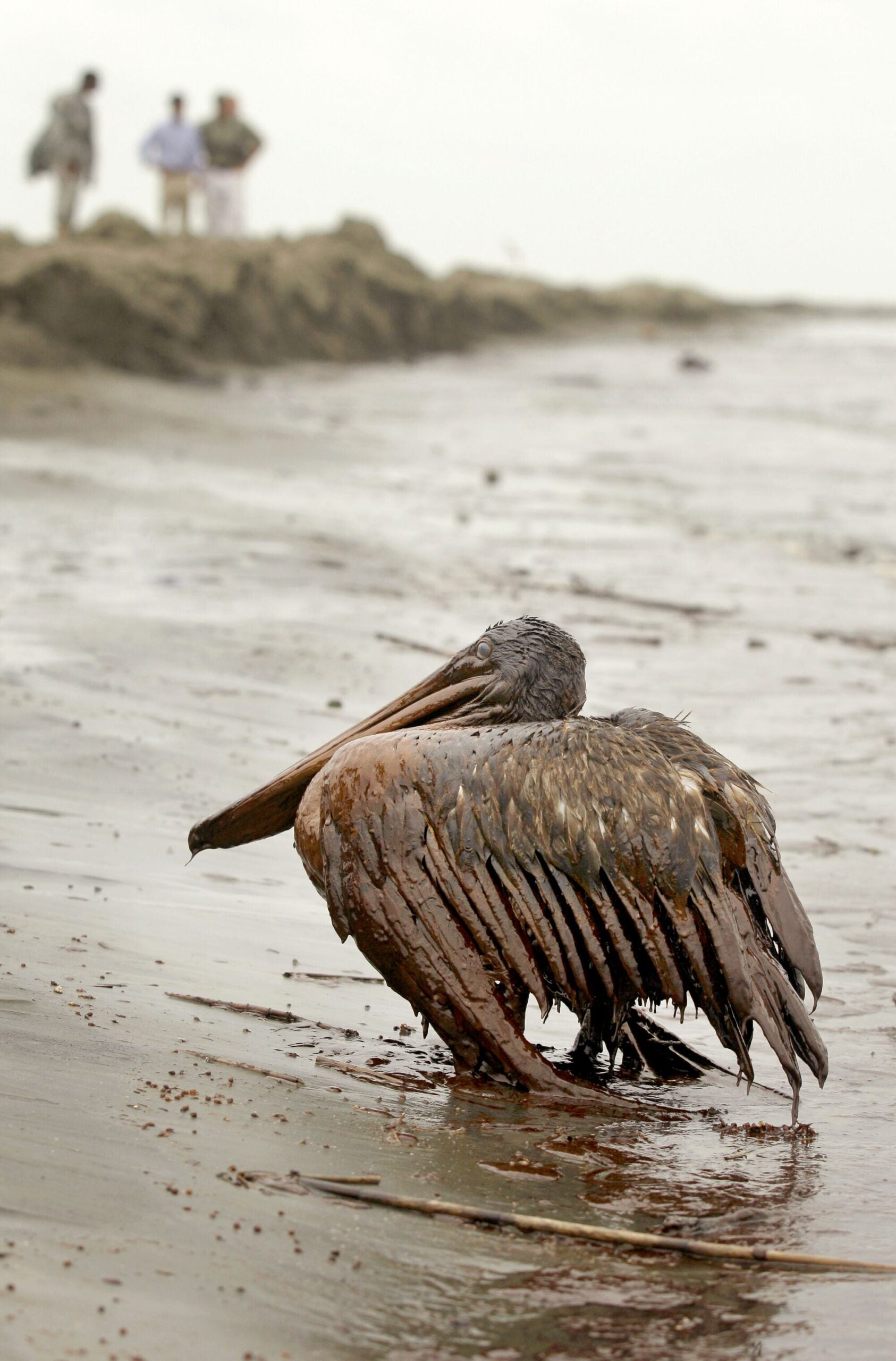
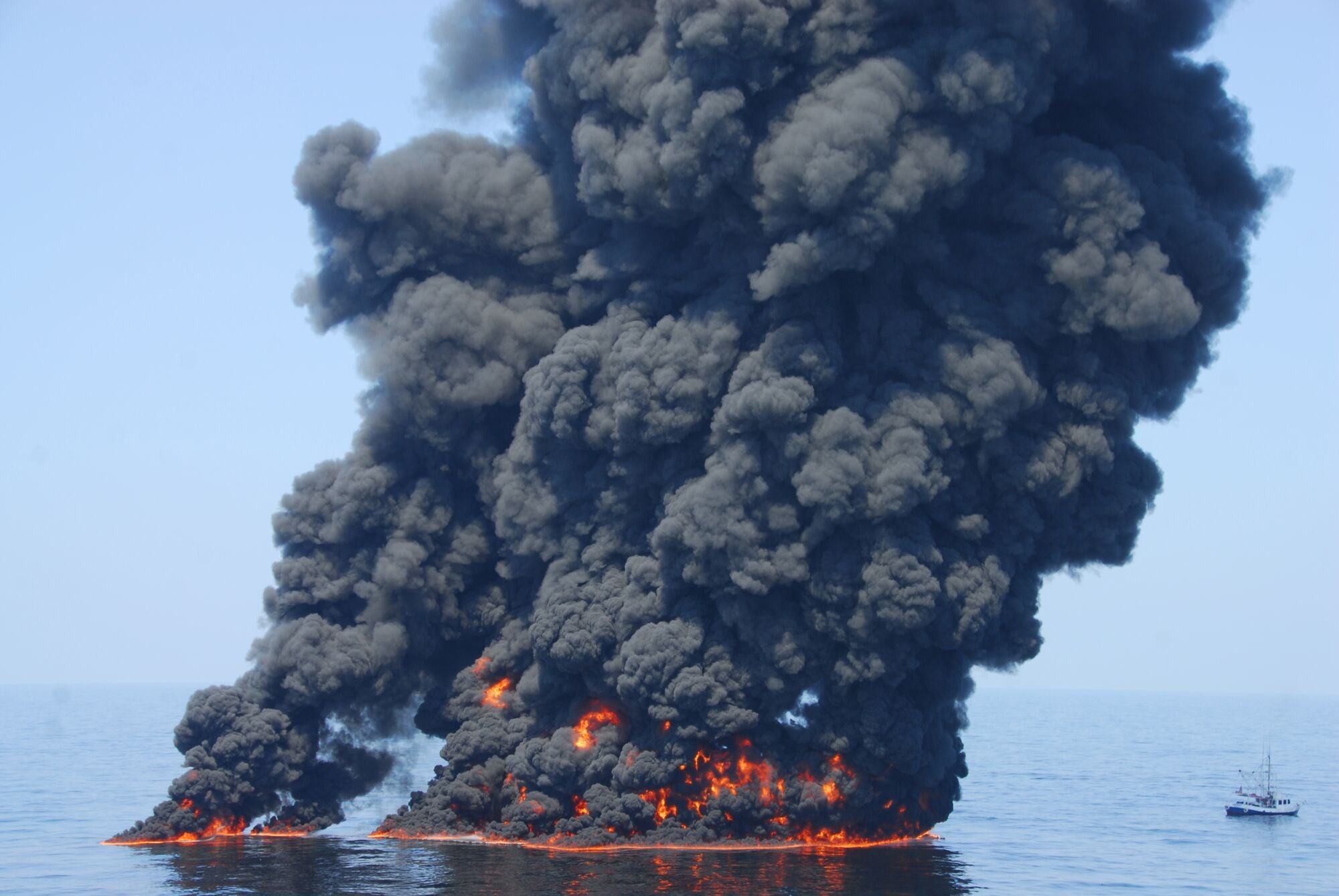
Clockwise from top left: U.S. Coast Guard; Saul Loeb / Getty Images; Benjamin Lowy / Getty Images; Michael Spooneybarger / AP
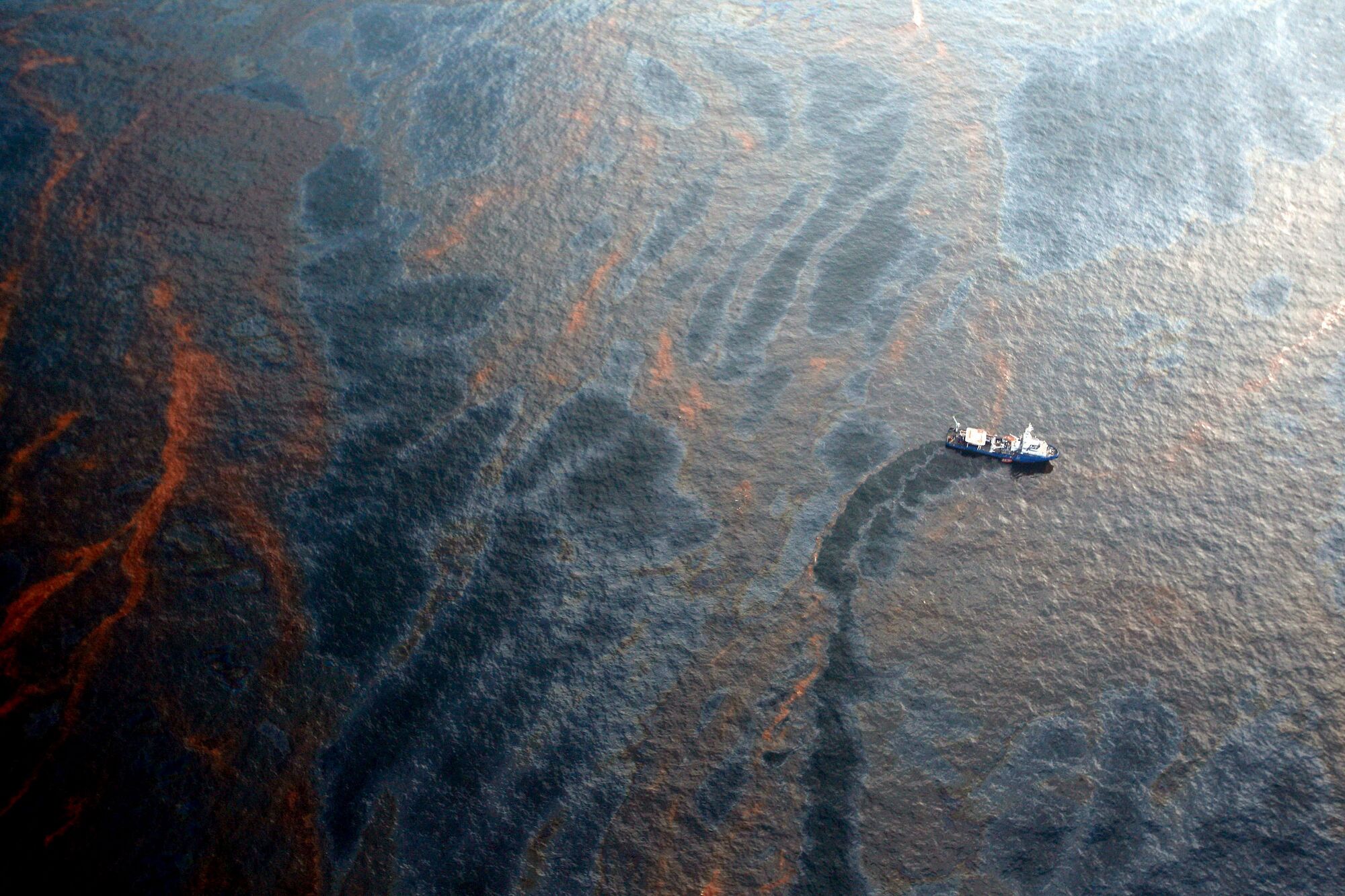
BP’s 2010 Deepwater Horizon disaster contaminated a vast swath of the Gulf of Mexico, devastating the coastlines of five states.
So much for lessons learned.
Just 16 years ago, BP’s Deepwater Horizon offshore oil rig in the Gulf of Mexico burst into flames, triggering the most destructive oil spill in U.S. history.
Now, the same company has received approval from the Trump administration for an even larger, potentially riskier drilling project in nearby waters.
BP’s “Kaskida” project would drill at much greater ocean depths than where Deepwater Horizon was, requiring still-emerging technologies to withstand the “high-pressure, high-temperature” oil well. Such extreme conditions would make the project far more likely to experience the type of “loss-of-control” incident that precipitated BP’s 2010 disaster, which killed 11 workers and spilled 134 million gallons into the Gulf.
Earthjustice is suing the Trump administration for its reckless approval of the project on behalf of Gulf and environmental groups.
The Trump administration’s Bureau of Ocean Energy Management, which did not immediately approve BP’s initial proposal last year, has now given the green light to the project despite significant legal and regulatory shortcomings with the proposal and vocal public opposition to the project.
Multiple members of Congress have called “an unacceptable threat to Gulf communities, ecosystems, and the climate.”
The Kaskida project comes amid a push by the Trump administration for a dramatic expansion of oil and gas development in the Gulf and across public lands, even as the U.S. produces more oil than any nation in history and has become the world’s largest producer of gas.
In the Gulf of Mexico, the oil industry has been moving steadily into deeper ocean waters where the greatest remaining reserves are found. This risky trend of ultra-deepwater drilling is both reckless and unnecessary — given the millions of untapped acres industry already leases in federal waters.

Drill leases move to deeper, riskier waters in the Gulf of Mexico
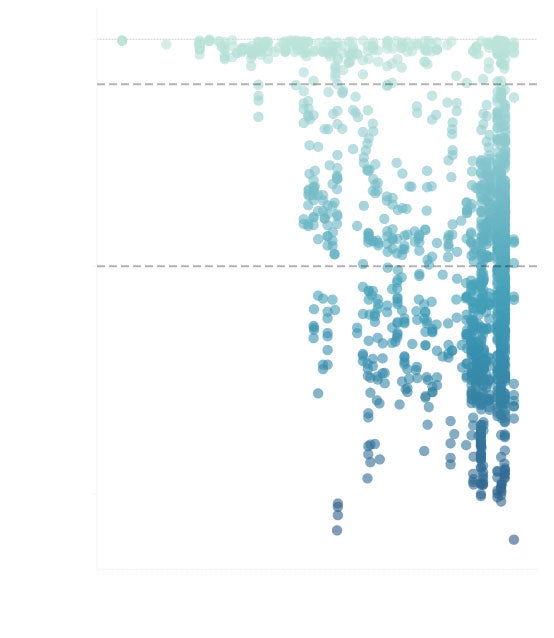
Deepwater: >1,000 ft
Ultra-deepwater: >5,000 ft
Since 2016, 79% of leases have been in deep and ultra-deepwaters. As depth increases, the chance of incidents rises exponentially.
0K
-5K
-10K
1960
1980
2000
2020
Water Depth (feet)
Lease Date
Source: Bureau of Ocean Energy Management, Offshore Statistics by Water Depth, 2/27/2026. Impact of water depth on safety, Muehlenbachs et. al., Energy Policy, Vol. 55, 2013.
Earthjustice has a long track record of protecting the Gulf from fossil fuel expansion in a region long overburdened by pollution and spills.
We will continue to fight against this risky project that threatens public health, vital ecosystems, and the regional economy.
What is Earthjustice doing about Kaskida?
On April 20, 2026, on the anniversary of Deepwater Horizon, Earthjustice filed a lawsuit against the Trump administration for greenlighting Kaskida, BP’s new ultra-deepwater drilling project.
We’re challenging the administration’s approval of BP’s development proposal because legally-required information is either missing or significantly flawed. The approval sets a dangerously low bar for oil-and-gas companies that want to drill in our public waters.
For years, Earthjustice and our partners in the Gulf have advocated for stronger protections against reckless offshore drilling in the region. But the Trump administration has been trying to tear down basic safeguards that protect people, ecosystems, and business across the Gulf from being harmed.
- Last February, we sued the Trump administration for seeking to revoke rules protecting millions of acres of undeveloped public waters from future oil and gas drilling.
- And last March, we successfully challenged a 73-million-acre oil and gas lease sale in the Gulf.
In fact, Earthjustice has challenged all nine offshore oil-and-gas auctions that the U.S. government has held since 2018 for violating federal environmental laws.
We have won 100% of these cases.
What is Kaskida?
The Kaskida project is an offshore oil drilling project proposed by BP and approved by the Trump administration, with drilling planned to start in 2029.
The oilfield is located roughly 250 miles southwest of New Orleans, as deep as 6,200 feet in the Gulf of Mexico.
The company projects the new ultra-deepwater hub would produce 80,000 barrels of oil per day from six wells, and open access to as much as 10 billion barrels in the deep waters of the Gulf. If developed, this project would be BP’s first new oilfield in the Gulf since its 2010 Deepwater Horizon disaster.
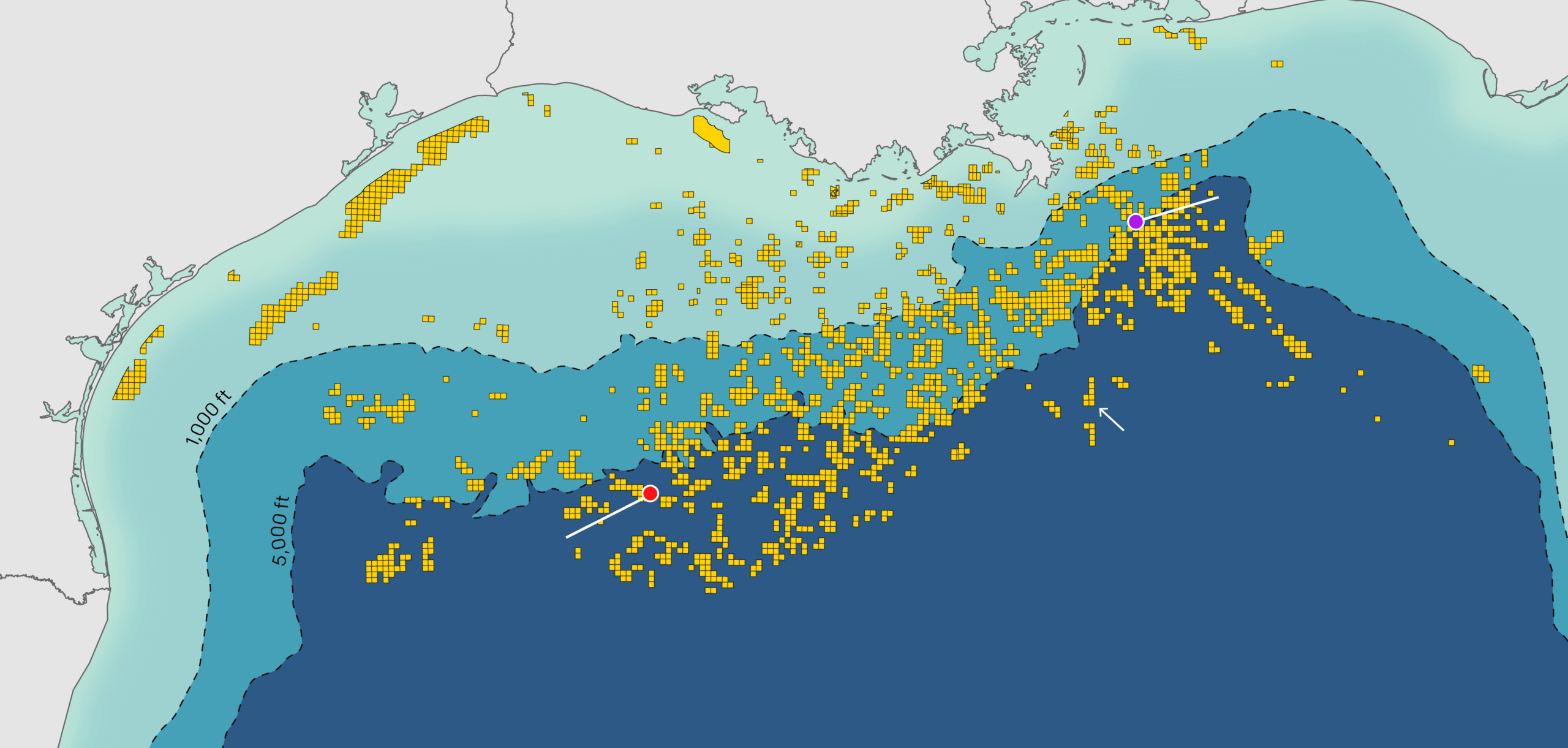
Oil companies target deeper, riskier waters in the Gulf of Mexico
BP’s Kaskida offshore oil drilling project is part of an alarming trend of companies pursuing leases in ever deeper public waters since the 2010 BP Deepwater Horizon disaster.
Shallow
water wells
Deepwater
wells
Ultra-deepwater wells

0 –
1,000 ft
1,000 –
5,000 ft
Deepwater
Horizon
5,000 ft
Kaskida
6,200 ft
5,000 –
12,000 ft
Deepwater Horizon
5,000 ft
Kaskida
6,200 ft

0–1,000 ft
1,000–5,000 ft
5,000–12,000 ft
Shallow
water wells
Deepwater
wells
Ultra-deepwater
wells
The latest leases go to at least 2034. Lease terms are usually extended for decades.
Deepwater Horizon
Kaskida
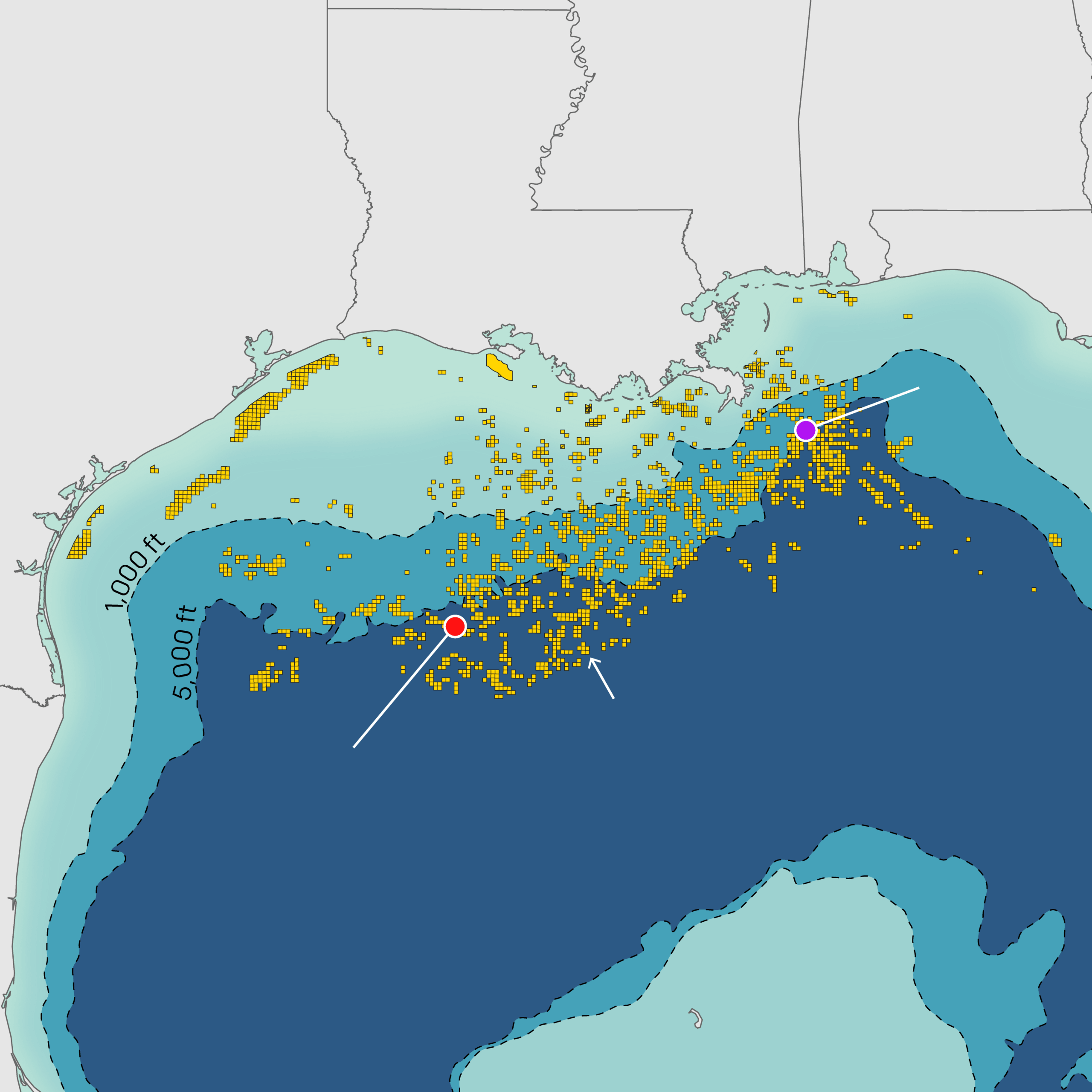
As of Feb. 27, 2026, there are nearly 2,000 active offshore lease blocks. Most are in deepwater and ultra-deepwater, where accidents and spills are much more likely to occur.
Source: Active lease polygons, BOEM, 2/27/2026. Depth bathymetry, GEBCO_2020 Grid.
Deepwater Horizon
Kaskida
As of Feb. 27, 2026, there are nearly 2,000 active offshore lease blocks. Most are in deepwater and ultra-deepwater, where accidents and spills are much more likely to occur.
Source: Active lease polygons, BOEM, 2/27/2026. Depth bathymetry, GEBCO_2020 Grid.
Why is Kaskida so risky?
While all deepwater drilling is inherently risky, Kaskida would take those potential hazards to new extremes.
Researchers have found that the likelihood of incidents like blowouts and oil spills from offshore drilling operations increases exponentially with depth, making this new frontier of ultra-deepwater drilling particularly risky.
How Much More Dangerous is Kaskida?
Deepwater high-pressure, high-temperature (HPHT) wells are more dangerous than standard deepwater wells. These charts show the likelihood of a “loss of control” blowout for HPHT wells, the type of event that caused Deepwater Horizon, compared to standard deepwater wells. Kaskida is classified as a HPHT well, where pressures exceed 15,000 psi and 350°F.
Deepwater wells incident rate
1x
High-pressure, high-temperature wells
6x more likely
HPHT wells in the Gulf of Mexico
7x more likely
Source: International Association of Oil and Gas Producers, Risk assessment data directory – Blowout frequencies, IOGP Report 434-02.
In its proposal, BP’s math shows that a loss-of-control incident at Kaskida could spill up to 4.5 million barrels of oil into the Gulf and take 100 days to stop.
To put that in perspective, the blowout that caused the Deepwater Horizon disaster led to the release of 4.9 million barrels and took 87 days to stop. Additionally, the company did not provide the calculations behind their projection, precluding the public from independently verifying the data.
BP has not indicated whether the equipment it will use to drill is certified for the high pressures and temperatures. BP also has not demonstrated that it is qualified to drill a high-pressure, high-temperature well. Nor has BP shown it has the expertise or equipment to stop a potential blowout or contain a spill at an ultra-deepwater site.
The Depths We Go to for Oil
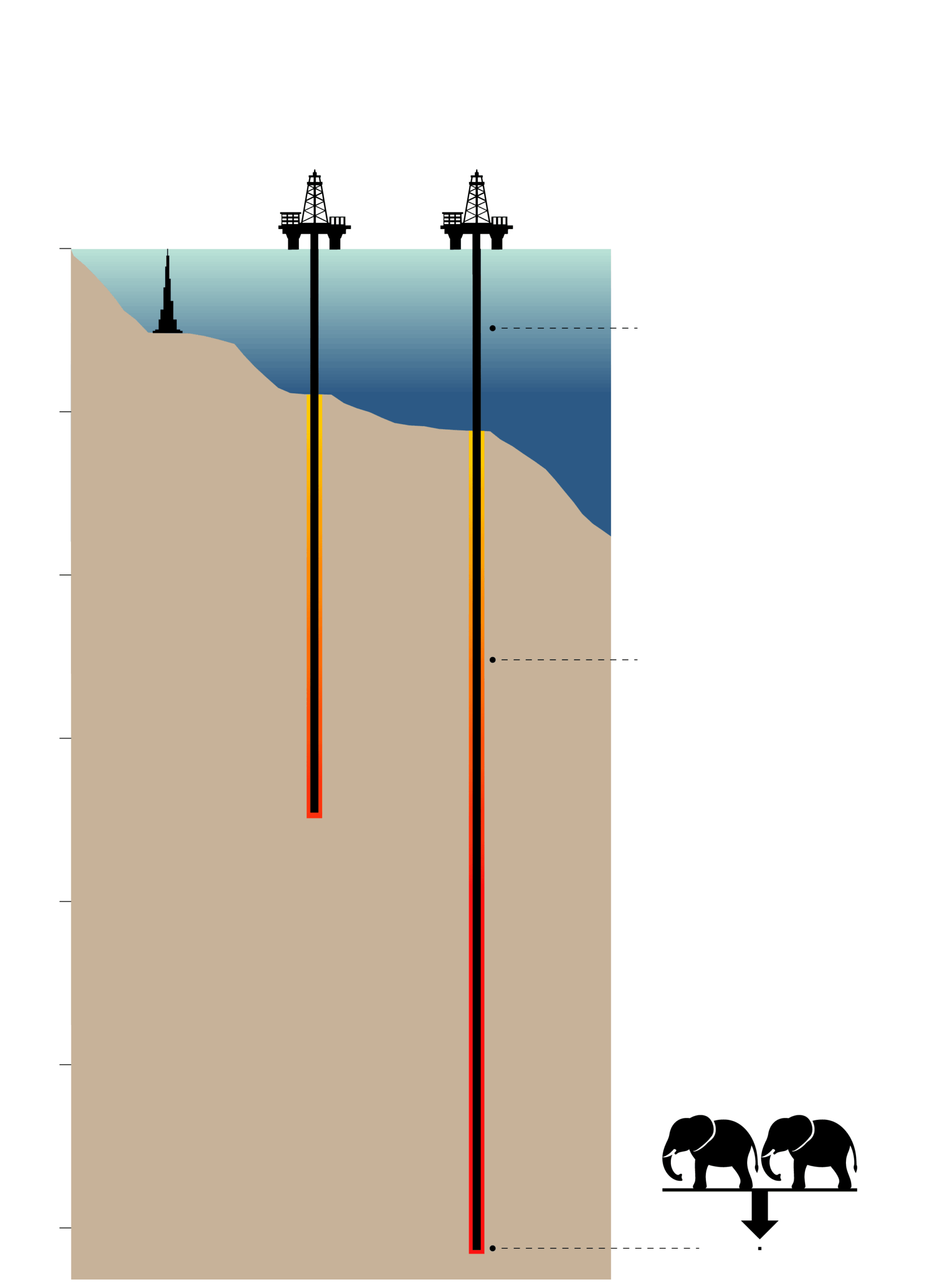
Burj Khalifa
Height:
2,717 ft
Deepwater Horizon Well Water depth:
5,000 ft
Below sea level: 18,360 ft
Kaskida Oil Discovery Water depth: 6,200 ft
Below sea level: 32,500 ft
The world’s tallest building is dwarfed by the depths of offshore drilling.
At 3.5 miles deep, this well pales in comparison to the Kaskida proposal.
At over 6 miles down, this hole is deeper than the height of Mt. Everest.
Depth matters: Researchers have found that as underwater depth increases, the chance of incidents increases exponentially.
Hot in here: Temperature rapidly increases, going up 1.4°F for every 100 feet. Conditions are harder to work in and containment becomes more difficult when an accident happens.
0 mi
1 mi
2 mi
3 mi
4 mi
5 mi
6 mi
The Depths We Go to for Oil
Burj Khalifa Height: 2,717 ft
Deepwater Horizon Well Water depth:
5,000 ftBelow sea level: 18,360 ft
Kaskida Oil Discovery Water depth: 6,200 ft Below sea level: 32,500 ft
0 mi
1 mi
2 mi
3 mi
4 mi
5 mi
6 mi
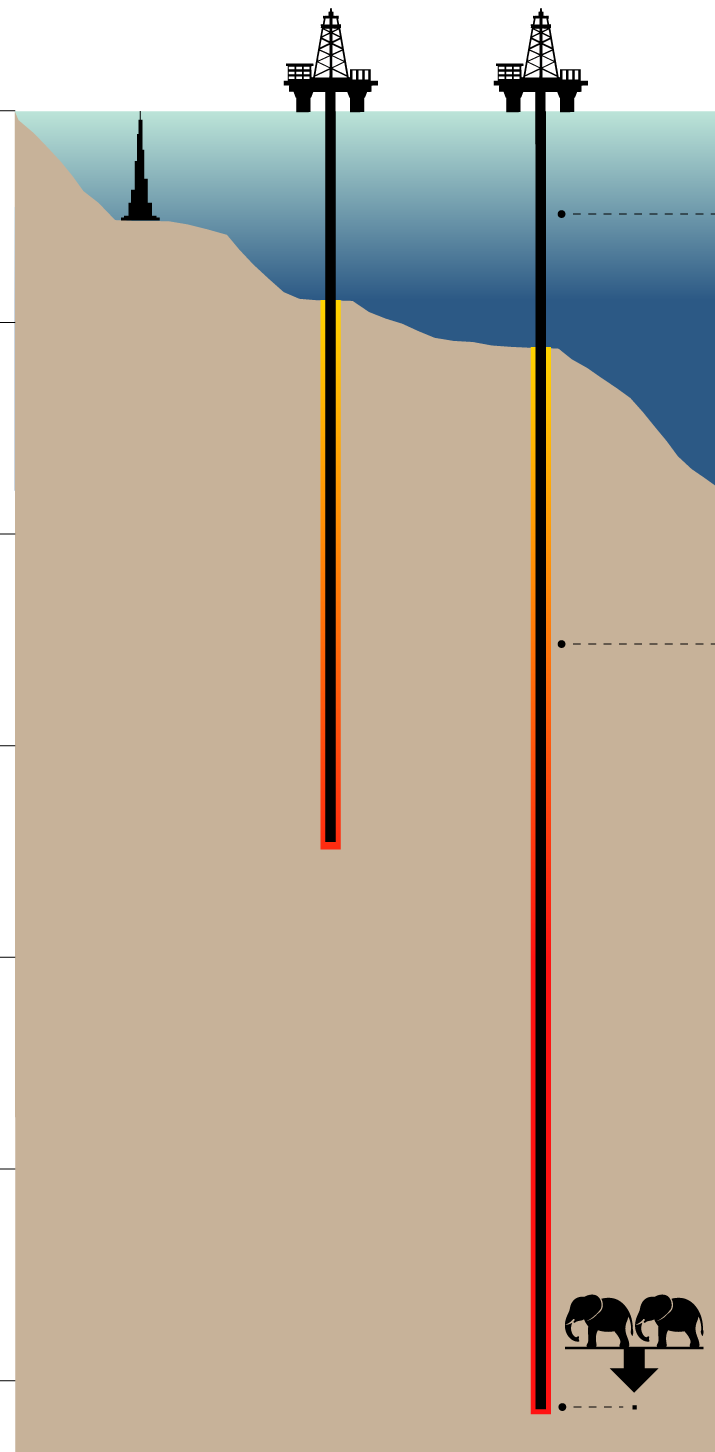
The world’s tallest building is dwarfed by the depths of offshore drilling.
At 3.5 miles deep, this well pales in comparison to the Kaskida proposal.
At over 6 miles down, this hole is deeper than the height of Mt. Everest.
An extreme environment: It all adds up, at this depth temperatures could exceed 370°F where the oil is scalding hot. Pressure becomes enormous, reaching up to 20,000 psi.
That’s like the weight of two elephants focused on the area of a postage stamp.
Depth Matters: Researchers have found that as underwater depth increases, the chance of incidents increases exponentially.
Hot in Here: Temperature rapidly increases, going up 1.4°F for every 100 feet. Conditions are harder to work in and containment becomes more difficult when an accident happens.
Kaskida would also be vulnerable to increasingly strong and destructive hurricanes, amid rising ocean temperatures related to climate change.
Meanwhile, the large waves and high winds at the site would make mechanical spill cleanup essentially impossible, forcing BP to instead rely on chemical dispersants and burning, neither of which remove pollution.
Kaskida is emblematic of an alarming trend in offshore drilling in the U.S., with companies increasingly pursuing ever deeper wells. Greenlighting the project greatly increases the risk of catastrophic oil spills, while further burdening Gulf communities forced to deal with polluting industries that are profiting at their expense.
Is there actually a need for the Kaskida project?
The oil industry and the Trump administration have claimed that projects like Kaskida are necessary to ensure U.S. energy security.
But the data tell a very different story.
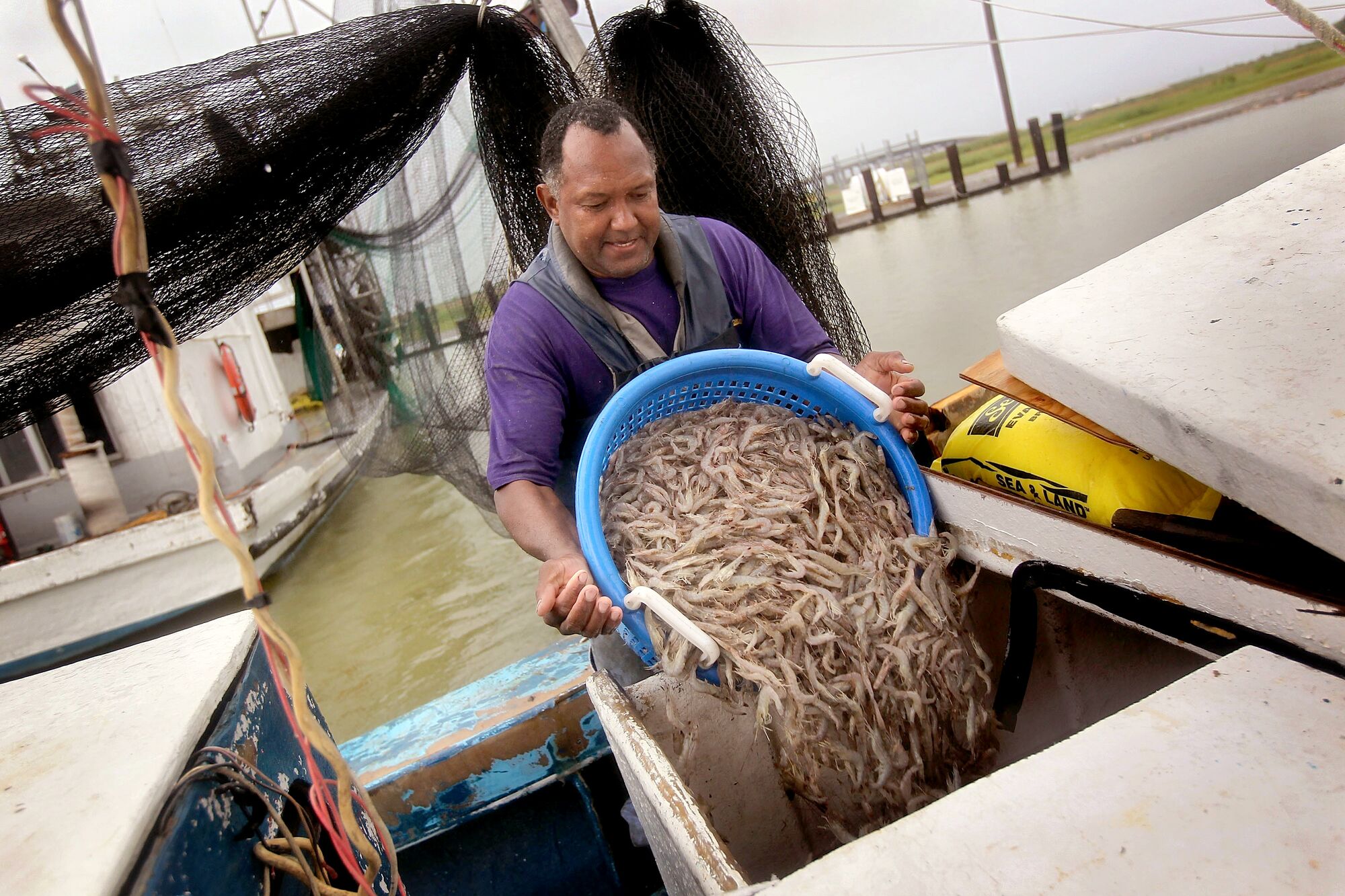
- The United States is already producing more oil than any nation in history, with a glut of supply. In fact, roughly 80% of the nearly 2,000 active leases that oil and gas companies hold in the Gulf are not actually producing anything at all, in large part because of an oversaturated market.
- Meanwhile, the argument that such projects are crucial job generators is also not borne out by the numbers. Despite record production and profits, some of the biggest companies involved in offshore drilling have actually cut about 25% of their domestic workforce over the last decade.
Under the guise of a “national energy emergency,” the Trump administration has opened up vast swathes of public lands and waters to drilling, while also accelerating permitting and rolling back environmental safeguards. And the fossil fuel industry is taking the opportunity to stockpile leases and profits.
What is BP’s track record in the Gulf?
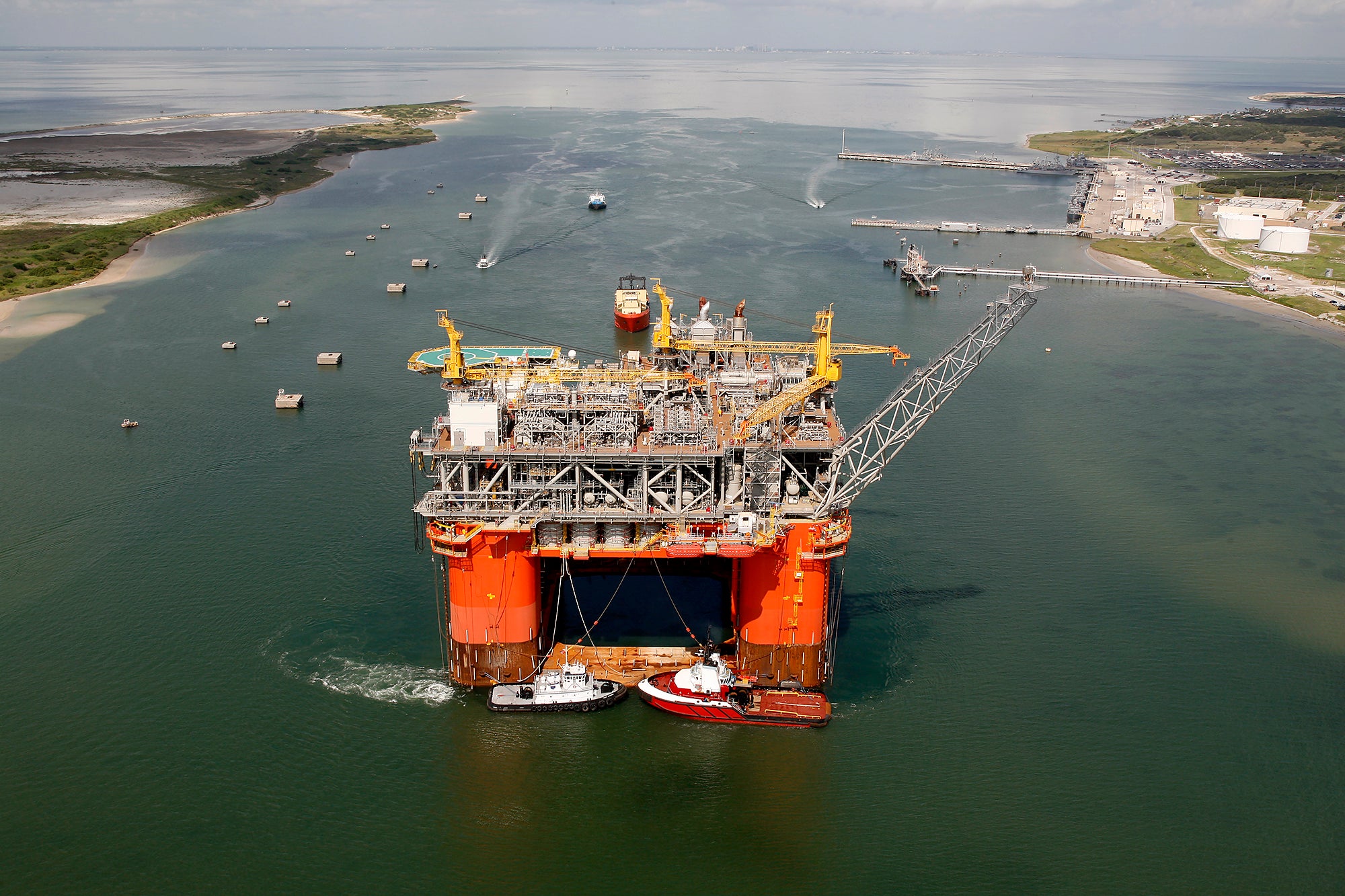
The 2010 Deepwater Horizon disaster contaminated an area of the Gulf the size of Virginia, polluting some 1,300 miles of coastline across five states.
- The vast amount of crude oil that gushed from the well for 87 straight days killed or seriously harmed billions of fish, sea turtles, whales, birds, and other animals — including many species listed as threatened or endangered — and severely damaged critical deep-sea coral communities.
- Some fish and marine mammals still show signs of chronic illness and toxicity from the incident.
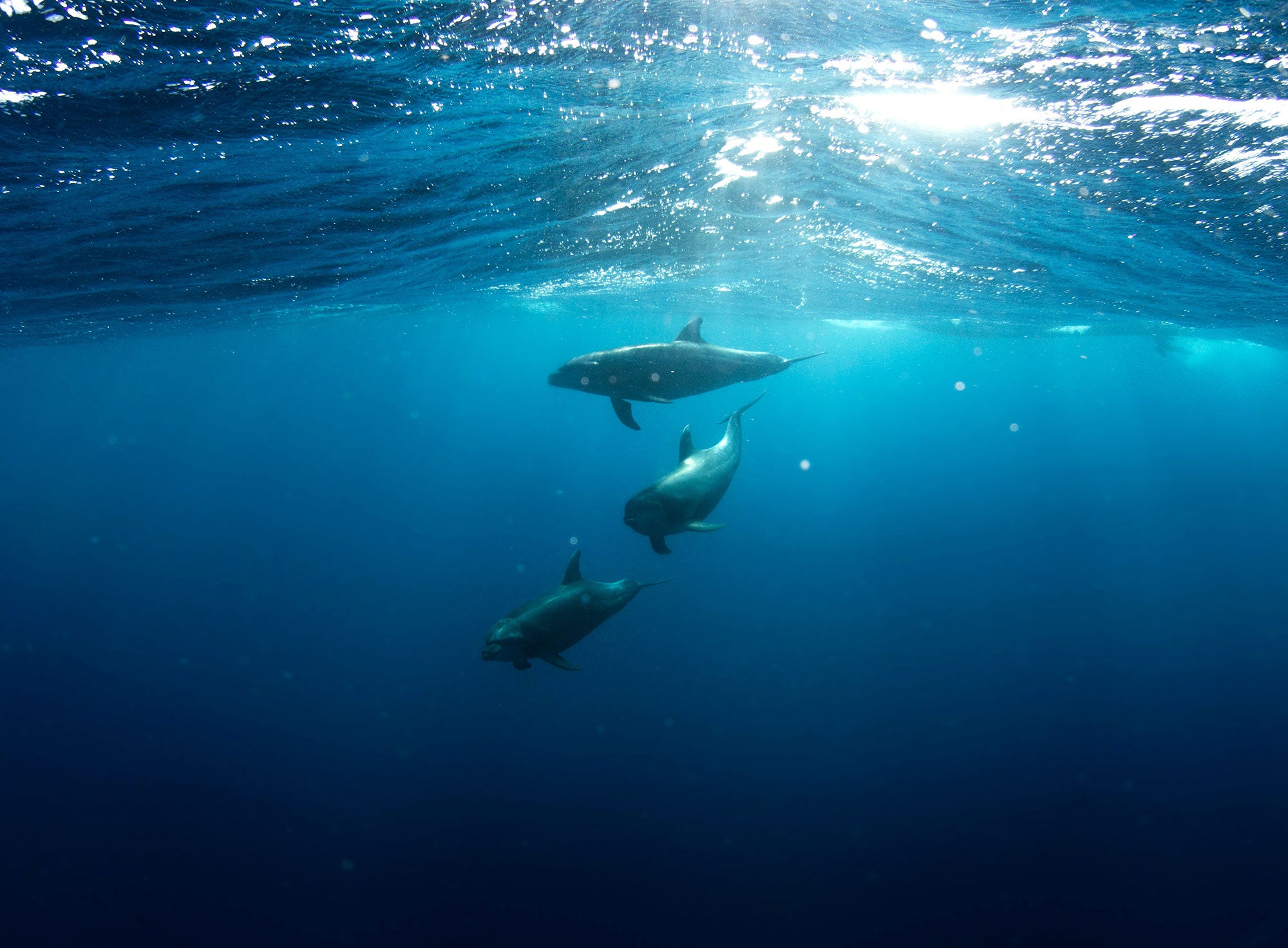
- The incident also wiped out as much as 22% of the critically endangered Rice's whale population, putting it on a trajectory toward extinction.
- The economic toll was equally devastating on the mostly lower-income communities of color in the region that have long been disproportionately impacted by the fossil industry.
All told, the spill inflicted more than $17 billion in damage to natural resources and 25,000 job losses.
Despite BP maintaining it was not chiefly responsible, a federal judge ruled that the company was grossly negligent, finding the company had acted with “conscious disregard of known risks.”
The resulting settlement in the case became the largest environmental damage settlement in U.S. history and the overall cleanup and claims costs have climbed to over $65 billion.
How You Can Help
We must protect our oceans from the dangers of oil and gas drilling. Tell your member of Congress how important these protections are to you.
Matthew Green is a Berkeley-based journalist covering a range of environmental issues. He was previously a reporter and editor at KQED News. When not chasing stories, he can usually be found chasing after his two young daughters.
“The Depths We Go To For Oil” Infographic Sources: Impact of water depth on safety, Muehlenbachs et. al., Energy Policy, Vol. 55, 2013. Average African elephant weight, Britannica, 2/18/2026. Kaskida oil discovery, “BP hits pay on Kaskida,” Offshore Magazine, 8/31/2006. Depth temperature calculated from average geothermal gradient.
Header Photos: BP’s 2010 Deepwater Horizon disaster contaminated a vast swath of the Gulf of Mexico, devastating the coastlines of five states.
Earthjustice’s Oceans Program uses the power of the law to safeguard imperiled marine life, reform fisheries management, stop the expansion of offshore oil and gas drilling, and increase the resiliency of ocean ecosystems to climate change.