

Supreme Court Will Consider Case Challenging U.S. Air Force’s Illegal Decision to Blow Up Bombs on the Beach in Guam
Oral arguments will take place during fall session
Contacts
Jackson Chiappinelli, jchiappinelli@earthjustice.org
The U.S. Supreme Court granted the Trump administration’s request to hear a case over the U.S. Air Force’s ongoing practice of openly detonating hazardous bombs and other munitions in Guam without the environmental review required under federal law.
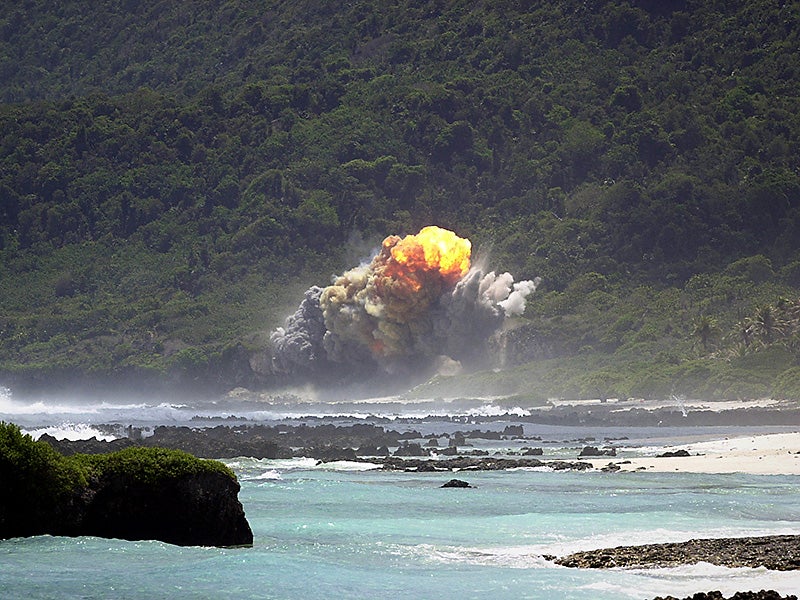
The case, Department of the Air Force v. Prutehi Guåhan, concerns whether the Air Force can be sued over its decision to conduct open burning and detonation operations on a beach in Guam, and if the Air Force violated the National Environmental Policy Act (NEPA) when it failed to conduct the legally required environmental review beforehand. Last February, the Ninth Circuit confirmed the Air Force can be sued for its decision — and that it must comply with NEPA.
Earthjustice is representing Prutehi Guåhan — a Guam-based group dedicated to the protection of the island’s natural and cultural resources — which sued the Air Force for violating NEPA before detonating bombs and other explosive hazardous waste out in the open on Tarague Beach. The Air Force’s disposal operations threaten significant harm to the surrounding environment, including by contaminating an aquifer that supplies more than 80 percent of the drinking water for the U.S. territory’s population. Contaminants from the explosions also enter the ocean, threatening harm to local residents who frequent nearby beaches, as well as to culturally significant fishing sites, endangered green sea turtles, and migratory seabirds.
“We continue to carry many scars of war and war games that remain in our landscape, our bodies, and in our hearts and minds,” said Monaeka Flores of Prutehi Guåhan. “We deserve justice for the harms that we continue to endure through the military’s ongoing practice of open detonation of hazardous materials. This decision only slows that delivery of justice for our island.”
“For years, the Air Force has chosen to dispose of its munitions stockpile by exploding bombs on our clients’ ancestral lands and threatening most of Guam’s drinking water supply,” said David Henkin, deputy managing attorney of Earthjustice’s Mid-Pacific regional office. “Federal law gives our clients a pathway to force the Air Force first to take a hard look at the consequences of that choice and consider less environmentally destructive ways to get the job done. Now that the Supreme Court has decided to hear the case, we will continue to defend Guam residents’ ability to protect their health, their land, and their resources.”
Background
The Air Force first received a permit to conduct open burning and detonation operations at Andersen Air Force Base in 1982. While no open burning has occurred since 2002, the Air Force has continued detonating hazardous waste explosives on Tarague Beach in northern Guam. The Air Force has never taken the legally required “hard look” at the impacts of these hazardous operations on the human environment or considered safer alternatives, despite the potentially significant harms that disposal of hazardous waste munitions can inflict on the surrounding environment and people’s health.
By failing to do so, the Air Force has denied Guam-based stakeholders like Prutehi Guåhan and the public the chance to provide input before the Air Force decides to move forward with operations that could poison Guam’s main source of drinking water and contaminate ancestral lands.
The practice of openly burning and detonating munitions releases harmful substances and chemicals linked to cancer, neurological damage, and groundwater contamination into the land, air, and ocean. The Air Force could avoid these environmental and safety risks by exploring alternative technologies and locations, including sites outside Guam. The National Academies of Sciences, Engineering, and Medicine confirmed such alternatives in 2019, before the Air Force decided to seek its latest permit to continue its disposal operations. The National Academies published a report that concluded that “viable alternative technologies exist within the demilitarization enterprise” for almost all the munitions in the military’s demilitarization stockpile, including munitions that the Air Force disposes of in Guam using open detonation. The report also concluded that alternative disposal technologies would all have “less of an environmental and public health impact” compared to open burning and detonation.
Additional Resources
About Earthjustice
Earthjustice is the premier nonprofit environmental law organization. We wield the power of law and the strength of partnership to protect people's health, to preserve magnificent places and wildlife, to advance clean energy, and to combat climate change. We are here because the earth needs a good lawyer.