
Zeldin wants you to think his EPA is serious about environmental enforcement. The evidence tells a different story.
Laws without penalties are just requests.
When the Environmental Protection Agency posted its enforcement results for fiscal year 2025, it made an astounding claim: it said the Trump administration was behind “some of the strongest achievements in years.” This followed EPA Administrator Lee Zeldin’s assertion in February that EPA is “racking up massive environmental accomplishments under the Trump administration.”
Last year, I wrote about the collapse in environmental enforcement under Trump. I’m not the only one; this trend is well documented. And no amount of hyperbole in EPA’s enforcement report can mask the administration’s rapid retreat from holding polluters accountable.
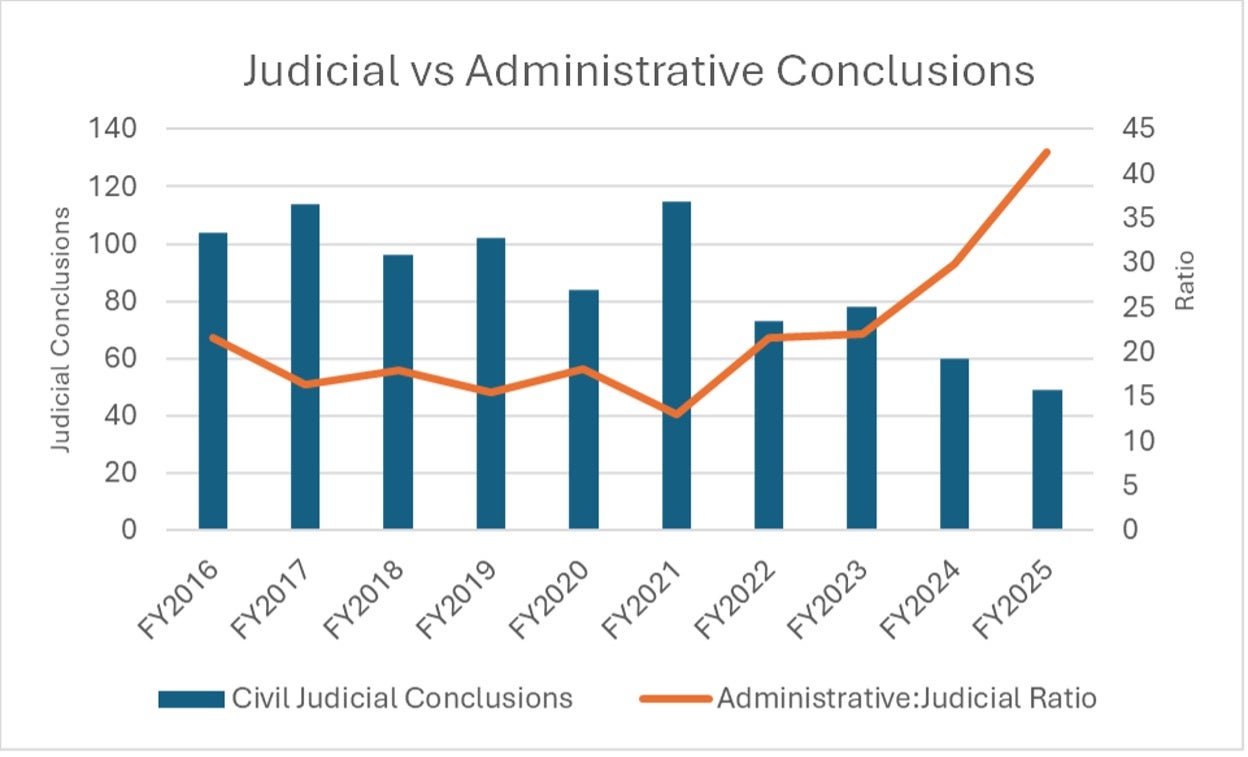
Take EPA’s boast that it concluded the highest number of civil enforcement cases in nine fiscal years. Yet EPA’s own data reveals the lowest number of conclusions in judicial cases (its strongest enforcement tool against industrial polluters) in at least a decade — a number that is 65 fewer cases than the first fiscal year of Trump 1. Meanwhile, the ratio of administrative to judicial conclusions skyrocketed under Zeldin.
Funneling Cases into Weaker Settlements
This suggests that Zeldin’s EPA is funneling cases into administrative channels, which are far less powerful enforcement tools. These in-house orders impose fewer requirements and lower penalties. They have a limited duration. There’s no avenue for community input and no federal judge to ensure that the outcome is a good one. These are low-visibility actions generally preferred by companies that want to keep their names out of the headlines.
To be sure, EPA has always resolved some cases administratively. This makes sense for smaller, less serious violations. But when the government wants to send a message, it files a case in court, where penalties can be an order of magnitude higher, compliance requirements are backed by the threat of court sanctions, and the media amplify the result.
It’s crucial that EPA chooses an enforcement path that fits the seriousness of the violations. You don’t issue a traffic ticket for grand theft auto. So, it’s alarming that the balance shifted so dramatically toward administrative actions. Under Zeldin, EPA is backing away from the enforcement path that creates the strongest deterrent effect and leads to the biggest public health benefits.
Trump Is Taking Credit for Biden’s Work
An Earthjustice review of government data reveals that the story gets even worse: the Trump administration is responsible for virtually none of the judicial cases behind what EPA calls the “strongest enforcement and compliance results in years.”
Consider one of the report’s “case highlights,” NL Industries-Raritan Bay Slag Superfund Site, which involved a $151.1 million settlement to support cleanup work in New Jersey. In this case — and a dozen more like it — all the substantive work of developing the case, negotiating claims, filing the settlement, responding to public comment, drafting briefs, and so on, happened before Trump took office. The only thing that Trump and Zeldin can take credit for is waiting for a court order.
Hino Motors, Ltd is another “case highlight” touted by EPA. In that case, EPA imposed more than a billion dollars in criminal fines and civil penalties for the illegal import of engines that violated Clean Air Act standards. This is a phenomenal result — one that was negotiated, executed, and filed on January 15, 2025, before Zeldin and Trump were in office.
Similar examples abound. Manitowoc? Biden. Honeywell International? Biden. Petroleum Products Corporation? Biden. Three major Clean Air Act (CAA) settlements totaling approximately $600 million in penalties? Biden, Biden, and Biden.
In fact, of the over $650 million in civil penalties trumpeted in the annual results, only $1.45 million (or less than one percent) is from judicial settlements filed and entered during the Trump administration.
No Penalties, No Consequences
This EPA would have you believe that penalties don’t matter. They’re wrong. Laws without penalties are just requests. Penalties incentivize compliance. They make sure corporations can’t profit from wrongdoing. They level the playing field so that bad actors don’t get an advantage. Penalties are what keep corporations from making noncompliance a business strategy.
In the next fiscal year, Trump and Zeldin won’t have the Biden results to hide behind. And it’s hard to see how the administration will keep up the charade. Trump’s DOJ is busy undoing its own enforcement results from years past, declaring that requirements in a court-ordered consent decree from 2020 can be “displaced” by an executive order. Meanwhile, EPA has given corporations a roadmap to delay enforcement efforts and demoted career staff who oversee enforcement.
And then there’s the exodus of staff from the section tasked with bringing judicial enforcement cases. Dozens of attorneys and professional staff left DOJ’s environmental enforcement section after Trump was elected. Dedicated public servants who stayed to protect the mission are now working on politically charged cases that seek to undo state environmental protections, instead of enforcing laws that protect human health and the environment.
What’s Really at Stake
The real question is why EPA wants you to think that it takes enforcement seriously, and whether it intends to keep up appearances after the midterms. Maybe EPA knows that Americans want the federal government to enforce strict clean air and water regulations. Maybe it’s hoping to distract from Zeldin’s massive deregulatory effort that will (among many other things) allow more toxic air emissions from coal-burning power plants and more forever chemicals in our drinking water.
Whatever EPA’s motivation, it’s clear that we must continue to hold the administration accountable for the collapse in enforcement of environmental laws. These are the laws that protect children from being exposed to toxic chemicals in school yards, that stop factories from belching cancer-causing smoke into the air, and that prevent untreated sewage from reaching our drinking water. These laws are empty promises without enforcement. And if the federal government won’t do it, then Earthjustice will.
Lauren Wollack
Vice President, Public Affairs and Communications, Earthjustice
lwollack@earthjustice.org