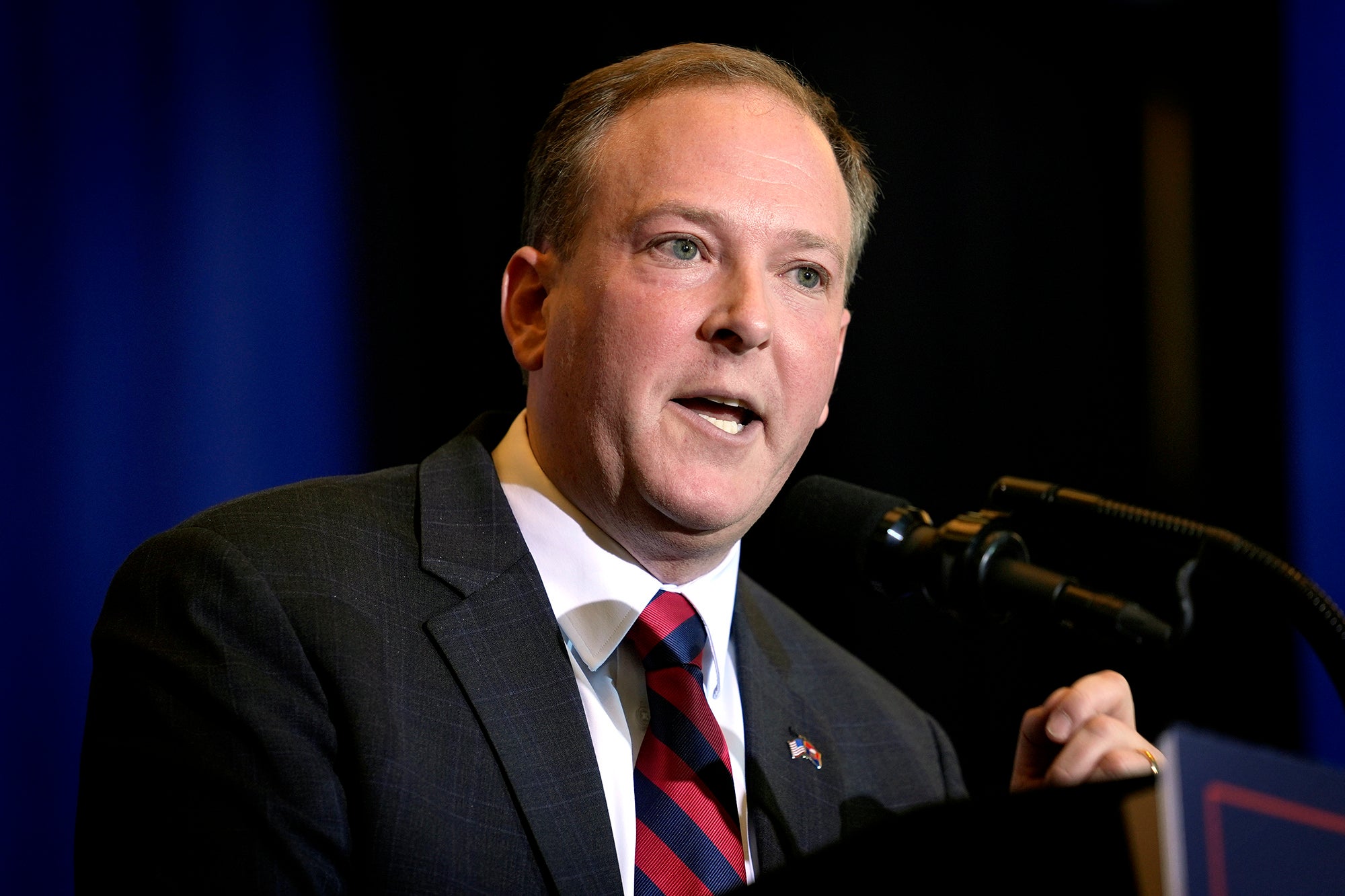

Zeldin Said He’d Protect Clean Air and Water. The EPA Budget He Brought To Congress Tells a Different Story.
Zeldin promised cleaner air, a stronger economy, and a more efficient EPA. Here's what a year of cuts actually produced.
Since taking charge of the Environmental Protection Agency, Lee Zeldin has staked his tenure on four claims: public health would be fine without the protections he’s dismantling; billions in agency grants were fraudulent; rolling back environmental rules would grow the economy; and his EPA would be more efficient and scientifically sound. Last month, he sat before Congress three times to defend a budget that would cut his agency’s funding in half. Not one of those claims survived the record.
Here are the receipts.
Promise #1: “Public Health Will Be Fine”
In April 2025, Zeldin told CBS News that he could “absolutely” guarantee his deregulations would harm no one. In January 2026, the EPA decided it would no longer account for the value of human lives in its analyses of air pollution protections. 31 Senate Democrats launched a formal investigation, noting that the policy contradicts Zeldin’s own confirmation testimony and the Clean Air Act’s directive to protect public health. During the Senate Environment and Public Works hearing, Senator Ed Markey (D-MA) put the result plainly: “American lives have become worthless — a value of zero in the eyes of your EPA.” The Environmental Protection Network, made up of hundreds of former EPA staff and political appointees, estimates 12 of the 31 rollbacks Zeldin announced in March 2025 could cause nearly 200,000 premature deaths over 25 years, and more than 10,000 asthma attacks every day. Under Zeldin, the agency tasked with protecting public health has decided to ignore the benefits of doing exactly that.
In fact, instead of protecting our health, Zeldin’s EPA seems keen to do the chemical industry’s bidding. During the House’s hearing, Alexandra Ocasio-Cortez (D-NY) submitted EPA visitor logs and internal emails showing that Bayer, facing tens of thousands of glyphosate cancer lawsuits, asked to discuss its active Supreme Court case with EPA officials. Later, Zeldin’s EPA updated its glyphosate web page in a way that aligned with Bayer’s legal position before the Supreme Court. Bayer’s internal emails (now in the congressional record) show that the company sent a “thank-you” to EPA staff for doing so.
Promise #2: “Environmental Justice Grants Are a Scam”
Zeldin canceled $22 billion in environmental justice grants, saying the Biden EPA had “lit [taxpayer dollars] on fire to fund cronies and activist groups.” He archived the op-ed on EPA’s website, shuttered all 10 regional EJ offices, and zeroed out the $100 million EJ program line—then sent his inspector general to investigate the grants he’d already canceled. He then sent his inspector general to investigate the grants he’d already canceled. The IG found nothing wrong, while federal courts said the EPA likely violated the Administrative Procedure Act by failing to conduct individualized grant reviews — meaning the agency didn’t just cancel the grants without cause, it may have done so without even following its own legal obligations.
These weren’t ideological pet projects. They funded low-income communities and communities of color to monitor air quality, challenge polluters, and enforce Clean Air Act protections.
Promise #3: “Deregulation Will Grow the Economy”
At the Senate EPW hearing, Ranking Member Sheldon Whitehouse (D-RI) read staggering numbers into the record: a net consumer loss of $180 billion from vehicle standard rollbacks, $580 billion flowing to big oil at the pump, and $230 million in excess energy costs from Clean Air Act exemptions quietly granted to just six coal plants — no public process, no health analysis, no accountability.
Then there is PFAS — the sharpest contradiction in the EPA’s FY 2027 budget. The budget brief document designates reducing PFAS exposure as an Agency Priority Goal. Yet, the same budget cuts the Clean Water State Revolving Fund — the primary mechanism communities use to remove PFAS from drinking water — by 90 percent. Rep. Jake Auchincloss (D-MA) asked the obvious: “How do we get rid of PFAS in municipal water supplies with 90 percent fewer dollars?” Zeldin mentioned the hope of promising new technologies, without attached funding. Auchincloss replied: “Hope is not a strategy.” Calling PFAS a top priority while eliminating the resources to address it isn’t a tradeoff — it’s a deliberate sleight of hand. It tells communities poisoned by forever chemicals that their health is a mere talking point, and that the check the government wrote to address widespread contamination was always meant to bounce.
Promise #4: “We’re Building a More Efficient Agency”
When Zeldin announced his 2025 reorganization, he called it “a promise to the American people that EPA is bolstering our commitment to transparency.”
Here is what it looks like: roughly 4,000 staff members are gone. The Office of Research and Development — the institutional engine of independent EPA science for half a century — dismantled. State environmental agencies, left without federal research support, are now quietly pooling resources among themselves just to maintain basic scientific capacity. The Restoring Gold Standard Science executive order revoked Biden-era scientific integrity policies and installed political appointees as the final arbiters of what science the agency can use. New Yorker writer Elizabeth Kolbert told NPR’s Fresh Air last week, “Gold standard science in the Trump administration seems to mean science that backs up what we want to do.” Science that survives political review simply agrees with decisions already made.
At Monday’s hearing, Rep. Greg Landsman (D-OH) asked Zeldin whether he supported every single aspect of the FY 2027 budget. Zeldin didn’t hedge. “The budget that I have before Congress is a budget that I support, that I take responsibility for crafting.” That’s the most honest moment in three days of hearings. What leader asks for less funding just as the public demands more action on toxic chemicals, contaminated water, and industrial pollution? Zeldin owns the answer — another 52 percent cut, a workforce at its lowest level since the agency’s founding, enforcement capacity reduced by nearly half, and a PFAS priority goal with 90 percent less money behind it than the year before.
Full Responsibility, Full Accountability
This administration touts itself as environmentalists while dismantling the very tools that make that claim possible. Zeldin has spent a year proving it — at the public’s expense. The consequences are no longer theoretical; they are already unfolding in communities across the country. Less enforcement, fewer scientists, and deeper cuts will only accelerate the damage. He told Congress he takes full responsibility. We’ll hold him to it.
Established in 1989, Earthjustice's Policy & Legislation team works with champions in Congress to craft legislation that supports and extends our legal gains.
Siham Zniber
Associate Director, Policy & Legislation, Earthjustice
szniber@earthjustice.org