

Our Court Win Strikes a Blow Against the Pipeline Threatening the Great Lakes
But the fight to protect one of the world’s greatest freshwater resources from a dangerous Line 5 pipeline is far from over.
In July, the highest court in Michigan delivered a huge blow to an oil and gas pipeline, a decision that will make waves across the Great Lakes region for years to come.
The state Supreme Court’s ruling stops the Line 5 project in its tracks, blocking a Canadian company from drilling a massive four-mile tunnel deep beneath the Great Lakes.
The decision helps protect one of the world’s greatest freshwater resources and the sacred places of nearby Tribal Nations. It also reinvigorates the right of any Michigander to challenge dangerous projects at a time when many other environmental laws are under attack.
Although the fight over the Line 5 pipeline is far from over, this latest victory in a yearslong battle shows how Earthjustice litigation, paired with strong public advocacy, can still stop irresponsible corporate interests from pursuing dangerous fossil fuel projects.
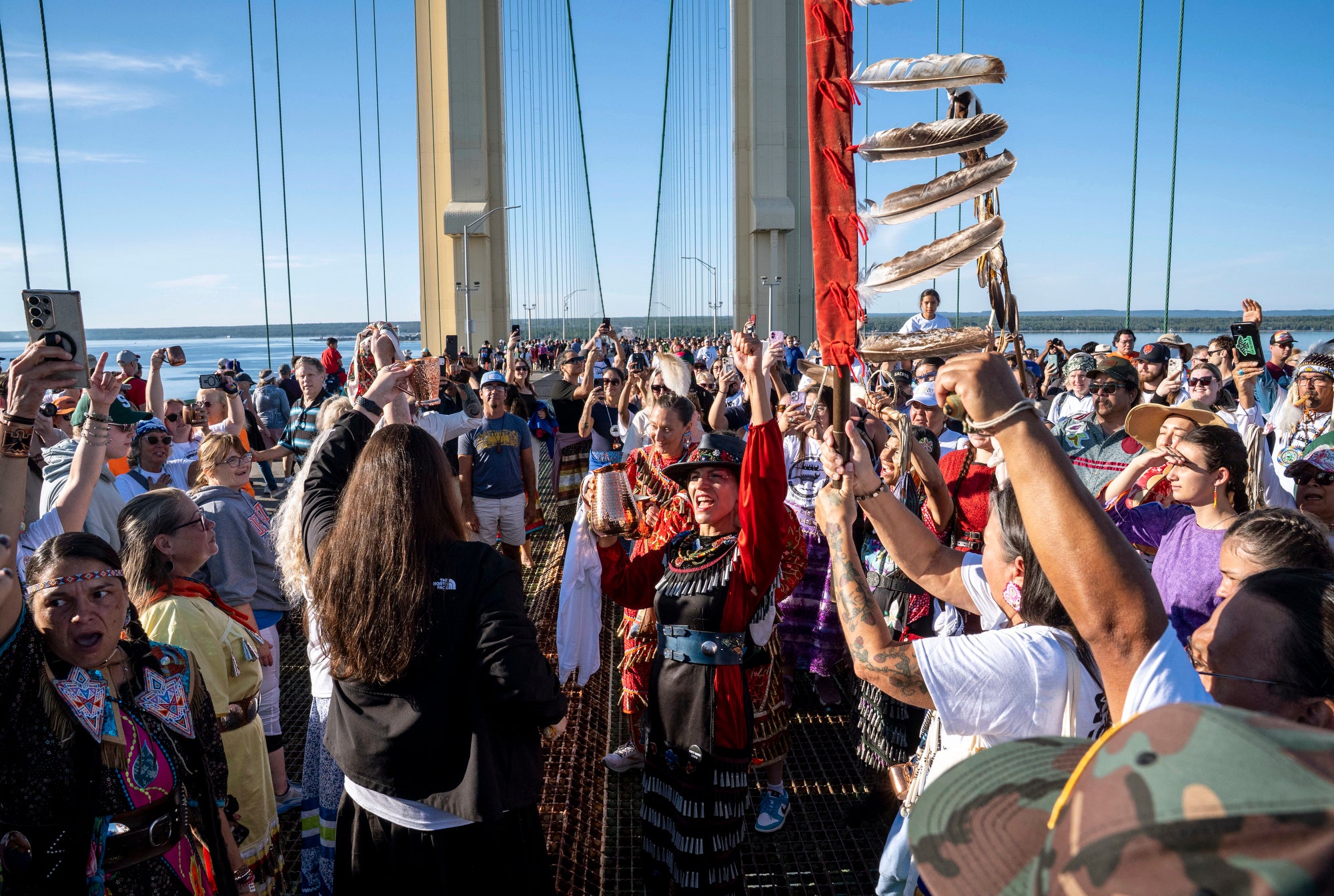
Participants in the Three Fires Confederacy Bridge Walk For Water celebrate on the Mackinac Bridge during their protest against the Line 5 pipeline on Sept. 7, 2026. (Sarah Rice for Earthjustice)
A troubled history of spills
The Line 5 oil and gas pipeline, operated by Calgary-based energy giant Enbridge, should probably have never existed in the first place.
Built in 1953, the 645-mile pipeline transports millions of gallons of hazardous fossil fuels from the upper Midwest to Canada every day. Along the way, it runs directly through the Great Lakes, a treasured ecosystem that provides drinking water for more than 40 million people. The pipeline also intersects treaty-protected areas of Michigan’s Bay Mills Indian Community, an Ojibwe Tribal Nation in the state’s Upper Peninsula, whose members were never consulted during the intensive construction process.
Since it began operating, Line 5 has had more than 30 recorded spills, discharging more than a million gallons of oil into the surrounding environment, and igniting several fires. Its most recent spill in August released 1.3 million gallons of natural gas liquids.
The pipeline is also more than 20 years past its intended lifespan, and it provides minimal benefit to the communities who live alongside it and are forced to carry all the risk. Yet for years, Enbridge has been able to beat back efforts to shut down Line 5, even after one of Enbridge’s other pipelines spilled over 1 million gallons of heavy crude into Michigan’s Kalamazoo River in 2010.
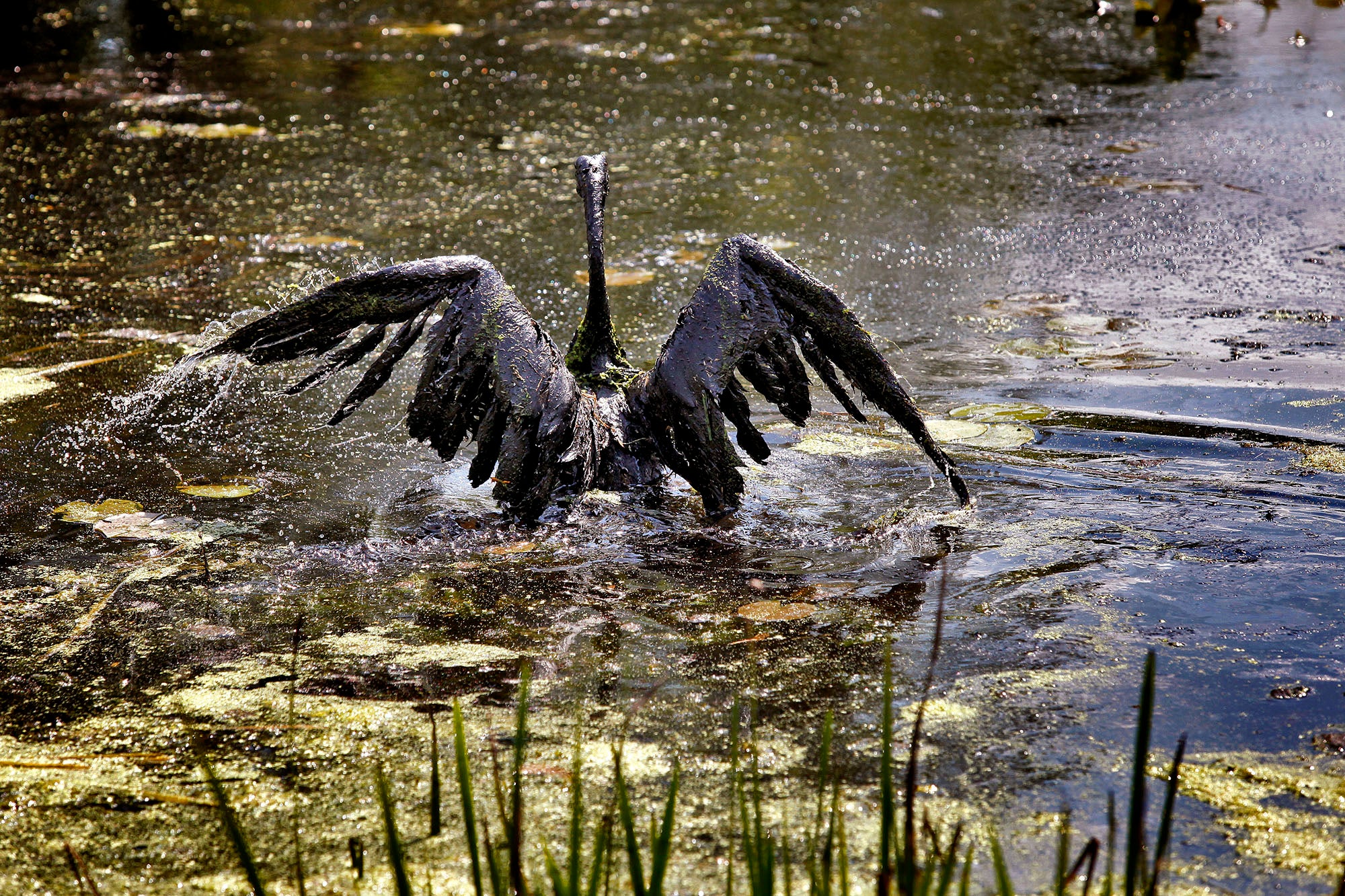
A Canada goose covered in oil from a 2010 Enbridge oil pipeline spill in the Kalamazoo River near Marshall, Michigan. (Jonathon Gruenke / Kalamazoo Gazette via AP)
“When the Kalamazoo spill happened, the Tribes were in really short order able to identify the risks and the harms that Enbridge’s pipelines present to not only our Tribal treaty rights, but also our Indigenous way of life,” says Whitney Gravelle, Bay Mills’ Tribal President. “But there wasn’t really anything that the Tribes could do despite knocking on every state and federal agency door.”
That all changed in 2018 after a 6-ton tugboat struck Line 5 in the Straits of Mackinac, a sensitive ecosystem that connects Lake Michigan and Lake Huron, ripping three gouges into the pipeline.
Rather than remove or repair the damaged section, Enbridge proposed building a huge underground tunnel to house a new section of pipeline. Experts warn that the risky tunnel project creates a potentially explosive situation in an environment marked by weak bedrock, high water pressure, and strong, unpredictable currents.
The tunnel project would also turn the Straits — considered the center of creation by the Ojibwe and other Anishinaabe tribes — into a construction zone for more than six years, threatening permanent destruction. More broadly, building the tunnel means extending the life of Line 5, even as scientists warn we must drastically reduce fossil fuel consumption to avoid further climate crisis.
Despite these concerns, in 2018 then-Michigan Gov. Rick Snyder greenlit the tunnel project on his way out the door. But in doing so, he inadvertently opened another door in the fight to protect the Great Lakes from Line 5.
Taking the fight to court
After Enbridge began advancing the tunnel project idea, Bay Mills reached out to Earthjustice, which had previously represented the Standing Rock Sioux Tribe in the Dakota Access Pipeline (DAPL) fight. Since DAPL, Earthjustice has launched a tribal partnerships team, as well as a Midwest office that takes on region-specific threats like Line 5.
In early 2020 Earthjustice began working on the case, with Bay Mills as one of its tribal clients. A massive project such as the Line 5 tunnel requires approval under multiple federal and state environmental laws. Earthjustice started by challenging Enbridge’s tunnel permits in front of two state regulatory agencies.
“Our job is to put forth a strong and reasoned case, and that’s what we’ve tried to do at every turn with Line 5,” says Earthjustice attorney Adam Ratchenski, who attended law school in Minnesota and so was all too familiar with Enbridge, which caused the largest inland oil spill in U.S. history in Minnesota three decades earlier. “We knew that these projects were risky, and so we wanted to stop Enbridge’s tunnel dead in its tracks.”
At the same time, Bay Mills began educating decisionmakers and the public about Line 5 and the threat it poses to the Tribes’ cultural and economic interests, including the right to hunt and fish in the area.
“This area is not only the spiritual epicenter of Anishinaabe people like Bay Mills,” says Gravelle. “It’s also a place where Tribal Nations have treaty-reserved rights and a sovereign responsibility to protect the Great Lakes. Those rights cannot be ignored.”
Earthjustice’s lawsuits against the state of Michigan finally gave Bay Mills and the other represented Tribes the opportunity to appear before regulators. Yet the Tribes’ voices were still largely disregarded after the Michigan Public Service Commission decided it wouldn’t consider the tunnel project’s broader impacts, including its prolonged existence by building the tunnel and the potential for additional oil spills in Tribal areas.
“The commission pretty much told the Tribe at the outset of this case, ‘The thing you care about most, the reason you brought this case to oppose this project, we’re not going to hear any evidence on that,’” says Ratchenski. “They tied our hands from the very beginning.”
In February 2025, an appeals court upheld the commission’s decision, siding with Enbridge and the commission. Earthjustice had only one option left: bring its case before the state’s highest court.
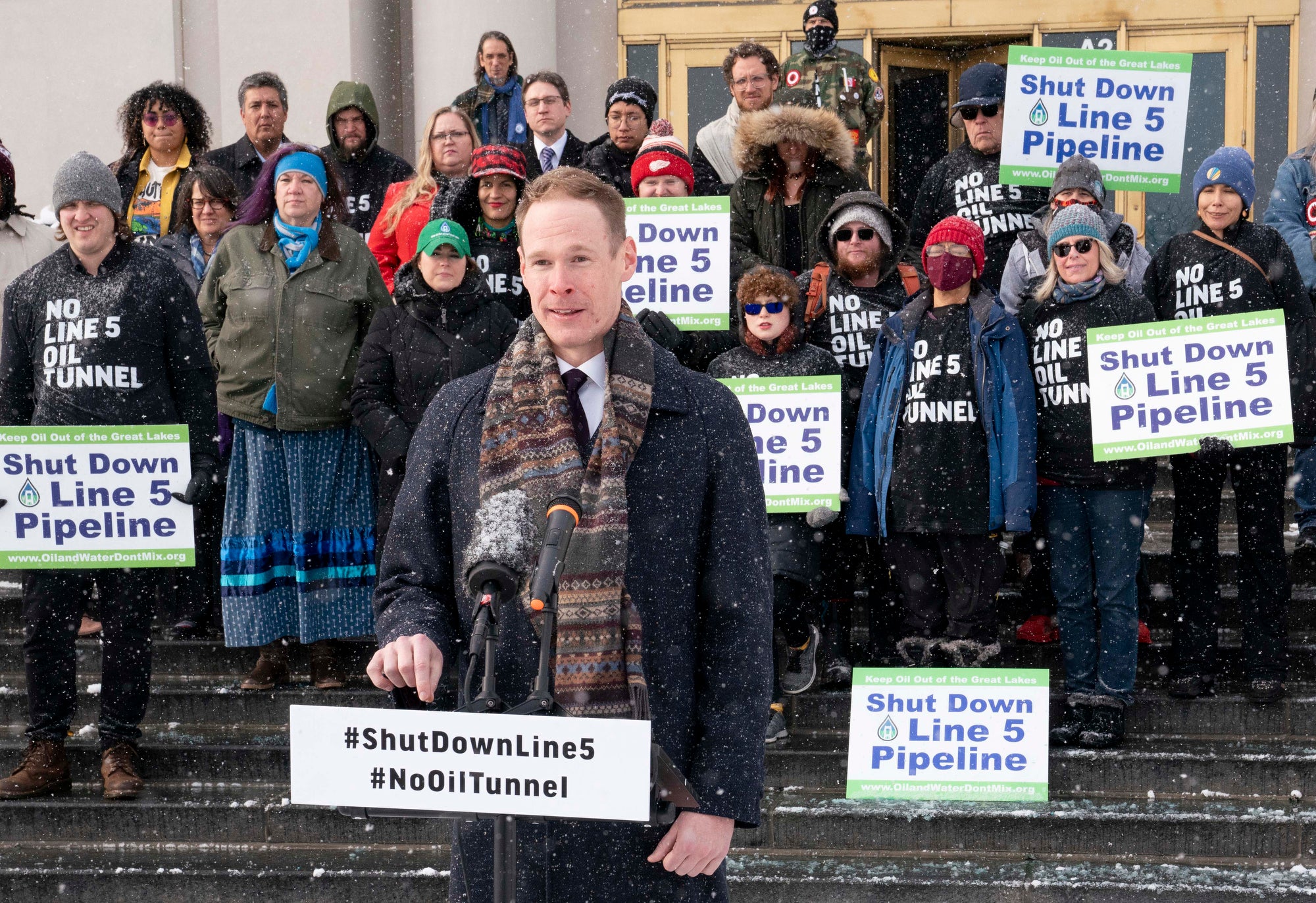
Earthjustice attorney Adam Ratchenski speaks during a press conference after a Line 5 hearing at the Michigan Court of Appeals in Lansing, Michigan, in 2025. (Sarah Rice for Earthjustice)
Upset but undeterred
Michigan’s Supreme Court accepts only a fraction of the more than 2,000 cases it’s asked to hear each year. In September 2025, Earthjustice got notice that its case would be one of them.
“We had been arguing the same issue for what felt like forever, and no one was giving us the time of day,” says Ratchenski. When the Supreme Court took up Earthjustice’s case, he says, “It felt like a momentum shift. We felt that we were right all along, but now we had hope that we might get traction.”
At the crux of Earthjustice’s appeal was the Michigan Environmental Protection Act (MEPA), a landmark law passed in 1970 that established the right of any Michigander to defend their environment from harm. The law says that the responsibility for determining whether harm has occurred or is likely to occur lies with the courts, not just the public agencies. The latter are often made up of political appointees who lack the expertise and impartiality to make fair and reasoned decisions.
“MEPA was passed with the recognition that agencies are often too close to industry,” says Ratchenski. “These close ties have created opportunities for a lot of mischief, which is why it’s critical to keep the courts as a backstop.”
On the day of the oral argument, Ratchenski carried a set of stones handed to him by Gravelle. She told him that the stones, which came from the shores of the Great Lakes, would give him strength and guidance.
“To have that connection to place, when you’re in some courthouse in Lansing, Michigan, far away from the Straits or the Great Lakes,” says Ratchenski. “It was an honor to carry that forward on behalf of Bay Mills.”
On July 31, 2026, Michigan’s Supreme Court sided with the tribes, determining that state regulators must start restart the permitting process. This time, regulators must properly review the potential harmful impacts of Line 5 and the tunnel project, as well as consider alternative options, including one that does not involve transporting fossil fuels across the Straits at all. Earthjustice’s win also prompted current Michigan Gov. Gretchen Whitmer to withdraw her previous support for the project and order additional review.
“To see a whole team of Earthjustice attorneys pull wisdom from various cases across the country and to tailor those cases’ strengths and weaknesses to this case has been a wonderful joy to see,” says Gravelle. “I can finally see a path forward where we can have a future without Line 5.”
Part of that future includes taking steps to make the Tribe more climate resilient while maintaining its sovereignty. Recently, the Tribe helped its members reduce their reliance on fossil fuels by installing energy-efficient heat pumps and solar panels in homes and tribal buildings. Bay Mills is also building a $17 million solar farm on its reservation.
“Imagine if the state of Michigan had been proactive about the Line 5 problem,” says Gravelle, stressing that officials should have spent this time working to reduce fossil fuel use, rather than pushing outdated, dangerous energy projects.
“It just feels like a lost opportunity,” she adds. “But now we can fight our way to a different reality.”
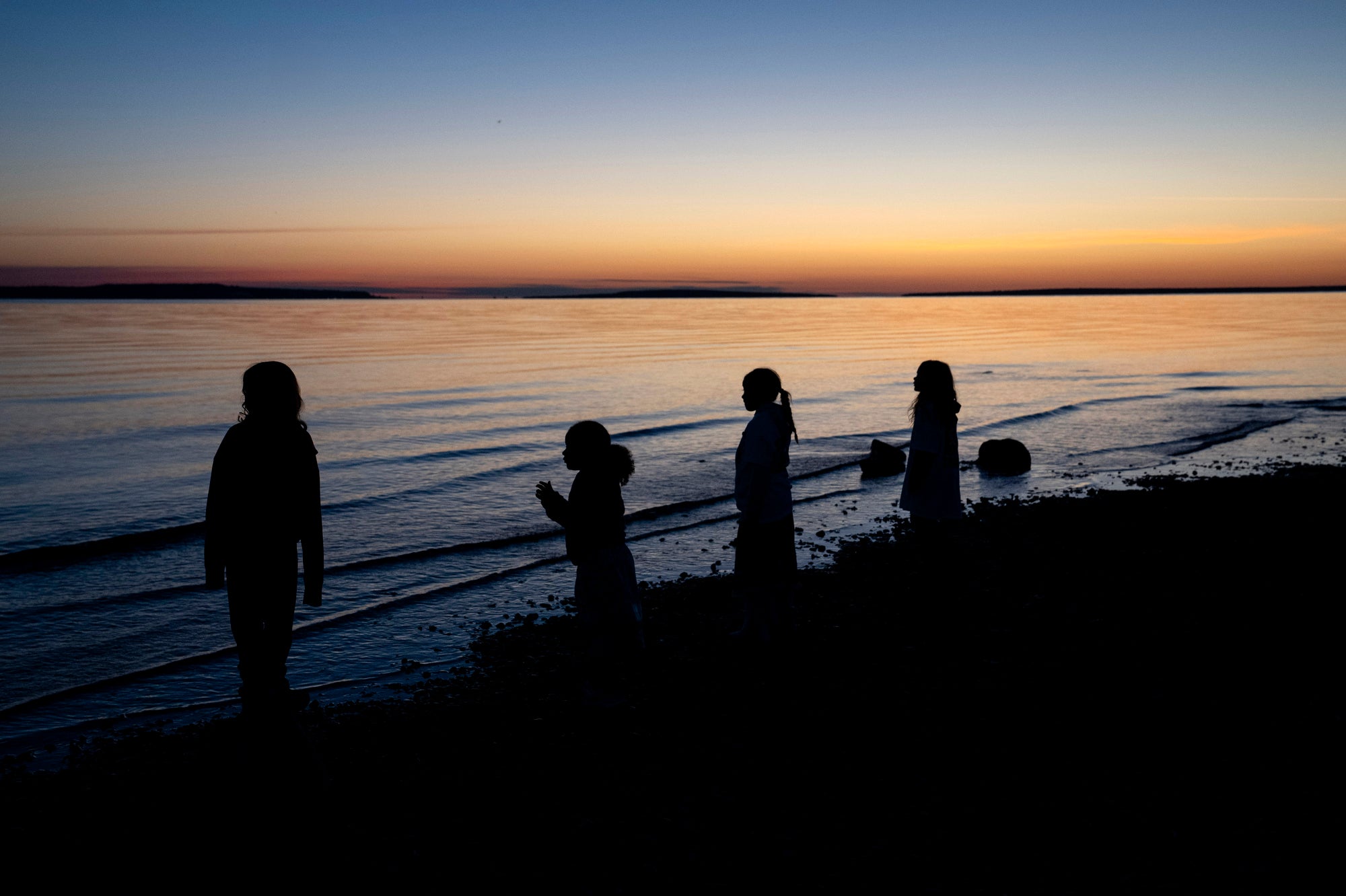
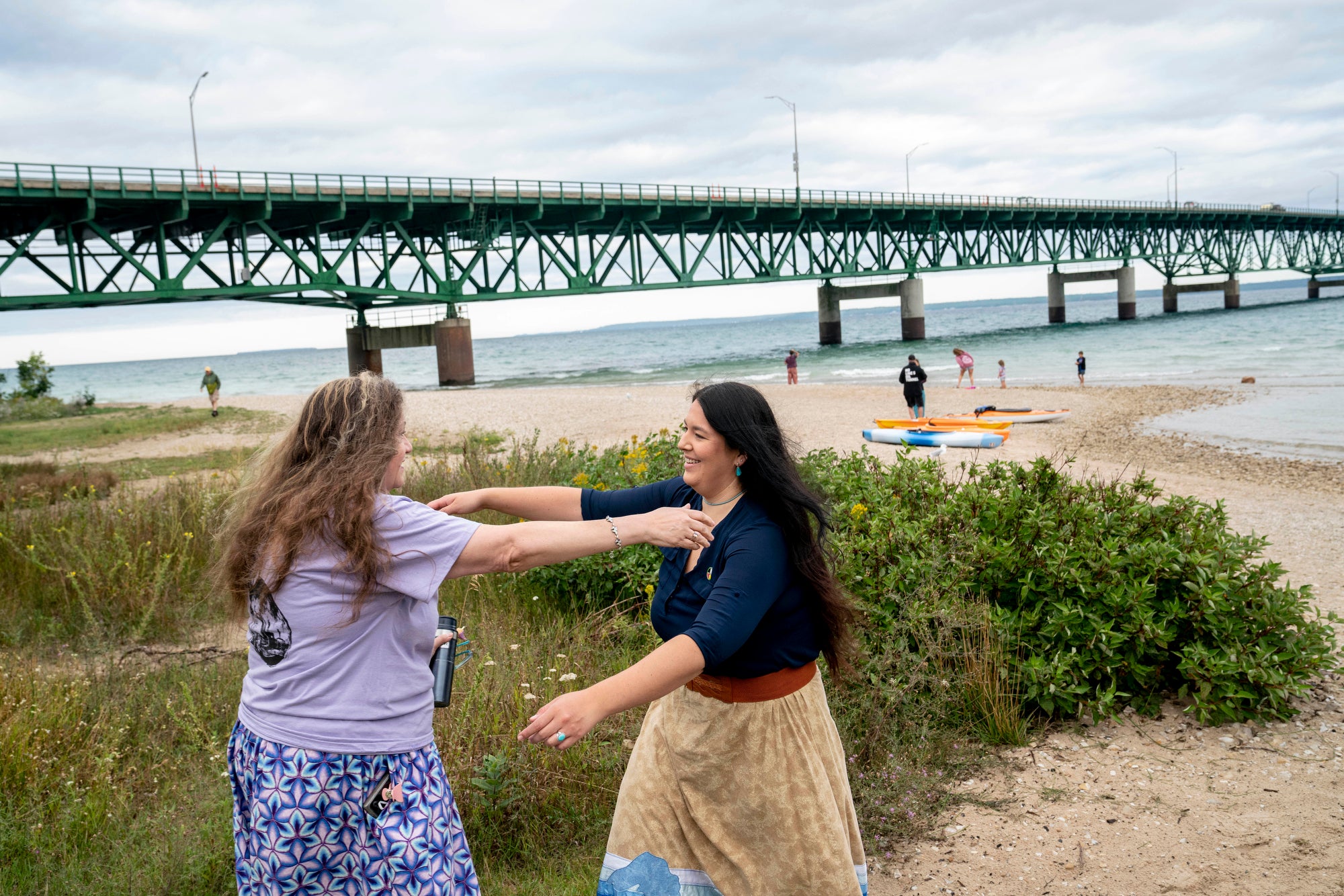
Children stand at the Straits of Mackinac in Mackinaw City, Michigan before the start of the Three Fires Confederacy Bridge Walk For Water. (Sarah Rice for Earthjustice)
We fight to ensure our tribal and Indigenous clients’ natural and cultural resources are protected for future generations.