How Gulf of Mexico Residents Are Pushing Back on the Oil and Gas Industry
Locals aren’t letting dirty industry expand in the Gulf without a fight.
Oil and gas companies are targeting the Gulf of Mexico to build a new generation of polluting infrastructure and carbon emissions. If successful, these facilities would lock us into decades of fossil fuels.
Though the consequences of a fossil fuel buildout in the Gulf will be global, the people fighting against it are mostly local residents. These communities will face the harshest impacts from sea level rise, intensified hurricanes, toxic pollution, and oil spills.
These new oil and gas projects are layering a new injustice on top of an old one. Many Black communities that are situated near industrial sites in the Gulf are descended from formerly enslaved people who planted roots in the area after emancipation. Additionally, early redlining practices by the federal government and co-signed by the banking industry restricted Black and Brown homeownership to undesirable areas zoned for industrial use.
But locals aren’t letting dirty industry expand in the Gulf without a fight. Communities and grassroots organizations are opposing fossil fuel projects that threaten their health and livelihood – and Earthjustice is fighting alongside them. We’re in court challenging multiple oil and gas projects to protect Gulf communities; and to deepen our commitment in the region, we recently opened a new office in Houston, Texas.
Read on to learn about two Gulf residents who are working to wrest the region’s future from the oil and gas industry, and the role Earthjustice plays in supporting Gulf communities in this battle.
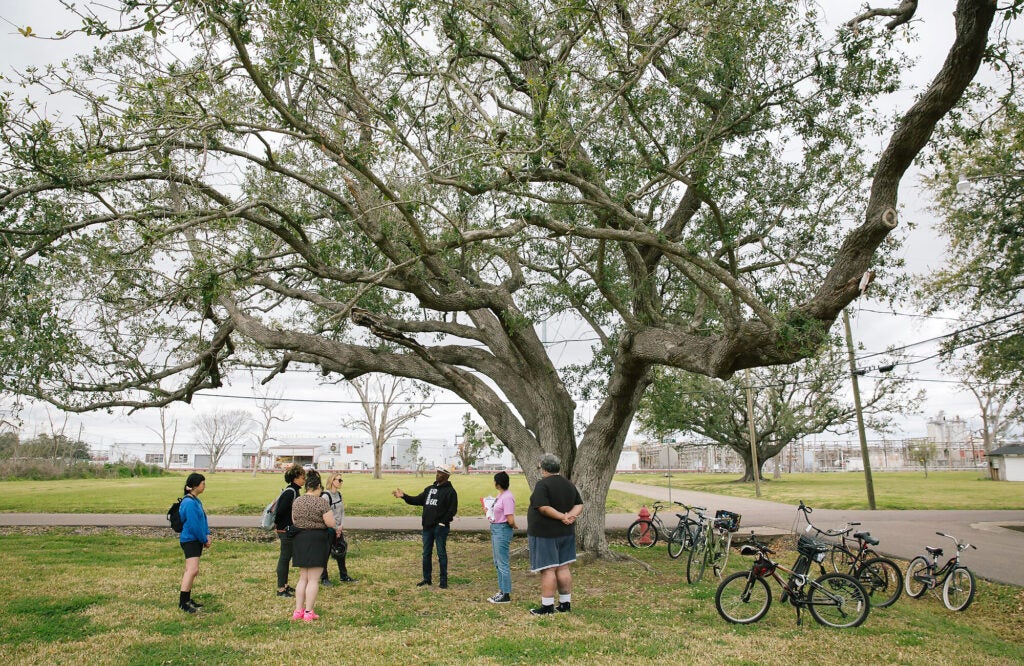
Pastor Harry Joseph, center, discusses the impact of the adjacent Shell chemical facility on the historically Black neighborhood of Norco, Louisiana, during the Louisiana Bucket Brigade’s “Down by the River Bike Ride” led by Sheila Tahir in March 2022. (Brad Zweerink / Earthjustice)
The Educator
When Sheila Tahir guides bike tours along River Road in St. Charles Parish, Louisiana, she says riders often comment on how peaceful the area is — and how dystopian.
“They are struck by how surreal the landscape is, beautiful cypress swamps bisected by pipelines transporting hazardous chemicals, leaking into bayous where ibis and bald eagles roost and alligators swim. Aging, rusted towers that spew poisonous smoke and emit toxic flares, the bursting flames a gigantic torch able to be seen from miles away,” she wrote in an email.
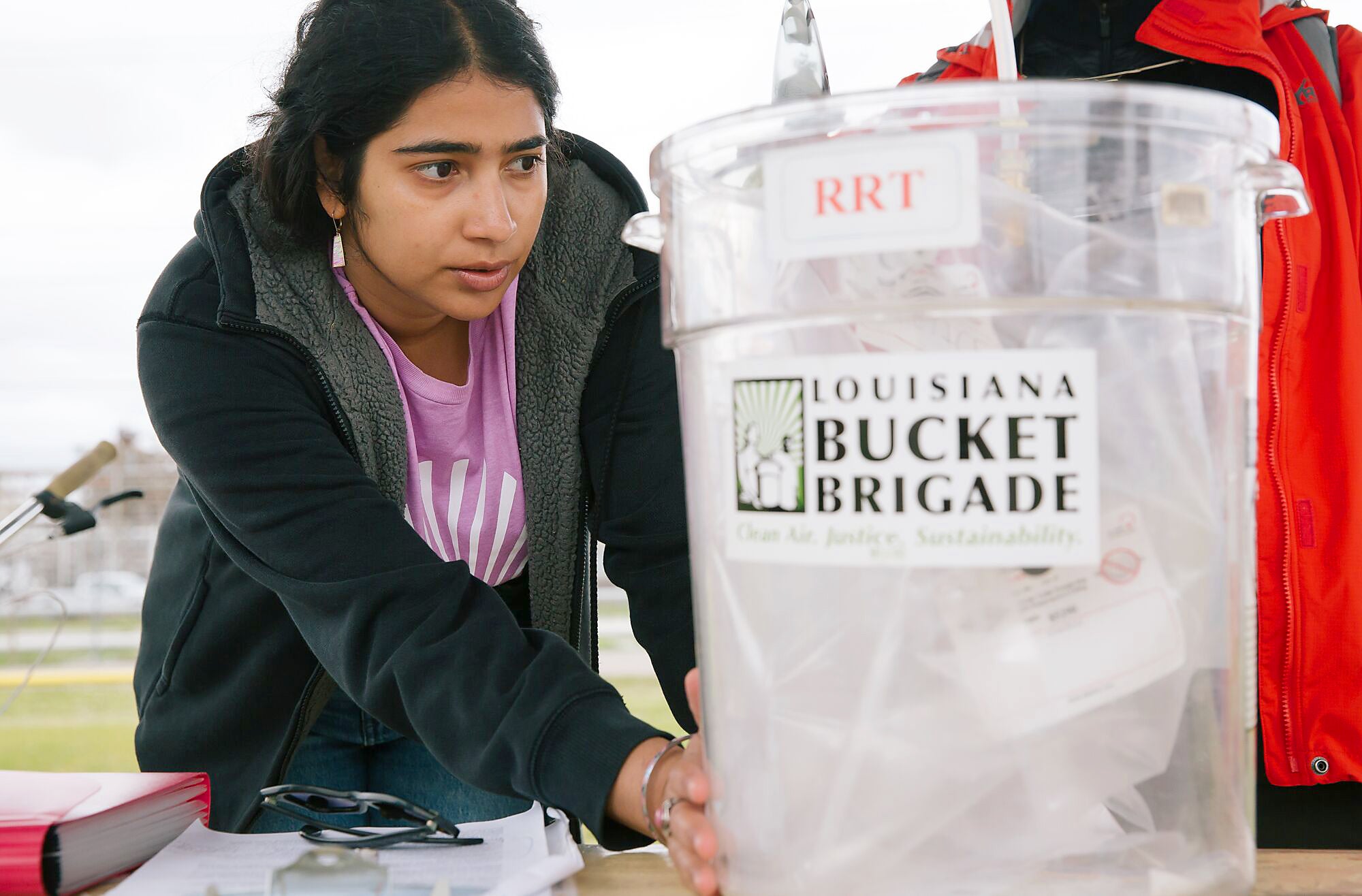
Tahir runs the Down By the River tour as part of her work with the grassroots environmental group Louisiana Bucket Brigade. The ride brings participants face to face with the realities of living in the shadows of refineries and chemical plants. It also offers an often- untaught education about the rich traditions within these historically Black communities and their legacies of fierce community advocacy and resistance, often led by Black women.
Many of the neighborhoods in this area were established by formerly enslaved people. One hundred years after the Reconstruction Era of the mid-1800s, the chemical and fossil fuel industries began insidiously creeping into neighborhoods and building their facilities on the sites of old plantations, lands already contaminated by generations of deep injustice.
Since 2000, Louisiana Bucket Brigade has been partnering with communities to help residents amplify their voices and challenge the relentless expansion of the petrochemical industry. Neighborhoods along the Mississippi River between New Orleans and Baton Rouge, sometimes referred to as Cancer Alley, are some of the most polluted areas in the country due to the high number of oil refineries, chemical plants, and petrochemical infrastructure.
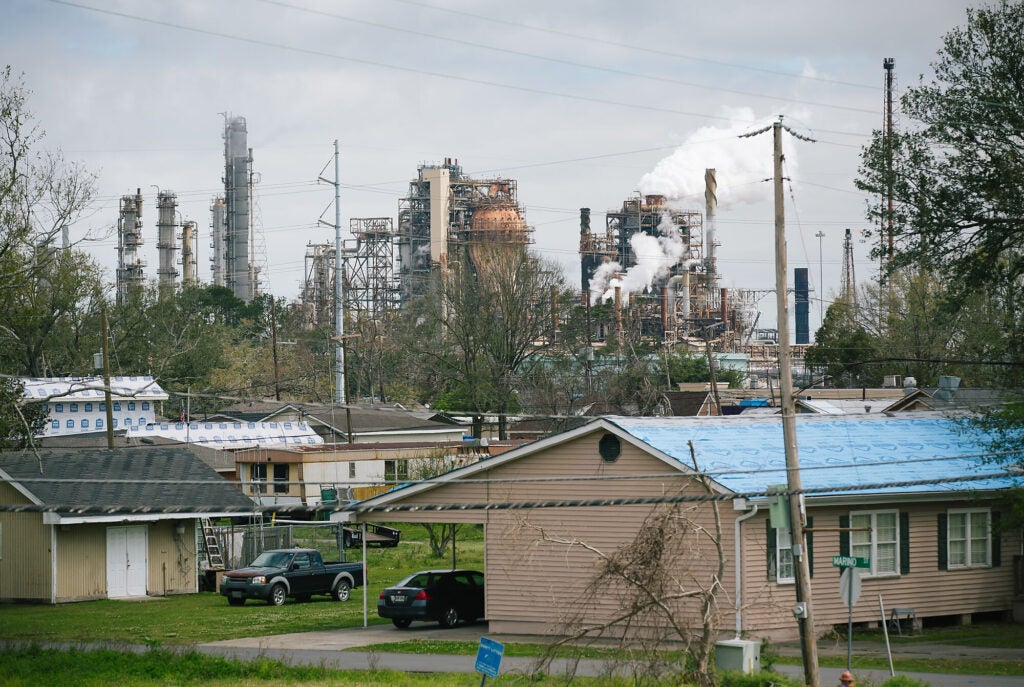
Homes adjacent to the Shell refinery in Norco, Louisiana. (Brad Zweerink / Earthjustice)
And pollution isn’t the only threat to the survival of these communities. They are also forced to contend with increasingly extreme weather, flooding, and natural disasters caused by the climate crisis.
“A slow violence is being committed against them,” Tahir writes, “which is doubly egregious since their ancestors were stolen from their homes and now they are being asked to choose between their homes or their health.”
In the face of this oppression, Tahir says the fierce resistance she sees among community members gives her hope.
“Residents in the river parishes are at the forefront of a powerful movement for climate and racial justice,” she writes. “They may bear a disproportionate burden of pollution due to racial inequities and segregation, but they are not victims. They are leaders, and if you come on the Down by the River tour, you will meet some of these brave and inspiring activists firsthand.”
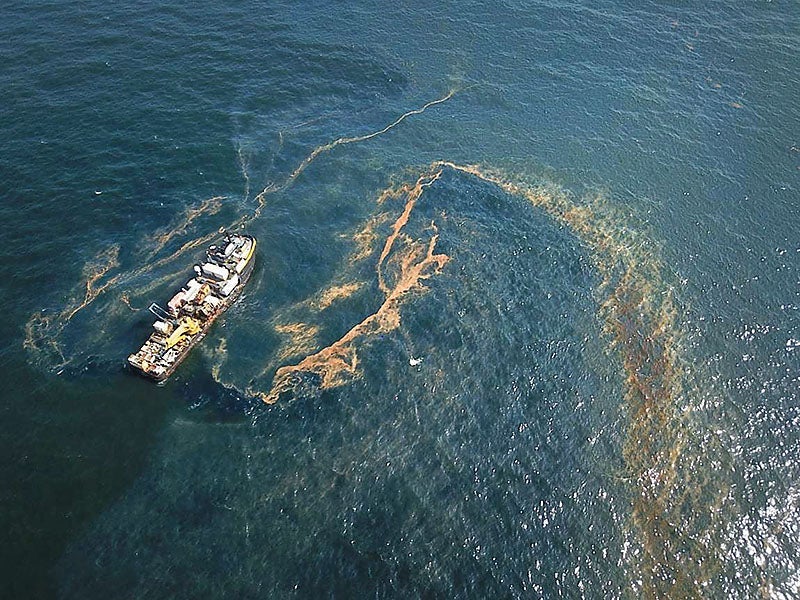
Oil on the surface of the Gulf of Mexico, before an underwater containment system was put in place at the site of the Taylor Energy spill in 2019. (Couvillion Group)
The Advocate
It’s hard to believe an oil spill could last for 18 years without much fanfare.
Yet a sunken oil rig owned by Taylor Energy, off the coast of Louisiana, has been spewing oil into the Gulf of Mexico since 2004. Hurricane Ivan slammed into the Gulf Coast that year, causing a landslide that toppled and sank Taylor’s drilling platform. The impact opened a crater in the sea floor the size of a basketball court, where Taylor’s sunken wells have leaked oil into the Gulf ever since.
In 2022, there was finally good news: After trying various scorched-earth tactics to avoid accountability, Taylor liquidated to pay over $400 million in cleanup costs. Earthjustice and Gulf-based environmental group Healthy Gulf achieved this victory after years of legal tactics by Taylor to stall the cleanup indefinitely.
At the time of the spill, Taylor downplayed the extent of the leak, claiming it was less than 3 gallons of oil per day. The government took Taylor at its word and did nothing for years.
The truth was much worse: according to a federal expert, as much as 29,274 gallons per day flowed from the leak.
“Taylor was an eye-opening experience for us,” says Cynthia Sarthou, who lives in Louisiana and was the executive director of Healthy Gulf until 2022. Sarthou was an attorney in Seattle in the late ‘90s when she saw an ad for a nascent environmental watchdog group that vowed to investigate environmental injustices in the Gulf, her home region.
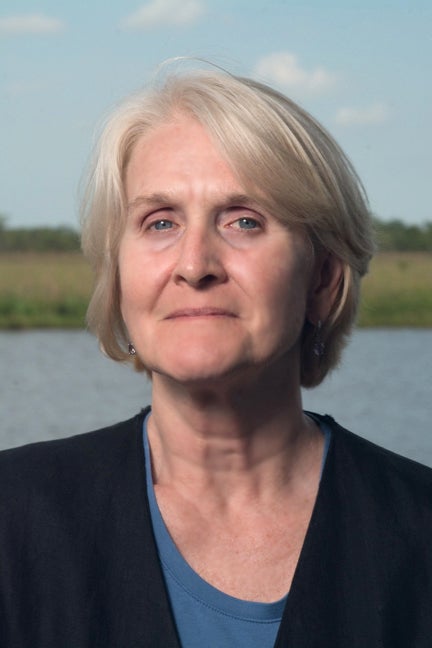
Cynthia Sarthou, the executive director of Healthy Gulf. (Healthy Gulf)
In 2010, Healthy Gulf discovered Taylor’s oil spill by chance while on a survey mission for the BP Deepwater Horizon spill.
Sarthou recalls, “My staff who were flying out there said, ‘There are miles of raw slick, but it’s not in the area of the BP disaster. What the hell is this?’ So, we started investigating.”
Healthy Gulf pressed the government for years to make Taylor contain the oil, which at times stretched 21 miles on the water’s surface. There were various half-hearted efforts to plug the sunken wells, but the oil continued flowing into the Gulf.
Fossil fuel catastrophes in the Gulf have become all too common as the oil and gas industry seeks to expand its footprint there, building new polluting infrastructure that will keep the country locked into fossil fuels for decades to come. Companies self-report thousands of oil spills to NOAA every year; many others go unreported. They are caused by tanker fires, malfunctioning equipment, sinking ships, or hurricanes.
Oil spills brutalize marine wildlife, inflicting poisoning, heart damage, enlarged livers, immune dysfunction, and a generally painful death. There is no safe level of oil in the Gulf: any amount can cause major environmental harm, and leaks are difficult to ever fully contain. The best way to protect the Gulf is to remove the risk of oil catastrophes completely, which is one reason why Earthjustice is fighting oil and gas development in the Gulf at every stage of the process. In 2022, we opened a new office in Houston, Texas, to bring the fight to the oil industry’s doorstep.
In 2018, Earthjustice began investigating the leak in partnership with Healthy Gulf. After a front-page story on the Taylor spill ran in The Washington Post, creating national media attention on the oil spill, the U.S. Coast Guard scrambled to hire a remediation company to cap and remove the oil.
Taylor employed numerous slimy tactics to block work on the oil spill or avoid paying for its cleanup. The company sued the government and the remediation contractor to stop the containment effort. Earthjustice intervened to defend the Coast Guard’s actions on behalf of Healthy Gulf — so Taylor sought court permission to pry into Healthy Gulf’s advocacy efforts, which the court denied. Meanwhile, the former owner of Taylor Energy, wealthy Louisiana billionaire Phyllis Taylor, reaped millions in tax deductions tied to the cleanup cost, making it profitable for her to drag out the cleanup. As the cases played out, remediation on the spill continued, collecting the oil even as the wells continued to erupt.
Victory came in December 2021, when Taylor settled with the government and agreed to pay more than $400 million towards the cleanup effort. The following June, the government ordered the company to liquidate.
“This means the Department of the Interior will now be able to move forward with finally plugging this long-running oil spill,” says Chris Eaton, senior attorney at Earthjustice. “The Taylor spill is another example of the disastrous impact of offshore drilling on the Gulf’s ecosystem, wildlife, and communities.”
It all comes down to stopping the industry’s lifelines — petrochemicals, oil exports — from taking root again in the Gulf, says Sarthou of Healthy Gulf. “Industry just comes back and entrenches in the Gulf. You can beat it back from the Atlantic, from Alaska, but it always comes back here. It sees the Gulf as its safe home base. They’re going to continue, unless we stop them here.”
How Earthjustice Shows Up
“People forget that the Gulf is the third coast of the U.S.,” says Jen Powis, managing attorney for the Houston office. “To transition to a clean energy economy, we have to stop the fossil fuel expansion here.”
Earthjustice attorneys are fighting new oil and gas proposals in the Gulf by going for the root: the permits for key projects that can cause other, similar projects to be delayed or stopped.
Challenging permits also strikes at the industry’s wallet. “A project without permits is bad for investors,” says Adrienne Bloch, managing attorney of Earthjustice’s fossil fuels program.
In addition to providing legal representation, Earthjustice aids Gulf communities on the ground by doing deep research — which can be difficult for local advocates who are juggling grassroots activism while living under the cascading effects of industrial pollution themselves.
“Ultimately, we’re creating space for communities to build power,” says Bloch. “While we’re drafting a 100-page comment letter with expert reports, community members start to build capacity and deepen their organizing strategy.”
A version of this story was originally published in the summer 2022 issue of Earthjustice Quarterly Magazine.
Alison Cagle is a writer at Earthjustice. She is based in San Francisco. Alison tells the stories of the earth: the systems that govern it, the ripple effects of those systems, and the people who are fighting to change them — to protect our planet and all its inhabitants.
Based in Philadelphia, Erin is the Healthy Communities senior media relations specialist.
The Gulf Regional Office works with communities and other partners fighting for a healthy and just future in the Gulf. We work to cut pollution, end fossil fuel expansion, protect our region’s precious places and wildlife, transition to clean energy, and drive climate solutions that work for everyone.